
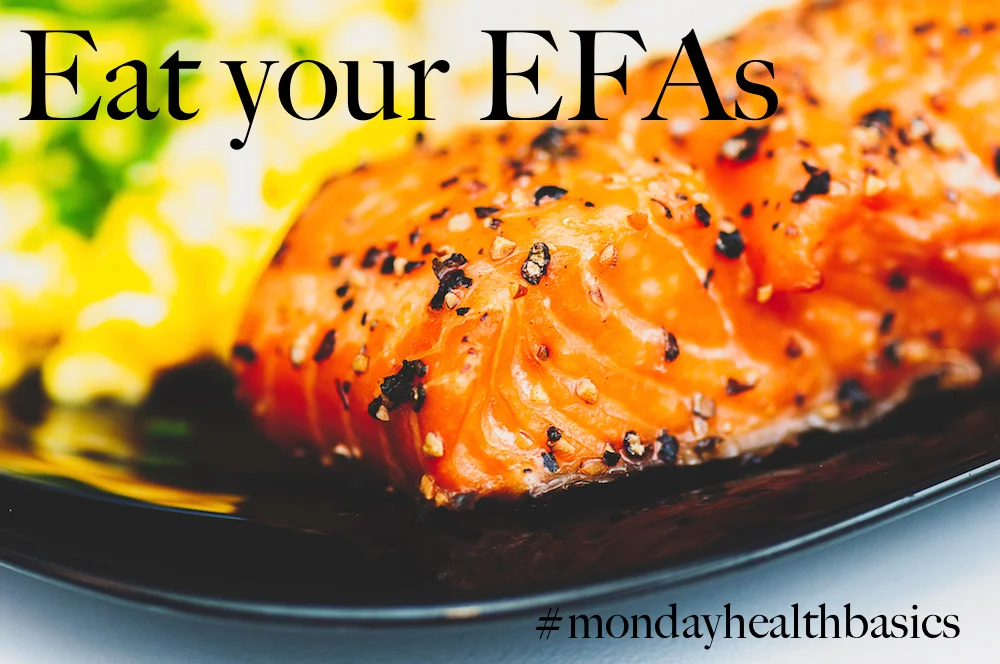
THURSDAY BASICS: Eat your EFAs
This week's Thursday Health Basics topic is one that I think about every live long day, and it involves choosing foods that will support just about everything going on in your body. Let's talk ESSENTIAL FATTY ACIDS.
As we’ve been zeroing in on those good practices to help reduce inflammation all month of May, I wanted to take this talk of EATING THE GOOD FATS one step further.
See, we’ve talked butter. We’ve explored what is a good fat. We’ve also talked about the benefits of reaching for pastured sources when it comes to animal fats. Let’s zero in on another fat category, yes?
EAT YOUR OMEGA 3s. (aka ESSENTIAL FATTY ACIDS)
COLES’ NOTES:
1. These fats are ESSENTIAL. Means we need to get them from our diet. Careful how you source your foods - choose wild + pastured when it comes to animal sources!
2. Work on balancing those Omega 3s with Omega 6s by boosting your intake of Omega 3s. (6s are everywhere…)
3. This is a key nutrient you want in your diet on the daily if you want to reduce inflammation.
Is it any wonder it’s my favourite macronutrient? Read on for some great tips and ideas on how to incorporate these fats in to your every day and why you might just want to.
This Monday Health Basics topic is one that I think about every live long day, and it involves choosing foods that will support just about everything going on in your body. Let's talk ESSENTIAL FATTY ACIDS.
I will work on keeping this one shorter and sweeter, dear reader. Talking FATS is a big ole conversation I have on a regular basis, and one that is tough to navigate. Today though, I just want to tackle ONE GOOD THING YOU CAN DO TODAY.
And that thing, starting this week, is adding some essential fatty acids in the form of Omega 3s to your daily regime! (Skip to the image of the sweet cows if you just want to get WHAT foods you should reach for.)
Now, let's make one thing clear: when we talk EFAs, I mean omega 3s (essential fatty acids). They’re essential because we can’t make them; it is therefore essential we get them from our diet. They are also needed for our bodies to do their thing. And many things, at that. Chief among them, we need omega 3s to reduce inflammation. (My favourite topic. Aside from talking the PHAT FATS.)
There are a few different kinds of Omega 3 fatty acids, and in the interest of keeping it brief, I will say the main ones are ALA (alpha-linolenic acid), DHA (docosahexaenoic acid) and EPA (eicosapentaenoic acid).
ALA is the one that we cannot make, we need to get it from our diets. The other two, if our bodies are in good working order, we are able to manufacture them out of ALA. But in this day and age, it's tough to do that conversion work because of toxins in our environment, decreased digestion, chronic conditions or chronic inflammatory statuses.
How do I know if I’m getting enough?
There is so much to take into consideration here, and it will depend on the individual. This means the answer can vary from person to person, depending on how well you’re digesting, how assimilation is working, how well you’re able to make the conversions needed, whether you have the cofactors needed for these conversions (assuming they’re not ‘bound’ by your gut flora) and whether or not you’re getting enough via diet in the first place.
Things to think about: exposure to toxic chemicals, if you smoke or are surrounded by second hand smoke; someone who is battling a health condition that is utilizing the precious Omega 3s.
If someone's digestion is compromised, they may not be able to get the nutrients they need in order to get the Omega 3s where they need them to be and for the chemical reactions to take place in order to get them working in the body.
This compromised digestion may also play a role in preventing a person from getting the micronutrients needed for those chemical reactions to take place, things like magnesium, zinc, vitamins E, C and B6.
There are studies out there that point to a correlation between a deficiency in EFAs with a diet where there was an abundance of foods containing trans-fatty acids. (Say no to soybean oil! ALWAYS! Ditch the canola, and cook with saturated fats!)
Of course, seeing as it is an essential that needs to be there in the diet, it goes without saying that a deficiency can also be as a result that the person in question just isn't consuming enough.
It's About Balance
One of the things you need to know here is how the Omega 3s play with other fats, or rather, how other fats play with Omega 3s. There are other EFAs out there, Omega 6s being one of them. Omega 6s and Omega 3s work in tandem in our body to do lots of things, but especially working at keeping our overall inflammation in check.
In order for this process to work properly, we need a ratio of 2:1 of Omega 6: Omega 3s. This means that for every 2 Omega 6 molecules, our body needs 1 Omega 3 molecule. The problem here is that with the way we eat in North America, our diet tips us more in the direction of 20:1 to 30:1 for Omega 6: Omega 3.
With this big of an imbalance, the anti-inflammatory work just can't happen. Not only that, but an over-abundance of Omega 6 fats can contribute to an increase in inflammation, kind of like adding insult to injury there. So yes, I will talk food sources for the Omega 3s, but know that by reaching for real food and reducing the processed foods, you will be working already on improving the ratio.
Know this as well: our ability to convert from a plant source to an animal source takes a lot of work. Sourcing animal versions of these omega 3s can be one of those ways you take one step off of your body’s to-do list, and increase how much you can assimilate from the foods you eat. (Better bioavailability from animal versions - this means you can get more of it in to your body if it’s from an animal than relying on plant sources solely.)
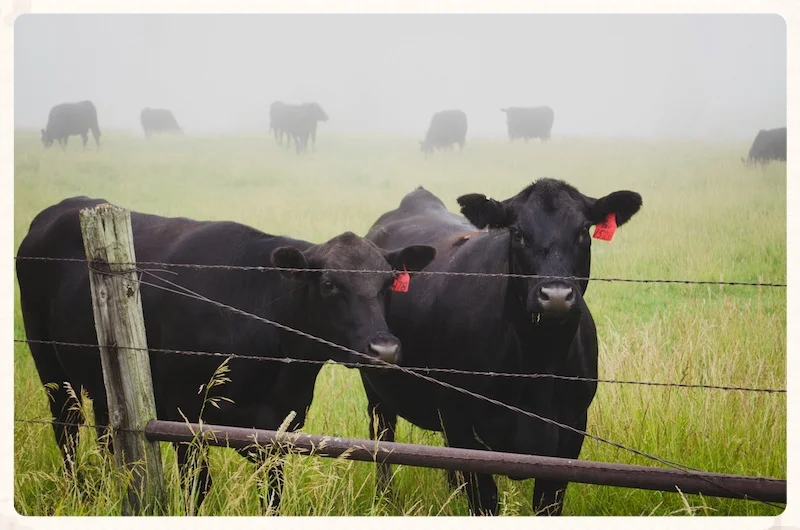
The foods that best serve as excellent sources of these essential Omega 3s:
caviar
sardines (only wild caught!)
salmon and other cold water fish like anchovies, mackerel, herring (buy only wild fish, as farmed fish will not contain any Omega 3s!)
pastured or grass-fed beef (not conventionally raised beef)
pastured or grass-fed bison (not conventionally raised bison)
wild game (deer, moose, venison)
shrimp
fish broth (homemade from scratch!)
walnuts
pumpkin seeds
chia seeds
avocado
olives and olive oil
flax seeds and flax seed oil (be sure to keep it in the fridge, and buy in small quantities; if it smells or tastes rancid, toss it)
Brussels sprouts
cauliflower
broccoli
sea plants and seaweeds like Irish moss, spirulina, chlorella
eggs (only from pastured sources)
any dairy products produced from cattle fed on grass (butter, ghee, cheese)

It's as easy as adding walnuts and cheese
If your body is compromised in any way, or if digestion isn't your strong suit, you may be having a hard time converting that plant form of Omega 3 fats to an animal form. (You are an animal. You aren't a plant.) In the case of someone like this, I would recommend reaching for the animal versions of Omega 3 fatty acids, in order to give your body that which it cannot make, taking some of the pressure off.
Taking a fish oil supplement may be of benefit to you. Why not make it do double duty, and pick up some cod liver oil instead? This contains those important EPA and DHA forms of the omega 3s we need, but it also contains other beneficial fat-soluble vitamins like one of my all-time favourites Vitamin A (retinol), necessary for all skin including mucosal linings like your intestinal lining; it's also a good source of Vitamin D, needed for strong bones, robust immunity, hormone manufacturing, mood balancing, thyroid work, and the list goes on.
The Why
Last, but certainly not least, I wanted to let you know that you need to reach for these foods every day, indeed ensure they're at the table for every meal.
Here is why:
these EFAs are critical components in our immune system function
they lower the risk of heart attack, stroke and hardening of the arteries
they are essential to skin and are of benefit to people with psoriasis, eczema, acne and other skin eruptions
they are critical for someone who is suffering from arthritis
necessary to cushion joints and ligaments
important to lubricate the colon and improve our ability to move the poop on down the chute
they reduce blood cholesterol
they help to prevent cancer
they are necessary to brain and heart function
Omega 3s are an essential nutrient for your eyeballs
they're needed for your thyroid + adrenals
you need them for strong bones
mood regulation
they reduce your risk of death in just about everything under the sun. Including effects from the sun.
they help reduce the risk of dementia and Alzheimers'
most important: THEY ARE NECESSARY TO PROTECT YOUR EVER LOVIN BODY FROM INFLAMMATION.
Eat them, dear friend, consume them. Make them a part of every meal.
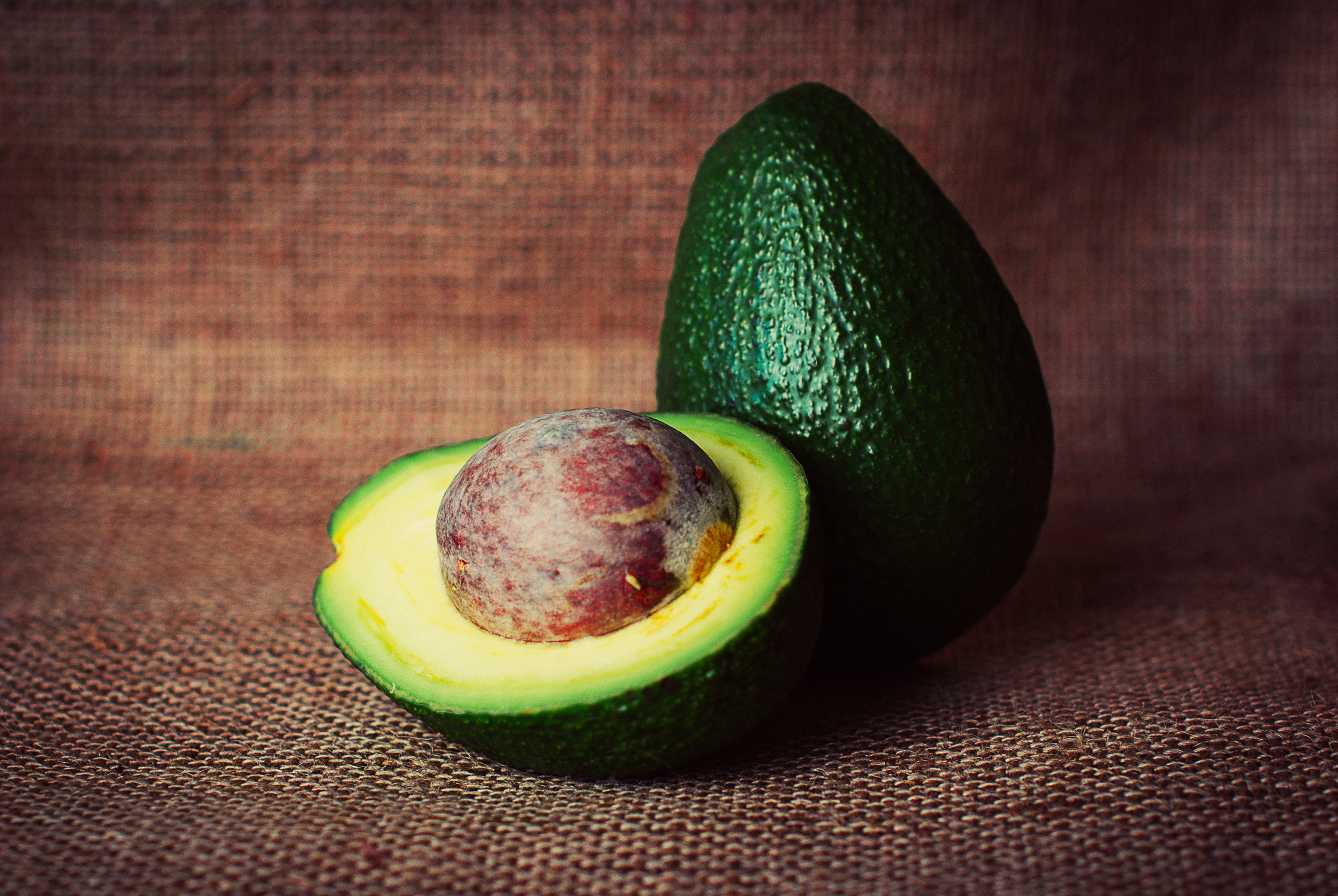
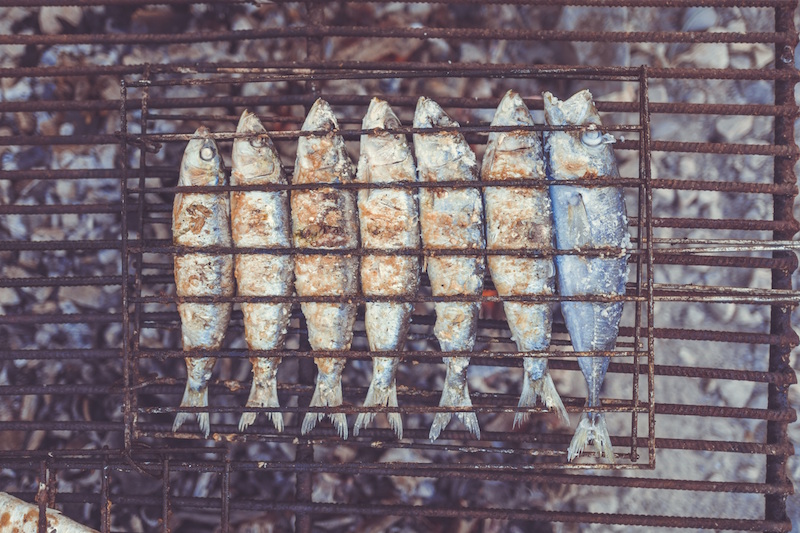
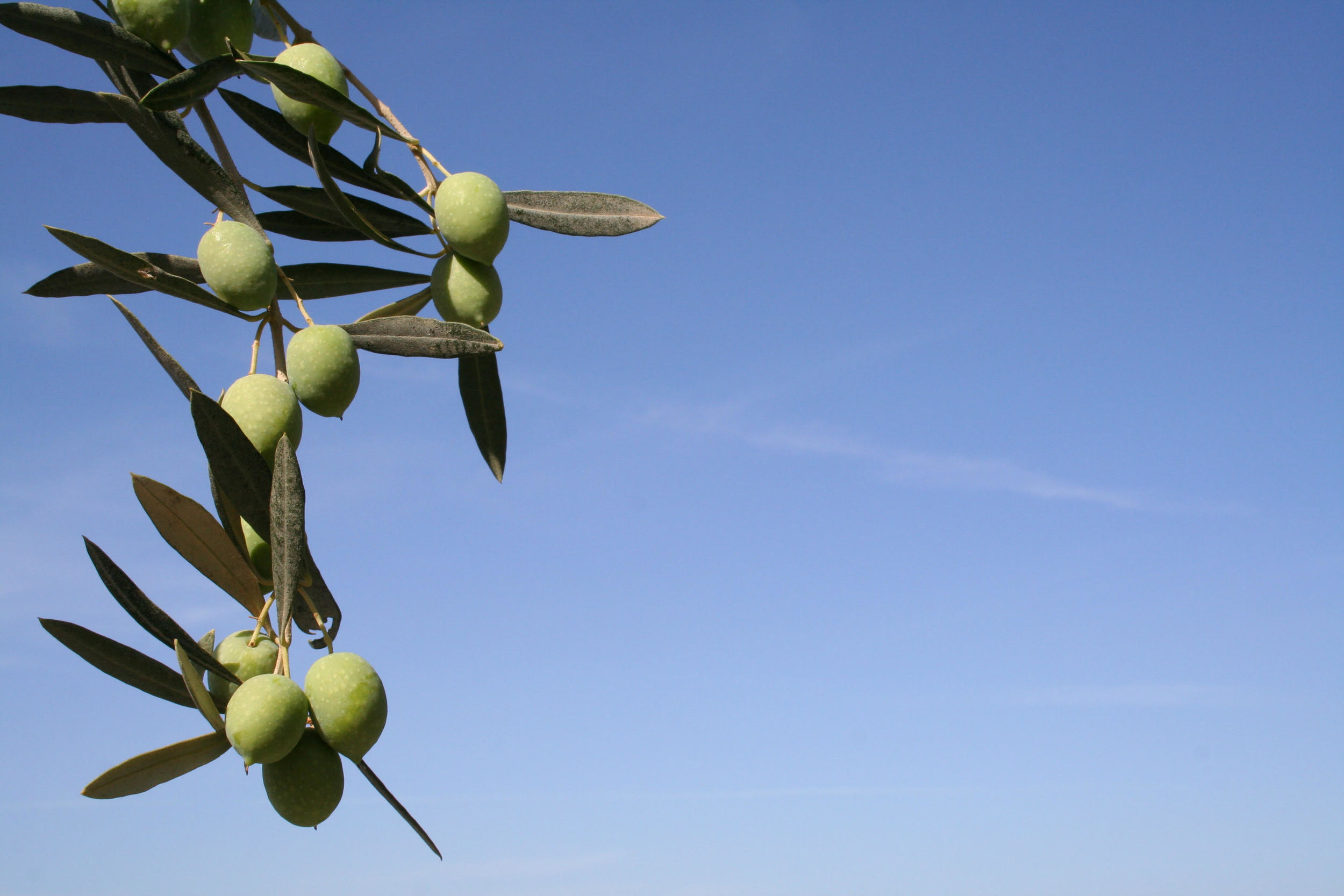
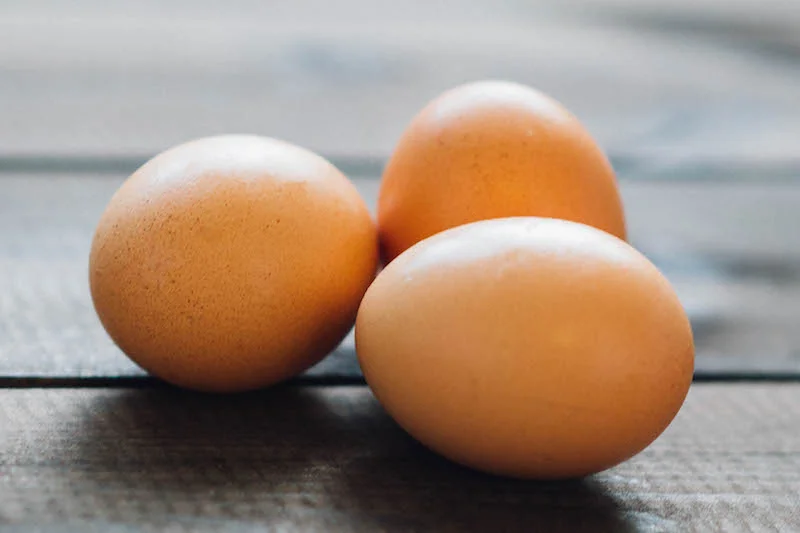
And eat in health. Good food is here, and it's got Omega 3s written all over it. Now go eat half an avocado stuffed with sardines, and drizzled with olive oil for lunch, will you?
MONDAY BASICS: Eat your EFAs
Welcome to February, sweet one. This week's Monday Health Basics topic is one that I think about every live long day, and it involves choosing foods that will support just about everything going on in your body. Let's talk ESSENTIAL FATTY ACIDS.
This Monday Health Basics topic is one that I think about every live long day, and it involves choosing foods that will support just about everything going on in your body. Let's talk ESSENTIAL FATTY ACIDS.
I will work on keeping this one shorter and sweeter, dear reader. Talking FATS is a big ole conversation I have on a regular basis, and one that is tough to navigate. Today though, I just want to tackle ONE GOOD THING YOU CAN DO TODAY. And that thing, starting this week, is adding some essential fatty acids in the form of Omega 3s to your daily regime! (Skip to the image of the sweet cows if you just want to get WHAT foods you should reach for.)
Now, let's make this clear: omega 3s are EFAs (essential fatty acids) which means they are necessary for our bodies to do their thing. We aren't able to make these omega 3s out of anything, we need to rely on our diet to supply them in order that we may utilize them in a myriad of biochemical processes in the body. Why may someone be deficient in the omega 3s, you ask? There can be so many different answers to this question from exposure to toxic chemicals, to someone who smokes or is surrounded by second hand smoke; someone who is battling a health condition that is utilizing the precious Omega 3s. If someone's digestion is compromised, they may not be able to get the nutrients they need in order to get the Omega 3s where they need them to be and for the chemical reactions to take place in order to get them working in the body. This compromised digestion may also play a role in preventing a person from getting the micronutrients needed for those chemical reactions to take place, things like magnesium, zinc, vitamins E, C and B6. There are studies out there that point to a correlation between a deficiency in EFAs with a diet where there was an abundance of foods containing trans-fatty acids. (Say no to soybean oil! ALWAYS! And other things. Come to the talk on Navigating Fats.) Of course, seeing as it is an essential that needs to be there in the diet, it goes without saying that a deficiency can also be as a result that the person in question just isn't consuming enough.
There are a few different kinds of Omega 3 fatty acids, and in the interest of keeping it brief, I will say the main ones are ALA (alpha-linolenic acid), DHA (docosahexaenoic acid) and EPA (eicosapentaenoic acid). ALA is the one that we cannot make, we need to get it from our diets. The other two, if our bodies are in good working order, we are able to manufacture them out of ALA. But in this day and age, it's tough to do that conversion work because of toxins in our environment, decreased digestion, chronic conditions or chronic inflammatory statuses.
It's About Balance
One of the things you need to know here is how the Omega 3s play with other fats, or rather, how other fats play with Omega 3s. There are other EFAs out there, Omega 6s being one of them. Omega 6s and Omega 3s work in tandem in our body to do lots of things, but especially working at keeping our overall inflammation in check. In order for this process to work properly, we need a ratio of 2:1 of Omega 6: Omega 3s. (This means that for every 2 Omega 6 molecules, our body needs 1 Omega 3 molecule.) The problem here is that with the way we eat in North America, our diet tips us more in the direction of 20:1 for Omega 6: Omega 3. With this big of an imbalance, the anti-inflammatory work just can't happen. Not only that, but an over-abundance of Omega 6 fats can contribute to an increase in inflammation, kind of like adding insult to injury there. So yes, I will talk food sources for the Omega 3s, but know that by reaching for real food and reducing the processed foods, you will be working already on improving the ratio.
The foods that best serve as excellent sources of these essential Omega 3s:
flax seeds and flax seed oil (be sure to keep it in the fridge, and buy in small quantities; if it smells or tastes rancid, toss it)
caviar
sardines
salmon and other cold water fish like anchovies, mackerel, herring (buy only wild fish, as farmed fish will not contain any Omega 3s!)
pastured or grass-fed beef (not conventionally raised beef)
pastured or grass-fed bison
wild game (deer, moose, venison)
shrimp
fish broth (homemade from scratch!)
walnuts
chia seeds
avocado (my favourite! Have 1/2 an avocado a day!)
olives and olive oil
Brussels sprouts
cauliflower
broccoli
sea plants and seaweeds like Irish moss
eggs
any dairy products produced from cattle fed on grass (butter, ghee, cheese)
pumpkin seeds
It's as easy as adding walnuts and cheese
If your body is compromised in any way, or if digestion isn't your strong suit, you may be having a hard time converting that plant form of Omega 3 fats to an animal form. (You are an animal. You aren't a plant.) In the case of someone like this, I would recommend reaching for the animal versions of Omega 3 fatty acids, in order to give your body that which it cannot make, taking some of the pressure off. Taking a fish oil supplement may be of benefit to you. Why not make it do double duty, and pick up some cod liver oil instead? This contains those important EPA and DHA forms of the omega 3s we need, but it also contains other beneficial fat-soluble vitamins like one of my all-time favourites Vitamin A (retinol), necessary for all skin including mucosal linings like your intestinal lining; it's also a good source of Vitamin D, needed for strong bones, robust immunity, hormone manufacturing, mood balancing, thyroid work, and the list goes on.
The Why
Last, but certainly not least, I wanted to let you know that you need to reach for these foods every day, indeed ensure they're at the table for every meal. Here is why: these EFAs are critical components in our immune system function; they lower the risk of heart attack, stroke and hardening of the arteries; they are essential to skin and are of benefit to people with psoriasis, eczema, acne and other skin eruptions. They are critical for someone who is suffering from arthritis; necessary to cushion joints and ligaments; important to lubricate the colon and improve our ability to move the poop on down the line; they reduce blood cholesterol; they help to prevent cancer; they are necessary to brain and heart function. Omega 3s are an essential nutrient for your eyeballs. They're also needed for your thyroid and adrenals. You need them for strong bones. Mood regulation. They reduce your risk of death in just about everything under the sun. Including effects from the sun. They help reduce the risk of dementia and Alzheimers'. Most important: THEY ARE NECESSARY TO PROTECT YOUR EVER LOVIN BODY FROM INFLAMMATION. Eat them, dear friend, consume them. Make them a part of every meal.
And eat in health. Good food is here, and it's got Omega 3s written all over it. Now go eat half an avocado stuffed with sardines, and drizzled with olive oil for lunch, will you?
(Oh and, did I mention yet that inflammation can show up as low moods? Depression? Anxiety?)
Goodness I'm verbose for a Monday morning. This topic isn't a short one, thanks for reading this far. #mondayhealthbasics
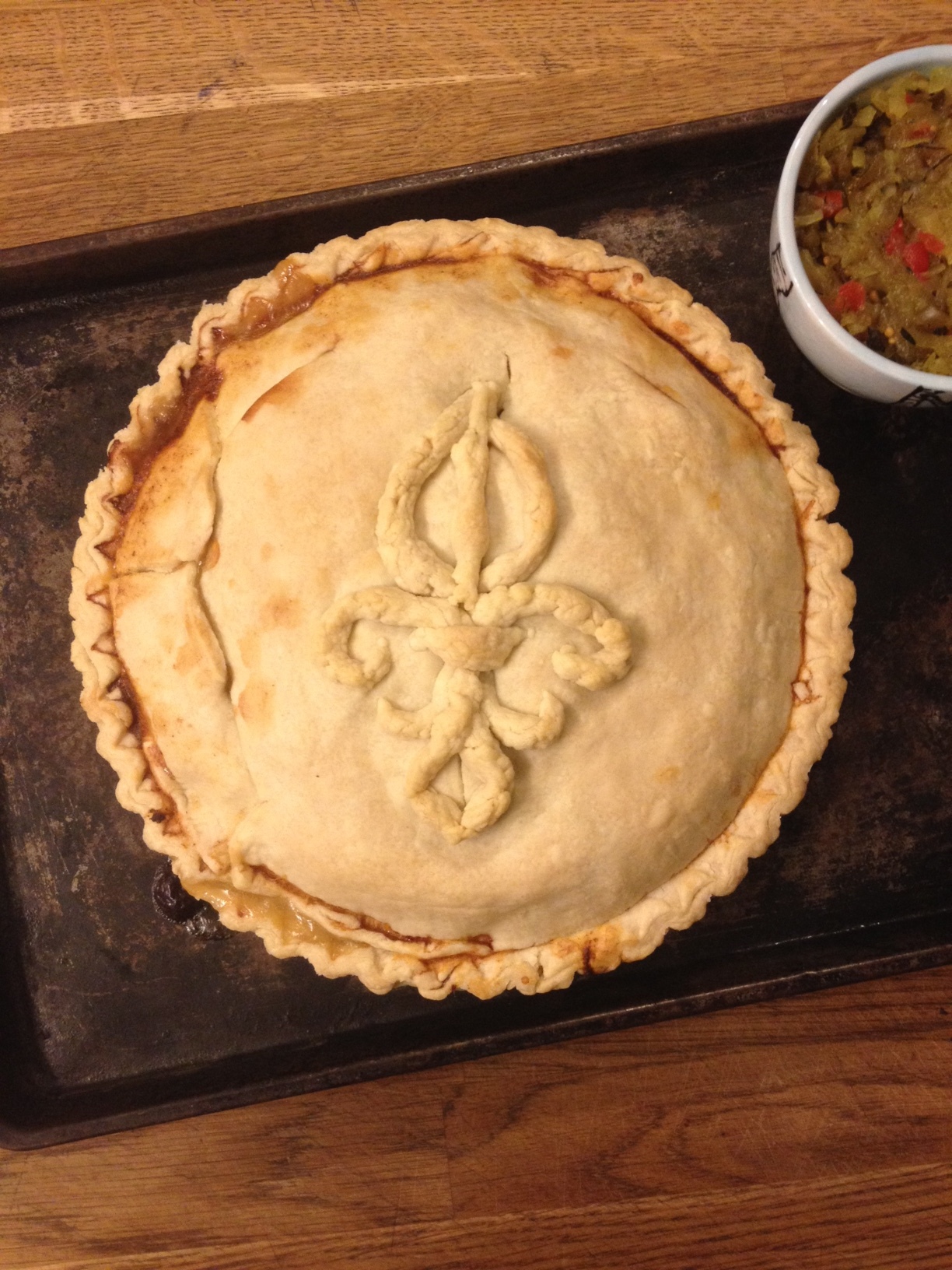
Tourtière
I grew up in a home where my Mom was cooking from scratch all the time; we were the lucky consumers of homegrown veggies and meals made by my Mom. My grand-parents lived next door, so it was a regular thing to go over after school to help my Grand-Maman make cookies (she never followed a recipe! She was amazing!), tarte au sucre, or my Grand-Papa's favourite, Tarte aux raisins. You knew Christmas was upon us when you could smell my mom and Grand-Maman making tourtière, the traditional meat pie served at French-Canadian Christmas feasts and Réveillons since the dawn of time I think! Those scent memories still live in me, witnessed by my gut reaction when preparing this pie last night for the celebration tonight. I was misty-eyed, as the flood of memories came; I immediately thought “Christmas is soon! Everyone will be here soon! This must also mean there are Christmas cookies already baked and stashed away in the house somewhere, I should go look!” Sigh.
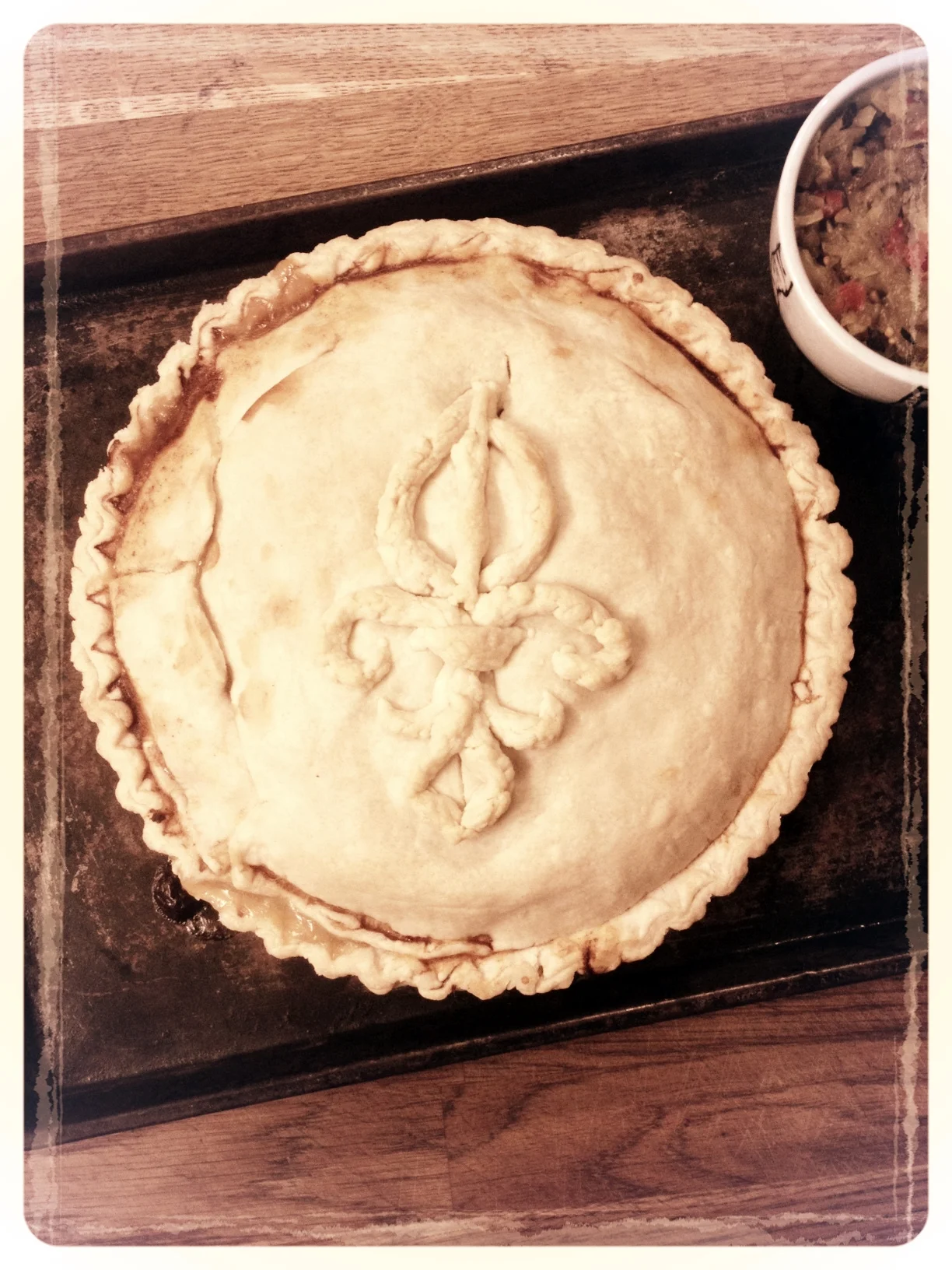
Tourtière du Lac St-Jean
Our daughter is a student at our local Waldorf school, a school that does things a bit different from the norm you could say. Their intent is to meet the child where they're at based on their development, and each grade has a series of stories or theme to the year. This year being Grade Five, they are in a year of transition, not quite a teenager yet but not feeling like they can relate to the younger kids in the school either. It is a year meant to give them a solid foundation, preparing them for the Middle School and all of the tumultuous things that await them in the coming years. (Hormones! Projects! Realizing the world around them is bigger than their family and friends!) They start with a focus on the world directly around them through local geography and botany, studying how the people adapted to the land and hearing their stories. They start to branch out into the greater world, starting with Ancient civilizations. They learn about history through mythology to see how myths were born out of reality. Their teacher will tell stories and lead them through work on Ancient India, Persia, Mesopotamia, the culture of Ancient Egypt, dabbling in Greek Mythology and ending the year with a tremendous travel themselves to a city in BC to meet up with other same-aged Waldorf school children, at the Greek Olympics. These stories and ways of leading these 10- and 11- year olds through this year is meant to give them that solid base of home and understanding of the outer world, and starting them on their path of figuring out how they fit in to the greater world and just what is their contribution to that world. Diversity is celebrated, and in fact, tonight's dinner was a celebration of that diversity!
Her class teacher organized a Multi-Cultural Night at our school, in celebration of those cultures that are represented in our class families. Each family was encouraged to bring a dish that celebrates their culture, a food traditionally found in their food repertoire. There were delicious offerings of sushi, perogies, samosas, salami and sauerkraut, pastries, bannock, an eggplant dish, empanadas, BBQ pork buns, jambalaya, pea soup, lamb stew, clam chowder, corn bread and green beans; it really was a feast fit for royalty. Countries represented at the dinner included Norway, Canada, England, Afghanistan, India, Ireland, China, Korea, Scotland, France, Colombia, Denmark, Germany. Our family contributed from both sides, we are lucky to be sharing a city with one set of grand-parents. They represented my father-in-law's roots from Mississippi and brought corn bread and green beans. As my ancestry is part French-Canadian, it was a no brainer that our family's contribution would be one of those staples from Christmas time at my house, tourtière. But not just any tourtière, the Acadian version.
I grew up in a home where my Mom was cooking from scratch all the time; we were the lucky consumers of homegrown veggies and meals made by my Mom. My grand-parents lived next door, so it was a regular thing to go over after school to help my Grand-Maman make cookies (she never followed a recipe! She was amazing!), tarte au sucre, or my Grand-Papa's favourite, Tarte aux raisins. You knew Christmas was upon us when you could smell my mom and Grand-Maman making tourtière, the traditional meat pie served at French-Canadian Christmas feasts and Réveillons since the dawn of time I think! Those scent memories still live in me, witnessed by my gut reaction when preparing this pie last night for the celebration tonight. I was misty-eyed, as the flood of memories came; I immediately thought “Christmas is soon! Everyone will be here soon! This must also mean there are Christmas cookies already baked and stashed away in the house somewhere, I should go look!” Sigh.
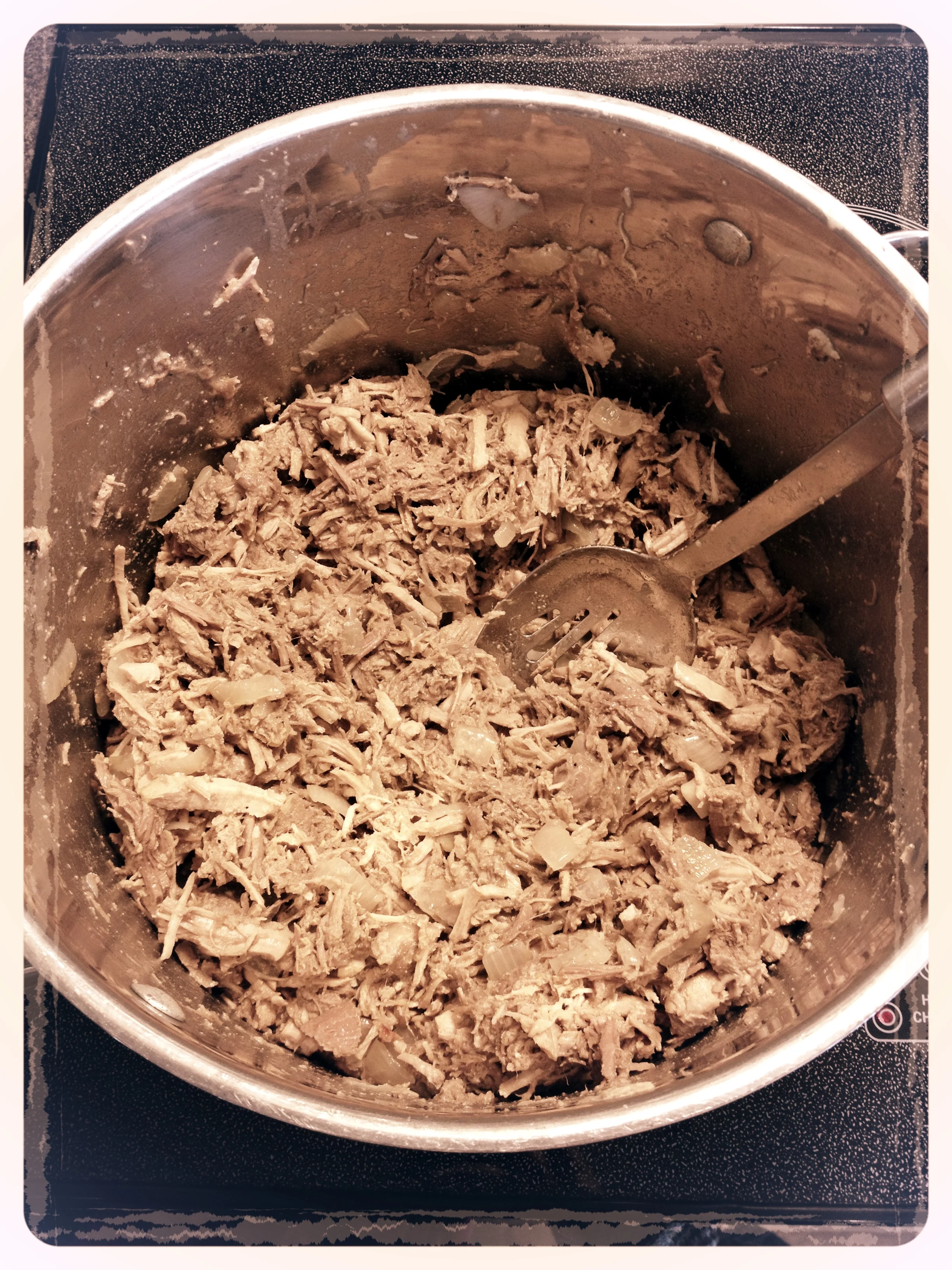
Tourtière is a traditional French-Canadian meat pie, and most would be familiar with the version made out of ground meat, either a combination of meats or one single type of ground. My dad has gotten into making a ground chicken version these last few years; I refuse to veer away from the ones that were regulars in my childhood. Call me sentimental, call me old school, I just love this version so much better. If done correctly and with enough time to allow the meat to mellow, it just Melts. in. Your. Mouth. The Acadian version uses stew meat instead, 1 part beef to 2 part pork. Onions are also added late in the game. It's really quite a simple process, and one I continue offering in tradition to my family at this time every year.
I'm including the recipe here, as it was dictated to me by my Maman some 10 or more years ago. The colours look bland, and with such a short list of ingredients, do not be fooled. This ain't a bland tasting seasonal treat at all. I hope you like it.
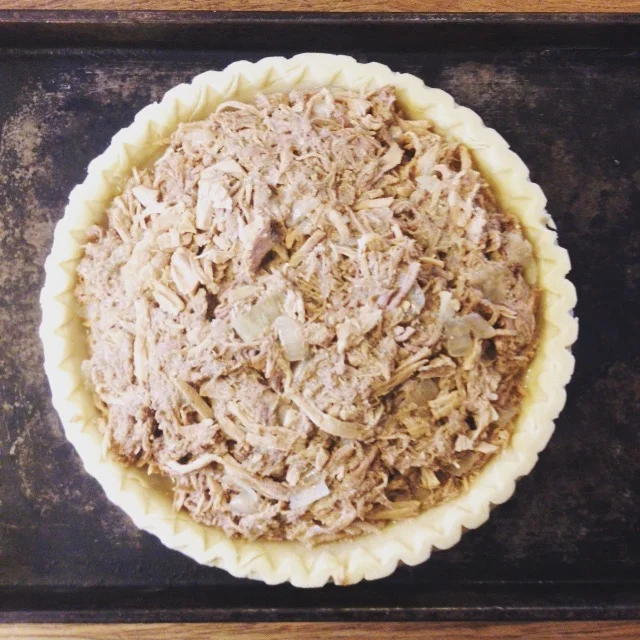
TOURTIERE DU LAC ST-JEAN (à Grand-Maman Lena et aussi Lorraine)
This amount makes about 2 pies
In a big pot, add 1 lb stew beef cut in cubes and 2 lbs pork shoulder roast cut in cubes. (You might want to remove the fat off of the pork.)
Put enough water in the pot, not enough to cover the meat but enough to see that there is water in there.
Add some salt and pepper.
Stir the meat from time to time as it cooks, breaking the meat up into shreds as it cooks. When the meat is about shredded and is almost done cooking (it will give up its toughness as it cooks), add 4 chopped onions. Let this cook until it's a good consistency. This will take a total of about 5-6 hours, with the onions added for that last hour.
Drain fat or juice if it's too soggy, or add bread crumbs to help absorb those juices in order to make it not leaky. Adjust your salt and pepper. Put in your pie shell, and add your pie lid. Bake at 350F for 1 hour or until the top crust is a nice golden brown.

Fleur de lis tourtière
Wishes to you for a smooth sailing kind of season ahead. Keep chaos at bay, friends. And make some tourtière.
*And truly, this being 2015 and in the spirit of sanity, I opted to use a store-purchased pie shell. I found a quite clean version in the freezer at my favourite local Health Food Store I felt ok using, from Wholly Wholesome. Straight up ingredients: organic wheat flour, organic palm oil, water, organic cane sugar, sea salt. My adrenals were requesting a free hall pass for this one. I obliged.