
MONDAY BASICS: liver loving brews
Ah yes, the birds are chirping, the bees have been busy, and the yellow fields have been greening up as spring is here upon us in the prairies and foothills. Hooray for spring! In Traditional Chinese Medicine, spring is the season best associated with the liver, as TCM practitioner Efrem Korngold states,
“The organ that shares the character of this season is the Liver, tasked in Chinese medicine with the job of instigating movement and arousing the mind by allowing tension and pressure to build. As spring signals the rising of sap in the trees, so the Liver lifts the blood upward and spreads it outward. Alternately gathering and releasing our rivers of blood, the Liver modulates the intensity and force of all body movement and process. “
I like to think of tea and herbal brews as necessary (and delicious!) tools in one's medicine chest. And so, in the spirit of the season, we will look at some liver loving brews you can add to your food arsenal, in order to best support this hard working organ. This is the perfect time of the year to do so.
Ah yes, the birds are chirping, the bees have been busy, and the yellow fields have been greening up as spring is here upon us in the prairies and foothills. Hooray for spring! In Traditional Chinese Medicine, spring is the season best associated with the liver, as TCM practitioner Efrem Korngold states,
I like to think of tea and herbal brews as necessary (and delicious!) tools in one's medicine chest. And so, in the spirit of the season, we will look at some liver loving brews you can add to your food arsenal, in order to best support this hard working organ. Perfect time of the year to do so.
First things first. Your liver is your main detoxification organ, and does something like 500+ jobs in the body. It hangs out just under your rib cage on the right hand side of your body (unless of course, if your inner organs are hanging out on the other side. In our cadaver lab at school, we got to witness this incredible phenomenon – FASCINATING. But I digress.)
Did you know it's actually a gland?
The liver's main tasks are to cleanse your blood and build blood-clotting factors, move the waste and toxins out, break down hormones, build up new ones. It gets rid of so much stuff, like chemicals, junk produced during metabolism and packages them back up in to bile. This good stuff helps emulsify the fats you eat, which means it makes those fats easier to digest and better to assimilate the nutrients found within. So bile is the perfect recycling tool, see? Isn't your liver a star?
The liver also regulates the sugars in your blood, and is the key player in metabolizing carbs, fats and proteins. It builds proteins from the smaller building blocks called amino acids. The liver is also a storage house for some good things like extra vitamins (the fat soluble ones, my favourites), and extra blood just in case. It is also a key player in your immunity, and is the principal organ that deals with inflammation in the body. Enzymes are made by this organ. As if it didn't have enough of a workload...
My favourite part about this big organ – IT REGENERATES LIKE A DREAM. It loves to repair and rebuild. Itself. Multi tasking, folks. That's what this organ's main super power is. It is the only organ in the body that can do this.

Herbs and Teas
There are so many things we can do to love our livers up, ways to let them know we appreciate their workload and are thankful for all they do. (Who's game to start having Liver Day, in addition to Mother's and Father's Day? I think it is warranted.)
Today's post is focusing on beverages that are best suited to this wonderful gland.
You can seek out Burdock root at your favourite local health food store and steep the dried parts in simmering water for a good 20 minutes. I personally like to throw in a few slices in when making good ole meat stock. Chicory root is another one that benefits the liver, and is a great alternative to coffee if you're looking to curb your caffeine intake. Know that chicory helps stimulate bile production, and so thus could help get your colon rollin. You can sometimes find a good coffee alternative that will include both of these liver-supportive roots in the mix.
Yellow Dock Root might be worth seeking as well: it has been shown to help purify the blood and super bile inducing. Astragalus root is a traditional Chinese herb that has been shown to be of wonderful support to the immune system, as well as showing promise of supporting liver metabolism, especially in those diagnosed with diabetes. I share a recipe on how to use it below.
Imbibing bitter brews will help support the liver, and influence it to produce bile. Think hot lemon with water, or nettle tea. (Remember my good friend nettle?) Peppermint tea, while not of the bitter persuasion, can stimulate the bile production as well. It's good at bringing down cholesterol as well, double bonus!
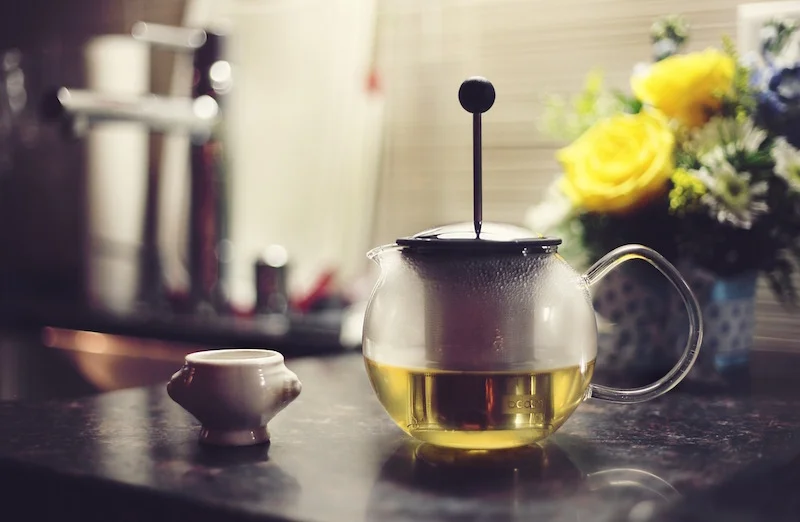
I am a big fan of the delicate notes of Green Tea as well, when it comes to liver support. The polyphenols found in the tea protect your cells from free radical damage, possibly contributing to slower aging and keeping certain diseases such as cancer and heart disease at bay. Be forewarned, green tea supplements may not be a good idea and in fact may prove to be toxic to some folks' livers. Consult your medical team before embarking on this new brew.
There are two roots I routinely use in my cooking and brew-making that you may want to get to know better: ginger and turmeric. They are in the same rhizome family, and are both wonderful protectors of the liver. They are adept at reducing overall inflammation, and are excellent sources of antioxidants, those all-important compounds that help reduce free radical damage at the cellular level. One of the active chemical compounds found in these rhizomes is called curcumin: it has been shown to be liver-protective, also helping to up the production of bile. They also help stimulate your liver to produce enzymes that will flush toxins out. How to make a brew: check out Toronto-based nutritionist Meghan Telpner's site for a good one. You can also easily purchase ginger tea in prepared bags for simpler preparation, or for taking on the road.
Rooibos tea is another good one you may already have in your cupboard. A 2008 study found that this loose leaf tea native to Southern Africa is high in antioxidants and may be a good tea for those wanting to support their liver.
Rose Hip tea is another popular wild-foraged food that can be made into a Vitamin C rich brew by allowing the rose hips to steep in just-boiled water for a time. This essential vitamin is a key player in this organ's detoxification work.
The wonderful world of medicinal mushrooms is an ancient practice that is seeing new light these days. Find your way to this article to read on the benefits of Reishi mushroom in particular, noting that it is a liver-protective herb that can be a key player in mitigating the effects of chronic inflammation and supporting the immune system, a system intricately linked to the liver.
Chaga is another wonderful medicinal mushroom that grows on birch trees and has been used traditionally for many centuries. (My sister has some growing on her property and recently shared some of her winter harvest with me!>. This mushroom serves as a potent blood purifier, and excellent at reducing chronic inflammation as well, providing the body with key nutrients necessary for the body's detoxification and antioxidant protectors. Check this article from Calgary's local lovelies The Light Cellar for a comprehensive write-up, including tips on how to prepare your own brews.
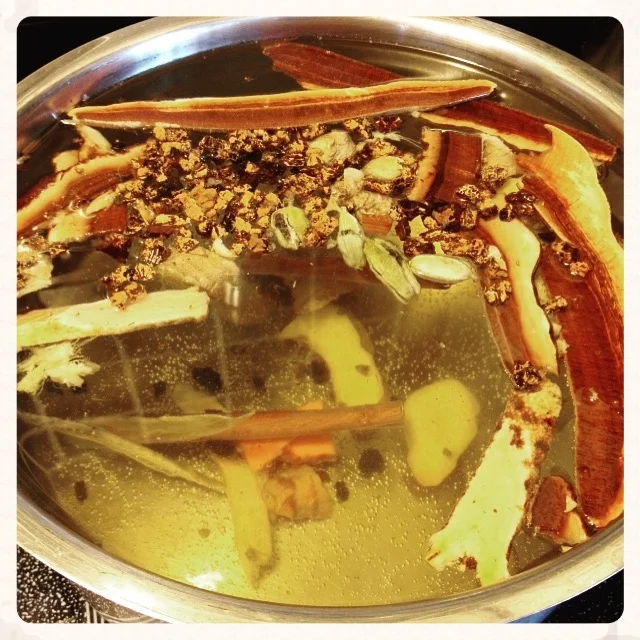
I like to prepare my own concoction at home to support my liver. Every few weeks, I set a pot of this goodness to simmer for the better part of the day, with the intention of consuming a good mugful every day until the pot is empty. I leave it on the stove top and bring it back to a good boil once a day before consuming it. I sweeten it with some delicious local honey to taste.
LIVER and IMMUNE SUPPORTING BREW
Steeping on a low simmer for six hours:
8 cups of filtered or spring water (the chlorine in tap water is an added toxin the liver has to handle)
5 slices dried Reishi mushrooms
1.5 tbsp chaga pieces
4 slices astragalus
2 cinnamon sticks
2" fresh ginger, sliced
1" fresh turmeric, sliced
4 cardamom pods cracked open
Dandelion Root Tea is a popular one in our house; it is a wonderful liver tonic. (Did you know the word dandelion comes from the french word 'Dent de lion'? I find that funny because the french name for this flower is 'pissenlit'. Which literally means pee the bed. And Dandelion root tea is a diuretic. See what they did there? Those smart frenchies.) I think this one may be my absolute favourite liver loving brew. It helps incite your liver to rebuild and function at a higher capacity. Read on for more information on this magical brew.

What kind of cuppa will you prepare next?
The information provided in this post is not intended to replace your doctor's advice. This is for educational purposes only. If your liver is currently giving you cause for concern, it is best to seek out the support of your Medical Team before consuming any of the brews mentioned in this post.

MONDAY BASICS: how to think about coffee
I am not going to lie to you. I love coffee. I love my morning cuppa. I look forward to it, I relish it, I miss it when it isn't in my routine. We often travel with our thermos-like french press, ready to make good java on the road at any point in time. I really really love my cuppa joe come morning time. I love the heat of the mug, the creaminess of the cream, the chocolate-y tones to the darker roast. I love how satisfying this mug of goodness is. I love my coffee so much that whenever we go on holidays, it is one of the first things we do when in a new town: we scope the place for the best cup of joe. We're not afraid to ask around. Two of the best cups of coffee I've ever had in my life were in Madison Wisconsin at a little cafe off the beaten path, and the other in Bath, England at a little corner cafe, where the cool stone benches were a welcome respite from the sweltering summer heat, a few blocks from the historic Roman Baths. I love me some good coffee.
For today's Monday post, I aim to go over some things to think about if you love your cup of joe as much as I do. If you're looking for optimal health, that is.
I am not going to lie to you. I love coffee. I love my morning cuppa. I look forward to it, I relish it, I miss it when it isn't in my routine. We often travel with our thermos-like french press, ready to make good java on the road at any point in time. I really really love my cuppa joe come morning time. I love the heat of the mug, the creaminess of the cream, the chocolate-y tones to the darker roast. I love how satisfying this mug of goodness is. I love my coffee so much that whenever we go on holidays, it is one of the first things we do when in a new town: we scope the place for the best cup of joe. We're not afraid to ask around. Two of the best cups of coffee I've ever had in my life were in Madison Wisconsin at a little cafe off the beaten path, and the other in Bath, England at a little corner cafe, where the cool stone benches were a welcome respite from the sweltering summer heat, a few blocks from the historic Roman Baths. I love me some good coffee.
For today's Monday post, I aim to go over some things to think about if you love your cup of joe as much as I do. If you're looking for optimal health, that is.

First things first. There is a lot of hubbub about coffee out there, and it might be a tricky situation to navigate. If you look hard enough, you can find a mountain of evidence to support consumption, and you can find just as much information there to suggest you quit cold turkey.
THE GOOD
Let's start on this side of the fence, shall we? Coffee is a seed, and looks a bit like a mix between a cherry and a cranberry when it is picked by hand off of the plant. (Check this page out if you're curious to know the whole process from planting to brewing. At some point in this whole harvesting, the beans are fermented. Yes, fermented! (All the best things are fermented, no?) Once dried, the beans get roasted, and either get ground before they get to you or you can opt to do the grinding yourself. These ground beans get brewed into what one hopes is a delicious cup of coffee.
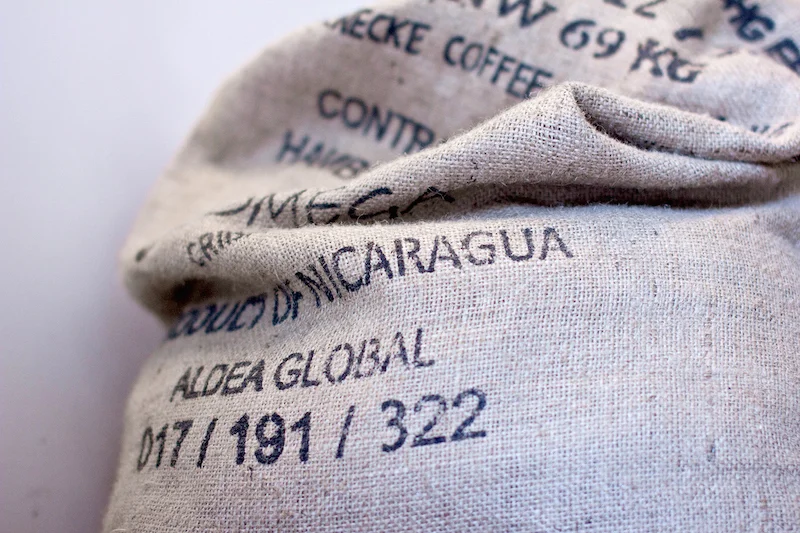
Know this: the coffee plant is one of the most pesticide-heavy crops out there. By opting to purchase organic coffee beans, you will be reducing the pesticide load and easing the burden on your digestive tract, as well as your liver. Good work.
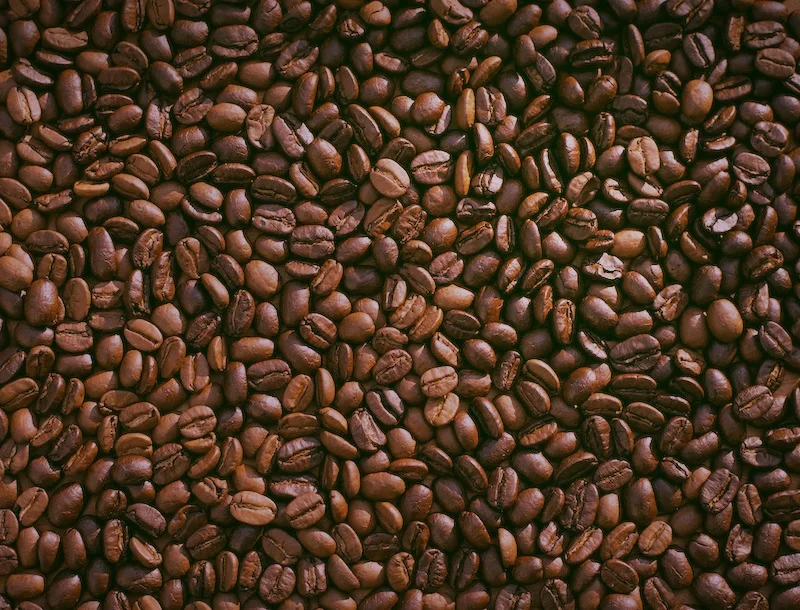
Coffee is rich in antioxidants, organic compounds that are known to reduce the risk of major chronic degenerative diseases, among them diabetes. It would seem that coffee is protective to the liver, your main detoxification organ. The consumption of caffeine found in coffee appears to be a protective agent against the development of Parkinson's (mostly in men, sorry ladies.) This study points to necessary further exploration of the benefits of caffeine in protecting one against Dementia and Alzheimer's. For more benefits of coffee, head to this article for a more thorough look at some of the science backing these notions. This article points to the benefits of caffeine for athletes. (I love it when they post things like 'Coffee Makes you More Intelligent.' That there is bait, and I fell for it. Who am I to dispute?)
THE BAD
As you probably well know, it is the caffeine found in coffee that is the main culprit of the negativity surrounding this beverage. Caffeine acts as a stimulant on your adrenals, prodding them to work overtime releasing excess cortisol. This cortisol being released triggers your body to release sugar in that ole bloodstream, which could feed opportunistic yeasts. They start to gain hold in your gut, and these bums now send out chemical triggers to your adrenals to release more cortisol so that insta-sugar hit can get into the bloodstream so they can be fed. Again, coffee (or rather, caffeine) contributes to this picture. Taking caffeine (and carbonated beverages with caffeine in them!) out of the picture will take some of the load off of your spent adrenals, and in turn, will start diminishing the sugars available to these yeasts with the idea of starving them. Sugar cravings are all part of this cycle; once that cortisol comes out and glucose is quickly released, your blood sugar spikes, insulin comes out to help level the sugar spike at the pass, but those levels aren't sustained for very long. That sugar level then dips quite low, and your brain starts to go on survival mode and sends out messages to your adrenal to release more cortisol again in order to get that glucose back into your bloodstream so that your brain doesn't starve. (Glucose is its main food). Again, taking coffee out of the picture would help alleviate some of the stress on your adrenals, and would contribute to helping to level blood sugar levels. If you're the kind of person who reaches for the 8th cup of coffee at 2pm, you might feel you are being kept captive by this cycle of blood sugar ups and downs. You would be a good contender to look at reducing that caffeine intake, and mitigating those cups you do have with some healthy fats.
Caffeine has been linked to increased blood pressure too; this is all part of the body's fight-or-flight reaction, originally meant to get us out of the saber-toothed tiger's way. While this survival mechanism served us well those many moons ago, consuming caffeine in excess can induce our body to be in that fight-or-flight mode more often than necessary. When this happens, we are setting the stage for low grade chronic inflammation, which is at the root of so many chronic diseases.

HOW TO STILL HAVE COFFEE AND MITIGATE THE EFFECTS OF IT:
Make it a dessert-y kind of coffee by adding something high in fat. Having the fat in the mix will help slow down the absorption of caffeine to the blood stream, which in turn will help moderate your adrenals' response. You can add a tbsp of ghee or coconut oil - coconut oil is best for someone with no gallbladder, as it is the easiest fat for your body to digest. Coconut butter or cocoa butter are good options here as well. You can use full fat whipping cream, it doesn't take much. Aim to not have any sugar in your beverage as well, as sugar further contributes to the tax on the adrenals and further exacerbating the whole fight-or-flight mechanism.
Another good idea if you are a regular consumer of coffee, in order to mitigate that extra stress on your adrenals, is to make sure to consume your coffee after a good meal. If your body is busy digesting and assimilating the eggs and avocado on toast you had for breakfast, it will release that hit of caffeine much slower to the bloodstream instead of a quick jolt you would get on an empty stomach. Slower release of caffeine ensures you aren't triggering that fight-or-flight reaction as well; unfortunately, when the fight-or-flight reaction is engaged, your body shuts down digestion in order to concentrate on the task at hand. Having a coffee solo first thing could contribute negatively here.
Additionally, some of the compounds found in coffee have been found to be mild irritants to the stomach lining and that of the intestinal lining; ensuring a good meal before having your cuppa will help protect those sensitive mucosal linings.
If you are curious to read more from the 'cut out the coffee consumption' camp, make sure to read this article. They explain the correlation between adrenals and mood, and how caffeine plays a big part here.
ALTERNATIVES
If you are someone who is wanting to love up your adrenals, keen to balance the blood sugars, realizing not everyone starts their day with 10 cups of coffee, or if you are wanting to reduce your consumption of caffeine, if you find you are wavering towards the no-coffee camp, there are some excellent options out there. Invest in some liver-loving Dandelion Root Tea, or better yet, harvest your own! (Skip the soy milk he suggests here, and go for one of the good fats mentioned above.)
On the subject of tea, you can switch one or more of your coffee cups for a steeped cuppa tea. While some tea does contain caffeine, it is much less than you would find in coffee. Green tea for instance is a fabulously rich in antioxidants tea that would benefit your adrenals, while satisfying that need for a warm bevy.
Wanting to take the caffeine right out? Reach for antioxidant-rich liver-loving herbal teas like rooibos and fruit flavoured herbal teas. You can also make yourself a medicinal mushroom hot chocolate like the one found here. There are many other options out there too, alternatives like chicory root or pre-made coffee alternative mixes you can find at your favourite health food store. Go play with your food!
One quick thing to note: caffeine is a diuretic, which means it pulls water out of your body and increases your urine output. (Yes, you pee more if you drink coffee.) Knowing this, just make sure you are replenishing those fluids and having an extra cup of water.
Good work my friend. I'm off to have my one cup of joe for the day. And you better believe I'm going to savour it and enjoy it. Thoroughly.

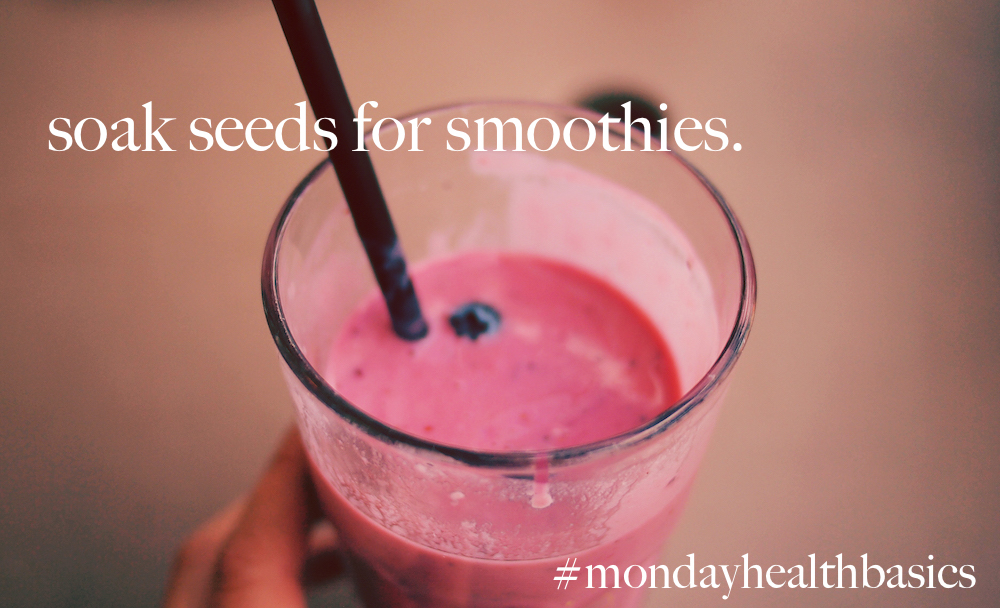
MONDAY BASICS: soak seeds for smoothies
This post is for those early birds who are regular consumers of smoothies come morning time. This next in the series of #mondayhealthbasics goes over some basic easy steps you can take in order to make that smoothie really count and nourish you from head to toe. Today's tip will ensure you are better able to digest your morning elixir, and what kinds of things to add in order to make that breakfast smoothie sustain you for longer periods.
This post is for those early birds who are regular consumers of smoothies come morning time. This next in the series of #mondayhealthbasics goes over some basic easy steps you can take in order to make that smoothie really count and nourish you from head to toe. Today's tip will ensure you are better able to digest your morning elixir, and what kinds of things you can add in order to make that breakfast smoothie sustain you for longer periods.
Smoothies come in all shapes and sizes, and the only thing between you and the flavours to wake your taste buds is your imagination. Some folks go for a non-dairy milk as the base: think coconut milk, or flax seed milk, almond milk or coconut yogurt. Others go for the full on dairy, from straight up milk to yogurt to kefir. (I do love me some creme fraiche for my quick smoothies.)
I'm going to offer an alternative to you today:
seeds and nuts as your smoothie base.
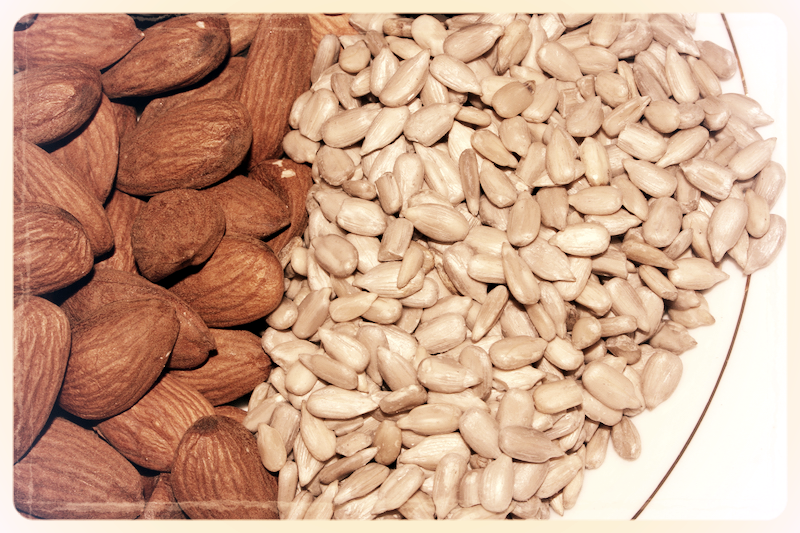
Why seeds and nuts, and not their milks you ask? For one, the packaged dairy-alternative milks you find sometimes list carrageenan in their ingredients. For a good primer on just what is this additive we often see listed on the label, check this post. (For folks who may have some digestive issues, this is one of those food additives that may be contributing to irritation and inflammation in the gut.) So omitting it might be a good idea, if you're looking to bring down inflammation in your body. (Have you heard me go on about inflammation yet? Inflammation is really at the root of just about every chronic degenerative disease out there. Find out more about inflammation and how to tame that beast at a talk coming up this Sunday the 10th!)
In order to eradicate this additive from my diet, I just make my own nut and seed milks. But sometimes, I don't know about you, but there is only so much time in the day.
Enter: THE INSTA-BREAKFAST.
Well, kind of insta-. As insta- as it gets in this house. This is inspired by a recipe from Dr. Carolee Bateson-Koch's book Allergies: Disease in Disguise and serves as a powerhouse of anti-inflammatory fats, good source of minerals like calcium and magnesium. Adding these nuts and seeds to your morning smoothie will also provide your body with satiating protein and fat, helping you go the distance.
But we aren't talking just throwing in some nuts and seeds to the blender when you think of it. No. We're allowing these nuts and seeds to hang out soaking in water overnight before blitzing them into breakfast delicious.
Why pre-soak these nuggets? See, it's all about de-activating the phytic acid and enzyme inhibitors in the nuts and seeds. Enzyme inhibitors and phytic acid are Mother Nature's way to ensure survival, but not for you; rather for the seed making its way through your digestive system. These two compounds are in all nuts and seeds and grains that will one day, make it into a whole plant form.

Imagine a fox. Little foxy is meandering through a field of oats. She takes a nibble from one of the plants and feasts on some oat seeds. She feels good, she feels satiated, so she lies down for a nap. But these seeds she ate? They were full of phytic acid (the plant's way of storing phosphorus) and enzyme inhibitors. As they make their way through the fox' digestive tract, the enzyme inhibitors turn off little foxy's enzymes, which means now she can't break down the seed and thus won't get the nutrients in the seed. (This is all done in order that all of the nutrients and minerals held within the seed/nut/grain can remain in the seed.)
While this non-digested seed winds its way through the fox' gut, the phytic acid also pulls out minerals from her stores, depleting her of important trace minerals necessary to bone building, enzyme production, metabolism, detoxification, I mean the list goes on. When this little undigested morsel of oat seed exits her digestive tract via her stool, that seed (fully intact!) will now be ready to grow into a plant. As it makes its way through her digestive system by "soaking" in the fox' digestive juices, this process deactivates the phytic acid and signals to the seed that it's time to grow. But it's only with time that this deactivation happens. You need a minimum of six hours. (Anybody ever heard of soaking their pea seeds the day before planting? It's the same thing.) Good work, seed!
Sorry little foxy. You were robbed.
How to get around this you ask? We must fool Mother Nature. NO WAIT. We must work with Mother Nature. We need to mimic what she's come up with. This means soaking your nuts/seeds/grains BEFORE you eat them so as to ensure you turn off those enzyme inhibitors found in the seeds. They will no longer be able to prevent you from getting the nutrients found within. Additionally, by properly preparing your nuts and seeds before consuming, you will retain those important trace minerals the phytic acid would have pulled out of you on its way through your system because that compound is turned off.
Sure, sometimes I prepare big batches of nuts and seeds and then store them in freezer bags once they are dehydrated. But I just can't be that far ahead of the eight ball most days.
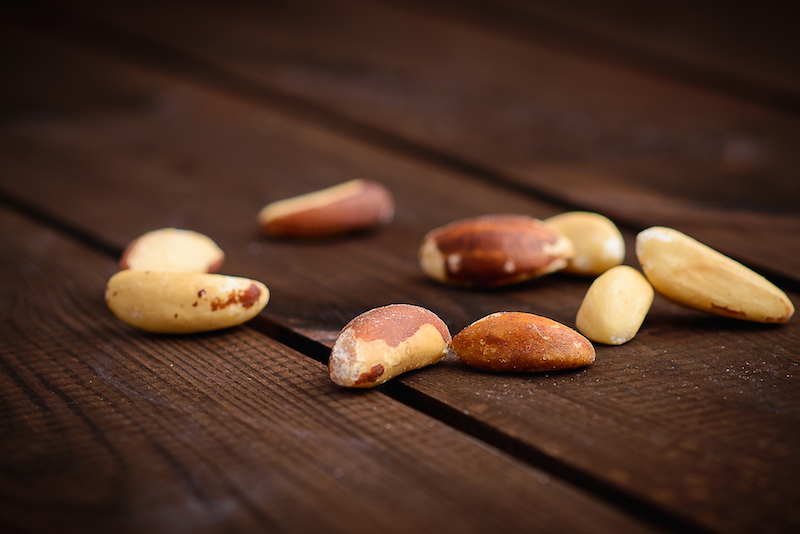
So here is my shortcut, for the person who'd rather do a small batch for their next morning's breakfast. This one will make two tall glasses of the good stuff.
THE PLAYERS
3/8 cup of nuts and seeds, combined (I love pumpkin seeds, sesame for the calcium, flax and brazil nuts but you can use whatever you have on hand)
3/4 cup of filtered water
THE HOW-TO
The morning before you plan to have this smoothie, measure your nuts/seeds mixture into the filtered water, cover and let sit on the counter for 24 hours, until tomorrow's breakfast. For added benefit, I'd add a tbsp of a ferment like kombucha or water kefir, or some whey from yogurt or kefir in my fridge. (Say goodbye, phytic acid! Sayonara, enzyme inhibitors!)
The next morning, blitz this mixture in your blender along with an additional cup of filtered water. You will be consuming the whole seed! No milking required!
You can add whatever you usually add to your smoothies at this point. I usually include about a cup and a half of frozen mixed berries, sometimes a banana, a little bit of maple syrup and voila. Down the hatch. Delicieux.
Of course you could add some swiss chard for the super-greens kind of effect (less of a negative impact on your thyroid than kale ), or an apple for extra fibre. I always make sure I have some good fats in my smoothie, in order to help slow down the absorption of sugars into my bloodstream and help carry me and satiate for longer periods. For me, this usually means creme fraiche, but you could add some coconut butter or coconut oil, or good old butter if you'd like.
Baby steps, my friend. Baby steps.
Soak those seeds for your smoothies. Love your guts. And bones. And liver. And heart. And brain. And every other sweet part of your body is attached to that gut.
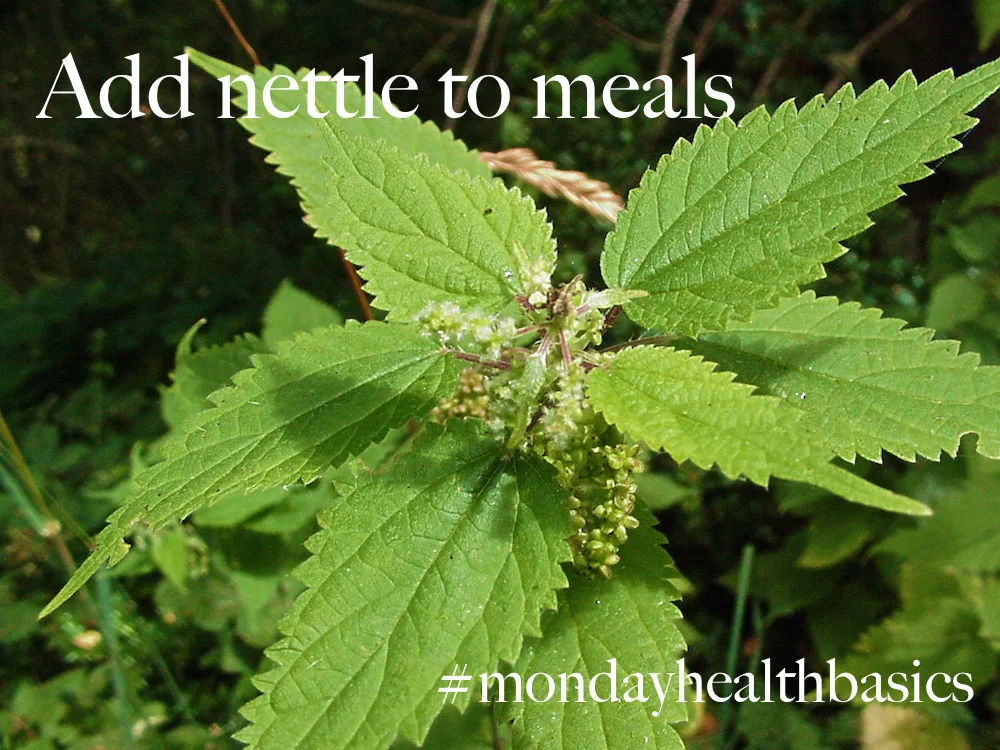
MONDAY BASICS: Add Nettle to Meals
Welcome to Monday. This week is St. Patrick's Day, and as I have some Irish roots, I did indeed aim to think green for this week's #mondayhealthbasics blog post. My week got off to a roaring start with a thoughtful gift from one of my sisters, a book from boreal herbalist wunderkind Beverley Gray called The Boreal Herbal: Wild Food and Medicine Plants of the North – a Guide to Harvesting, Preserving and Preparing. Oh the joy. Oh the possibilities!
Leafing through the book last night, I zoned in on the Stinging Nettle, or Urtica dioica. Yes yes yes, the same plant that gives you the very intense zing-like needling you would experience were you to chance upon a patch without knowing it. This perennial plant runs wild in almost every nook and cranny of this planet where there are wetter areas or where the soil has been disturbed. It loves rich damp soil. And seeing as spring seems to be just around the corner, it will be one of the first wild plants that will pop up for early harvesting.
Welcome to Monday. St. Patrick's Day is happening this week, and as I have some Irish roots, I did indeed aim to think green for this week's #mondayhealthbasics blog post.
My week got off to a roaring start with a thoughtful gift from one of my sisters, a book from boreal herbalist wunderkind Beverley Gray called The Boreal Herbal: Wild Food and Medicine Plants of the North – a Guide to Harvesting, Preserving and Preparing. Oh the joy. Oh the possibilities! (I am so lucky to have two awesome sisters. I love them so!)
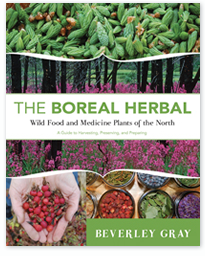
See, I am a forager at heart and as I dig a bit deeper into our family's history, I realize I come by this quite honestly. This book has been on my radar for years since a good friend shared the knowledge within and a few recipes and foraging forays with me. But leafing through this new tome to my collection last night got me dreaming of things I want to uncover in places near by. As the book cover suggests, “(this) is an indispensable guide to identifying and using northern plants for food and medicine.” In this book you will find profiles of plants, berries, herbs and trees that will help you identify them in the wild. These profiles will help you figure out how and when to gather and preserve these goodies, with safety tips. You'll find lots of recipes and how-tos with detailed information on how best to gather these medicinal foods and make the most of the plants growing wild in the recesses of your back yard to the more remote spots found in nearby wilder areas.
Leafing through the book last night, I zoned in on the Stinging Nettle, or Urtica dioica. Yes yes yes, the same plant that gives you the very intense zing-like needling you would experience were you to chance upon a patch without knowing it. This perennial plant runs wild in almost every nook and cranny of this planet where there are wetter areas or where the soil has been disturbed. It loves rich damp soil. And seeing as spring seems to be just around the corner, it will be one of the first wild plants that will pop up for early harvesting.
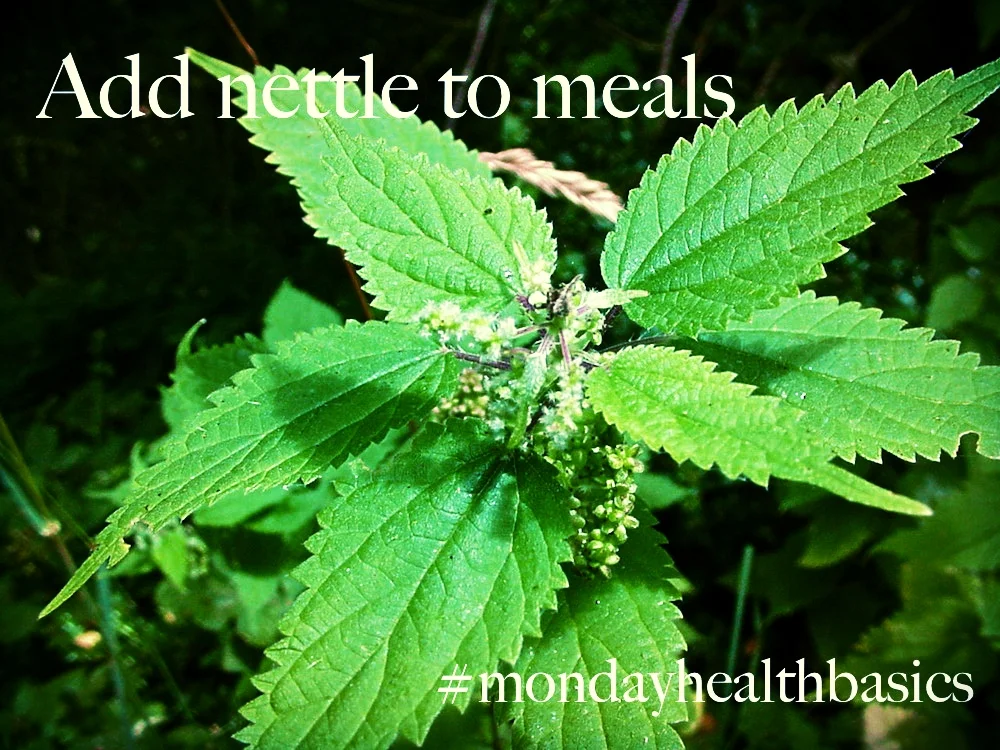
I love nettle for so many reasons: it grows wild and can be found quite easily if you know where to look and what to look for. It's a super green, providing a rich source of iron (we need for energy and oxygen transport in our bodies) and silica (a mineral necessary for our body's structural force so think strong bones, nails, skin and hair). It's a power house of vitamins and nutrients, a good source of vitamin K, magnesium, chlorophyll, vitamins A and C too. My favourite thing in nettles is the high calcium content: 1 cup will supply your body with roughly 40% of this important mineral for the day! All of this to say that nettle is a food that will promote the good health of bones and teeth, my friend. And these things we need strong for this world, yes?
The Boreal Herbal book explores the folklore behind this nutrient-dense herb, stating it is a blood purifier. It's purported to help your kidneys and liver. There are new studies looking into the efficacy of this herb in the treatment of BPH (benign prostatic hyperplasia), a non-cancerous growth of the prostate gland. So fellas, this one is for you too!
This herb is a fabulous anti-histamine herb, and as such would be of tremendous support for anyone dealing with allergies or the kinds of reactions we would associate with hayfever like itchy watery eyes. The leaves have also been shown to help combat inflammation, and so this herb would be of great benefit to someone suffering with arthritis or gout, eczema or psoriasis. Any kind of inflammation!
Nettle has a diuretic effect as well, so if you are someone who tends to retain water, this would be a good herb to add to your arsenal. Love your kidneys up, my friend.
Some companies have added it to their hair care products in order to help control dandruff. There are even manufacturers out there who have figured out how to utilize the fibres of the plant to produce textile. Fabric! All because of how easily and prolifically it grows. (Some folks call this a weed. A weed to you is a herbal delight to me.)
WHERE TO FIND THE GOODS
Now not everyone is up for hiking through dense marshy areas in search for this perennial herb. And fair enough. (I am not a super experienced forager, so I will forego sharing any tips or ideas on how or where to find nettle. I don't want to send you in the wrong direction or fail to give you the full and complete information you would need to ensure the plant you have in your hand is indeed the nettle plant. Plus, I don't want you to get hurt. BUY THE BOOK. It's about all I can say.)
So where would one find this amazing herb then, you ask, should one prefer to go the surer route? There are quite a few favourite local haunts where I have seen them on the shelves, or where I have purchased bags of the good stuff. Make sure to check your local favourite health food stores like Amaranth, Community or Blush Lane. You can also pick some up at The Light Cellar next time you're in Bowness.

Dry nettle leaves
HOW TO CONSUME THE GOODS
I'd forego trying the stuff raw. Imagine it stings you. While you're chewing. I'm just not that much into extreme food sports, you know? I mean they're called stinging nettles for a reason: there are hairs on the plant's stems and leaves that, when they come into contact with your skin, well they STING! And that feeling is just not pleasant.
But once you cook them, that stinging property disappears and you are left with a wonderfully dense, nourishing green that will provide your body with the good food. One of the easiest ways to consume the benefits of this herb is to steep it in a tea. Just toss the lot in with some water, and simmer for a short time if you prefer a weaker tea, or go ahead and let it simmer for longer for a deeper greener taste. I myself like to throw it in with other herbs in my thermos for the day's tea, depending on what I have in my pantry or what organ I want to support at that time. Nettle is always in the mix, every single day.
If you go digging around the internets, you'll find some wonderful recipes like this Potato, Golden Beet and Nettle Soup that sounds scrumptious. The good folks at The Kitchn have compiled a comprehensive list of recipes for clever ways to consume nettle in things like pestos, pastas, pies and pizzas here. You'll also find a wonderful compendium of recipes featuring this herb at a website solely dedicated to the health properties of Nettle.
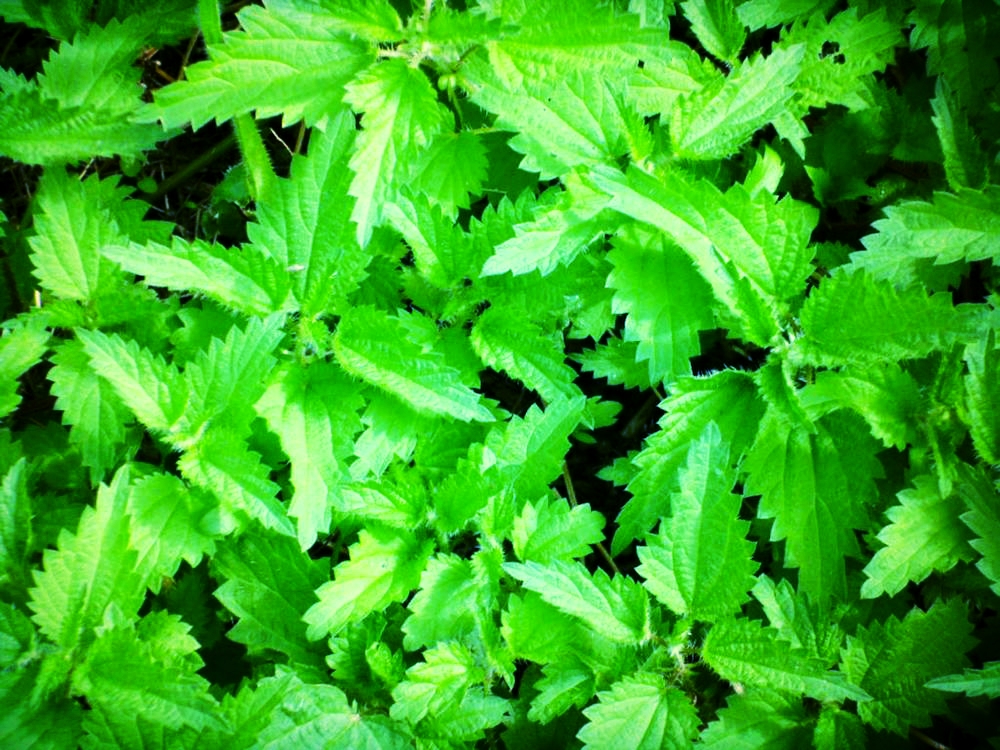
I'm not so calculated, I tend to cook from the hip. I throw a handful of dried nettles in lots of things from meatballs to soups and stocks; I've been known to throw some in with the ground beef or bison I'm cooking for a taco salad or add it in to spaghetti sauce or a chili. Anywhere you want a little more green, my friend. It's as easy as that. Toss it in with your morning egg scramble; add it to the shredded sweet potato pancakes you have on tap for dinner tonight; simmer them a bit in a cup of meat stock for snack time; add it to your herbal profile when making a bouillon salt; add it to the greens you're cooking up for a yummy Palak Paneer; throw it in with the vegetables in your next ferment.
Whatever you do my friend, you best
GO PLAY WITH YOUR FOOD.

And happy St. Patty's day!
MONDAY BASICS: Lemon water to start your day
The ninth in this blog series of weekly easy upgrades for better health is a pretty simple one. It takes all of 3 minutes of prep once every two weeks, and a little forethought every night before hitting the hay. We're talking the pros of starting your day with a glass of lemon water.
The ninth in this blog series of weekly easy upgrades for better health is a pretty simple one. It takes all of 3 minutes of prep once every two weeks, and a little forethought every night before hitting the hay. We're talking the pros of starting your day with a glass of lemon water.

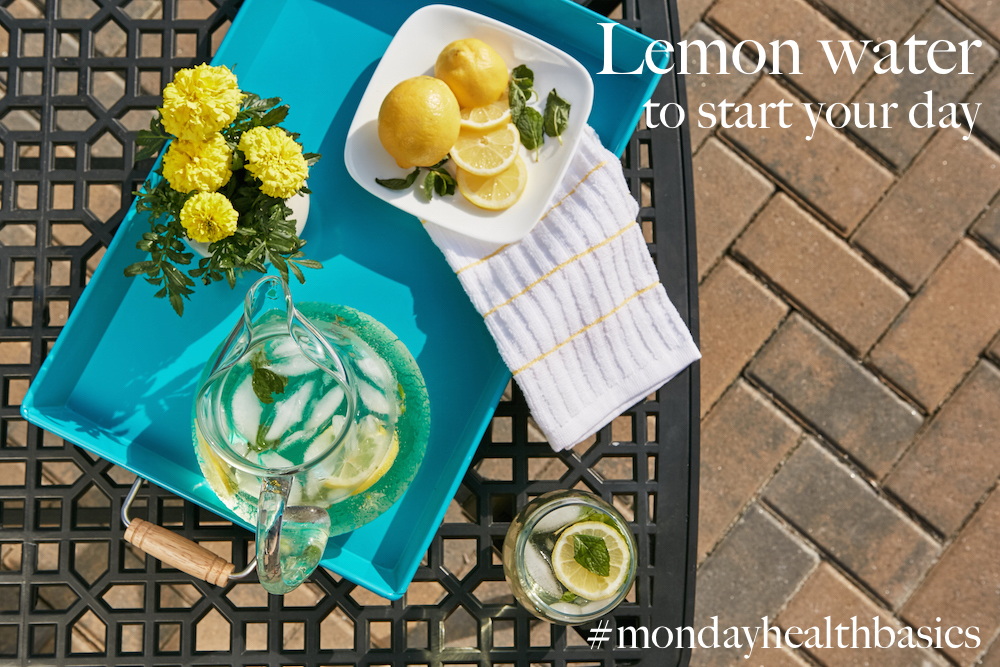
Omit the ice cubes for improved benefits. I just liked the colour here.
There are so many benefits to kicking your day off on the right foot with this lemon water business. This recommendation is one that just about every client I see on an individual basis will get early on in our work together. The benefits are many, as you will see by the list below.
But first, the how-to:
There are a few ways to do this. It's a good-better-best kind of deal if you simply add a tablespoon of bottled lemon juice to a glass of room temperature water first thing upon waking in the morning. Upgrade that to a freshly squeezed half lemon for even more benefits in the same glass of water.
Want to really knock this one out of the park? Purchase a bag of organic lemons and run the lot through your stand mixer or food processor in order to reduce them to a mushy paste. Yes, skin, rind, seeds, pith and all. Pour this paste into ice cube trays and tuck in the freezer for easy retrieval. Before heading to bed at night, pop one of those lemon ice cubes out of the tray and toss in a glass of filtered water, and set on your night table so that come morning, that lemon will be melted into the water. Down the zesty drink first thing before even getting up, and you've done your body a good deed already. And your feet haven't even touched the floor yet! GOOD WORK.
Now go about your morning routine, washing up, getting dressed, packing lunches, feeding others, and preparing your breakfast. Getting the water down the hatch first thing will allow your body to absorb that water and give a good 30 minute buffer before your breakfast is ready to eat. This buffer means that the water will not dilute your hydrochloric acid, and thus will not hinder your digestive prowess first thing in the morning. Again, GOOD WORK.
But why?
The reasons for implementing this daily ritual are many. First things first: after a good night's sleep, your body can be leaning towards dehydration as it hasn't consumed any water for a long period of time. Starting the morning with room temperature water will help rehydrate, and the added lemon will get your digestive system started. As our body does its restorative work during our sleep, starting the day with this bitter beverage will induce the liver to do a very gentle cleanse first thing, flushing out toxins and getting bile flowing. Water is the main component of our lymph system, and so by consuming this glass of water in the morning we are further supporting our body's natural detoxification job in moving toxins and antigens out.
As is well documented, citrus fruits are also good source of Vitamin C: this crucial antioxidant plays an important role in supporting the liver, a main player in immune and a necessary nutrient for supple skin and health for connective tissue (we need it to make collagen in our bodies). And let's not forget the adrenals, they too rely on Vitamin C and so think of this as a good support for you to better be able to handle stress. Vitamin C is also a big player in keeping free radical damage at bay, and so of good support to skin.
As an added bonus, citrus fruit have been well documented to contribute to reducing overall inflammation be it systemic, chronic or acute in nature. What's not to love?
Make sure your glass of water is either at room temperature or a bit warm, as cold water will shock your system and reduce the benefits you may be seeking here. This is part of the reason why I recommend you prepare this morning wake up the night before, to ensure the temperature won't slow down the benefits we're seeking here.
If you're worried about any negative effects on the health of your teeth when consuming lemon water on a daily basis, you may want to consume your water through a straw, bypassing your teeth entirely.
Just adding this one easy task to your morning routine can bring support to your liver, lymph system, skin, digestive system, connective tissue, reduce inflammation, neutralize those free radicals and help rehydrate your body. It's really an easy add-on with myriad benefits. Try this one out, and let me know how you feel one week in!