

MONDAY BASICS: add seaweed
For this week's topic for the #mondayhealthbasics series, I am going to work hard at not getting bogged down in scientific evidence and fancy words to try to extoll the virtues of seaweed or sea vegetables. (Although if you're looking for research behind some of these facts, simple hover over parts of the text and you're bound to find a link to something that may prove to be an interesting read, should you be wanting to delve further into the science side of things.) We're talking adding seaweed to your regimen today on the blog. Because minerals. Because lignans. Because cancer protection. Because reducing inflammation. Read on if you need more evidence.
For this week's topic for the #mondayhealthbasics series, I am going to work hard at not getting bogged down in scientific evidence and fancy words to try to extoll the virtues of seaweed or sea vegetables. (Although if you're looking for research behind some of these facts, simple hover over parts of the text and you're bound to find a link to something that may prove to be an interesting read, should you be wanting to delve further into the science side of things.) We're talking adding seaweed to your regimen today on the blog. Because minerals. Because lignans. Because cancer protection. Because reducing inflammation. Read on if you need more evidence.

Some call them seaweed, others call them sea vegetables; they are one and the same. It might be obvious, but these culinary (and healthy!) delights live typically in marine waters (so think salty seas) and in some freshwater lakes too. They are mainly lumped into one of three categories, based on their colour: brown, red and green.
Not all kinds are fit for consumption, but there are scores of edible sea vegetables you can include on your table. Some of my favourites include arame, hijiki, kombu, kelp, wakame, nori and dulse. Most folks would be familiar with seaweed as the wrapping around sushi, or the floating green bits in their miso soup. I have a wonderful few recipes from Darina Allen in a book on traditional Irish cooking where she shares recipes on using Carrageen Moss to make pudding. Seaweeds have been a part of traditional culinary cultures living in proximity to ocean waters for many centuries, and with good reason!
Why I love seaweed: they are a fabulous source of minerals. As we move away from traditional ways of cultivating our foods and harvest, our soils are losing some of their mineral content. This loss of minerals is reflected in the produce grown in these depleted soils. As we consume these foods from depleted soils, so we start missing some key minerals in our diet. A good way to help support our health then would be to add in to our diet those foods that would help bridge that gap and provide those lost essential minerals. This is where seaweed comes in!
You'll find these sea vegetables are a good source of important minerals like magnesium and calcium (minerals that work in tandem for bone health, nerve health, heart health, adrenal and thyroid health too), iodine (thyroid health, protecting against breast cancer), a good source of folic acid (a critical B vitamin essential to nervous system health, cardiovascular health and reproductive things as well). You'll also find these vegetables to be good sources of iron, potassium, other B vitamins. But what you may not know is that they also supply us with good amounts of lignans and fucans or fucoidans: these two nutrients bring with them cancer-protecting properties (especially estrogen-dependant cancers) and help support the body in reducing overall inflammation, assisting in reducing blood cholesterol.

Sea vegetables are considered to be a blood tonic, supporting the kidneys and stomach function. One of my favourite party tricks of theirs is that they are excellent at chelating out heavy metal toxins from between your cells: I mean, COME ON! That's reason right there to include them at least once a day.
But how does one just start eating seaweed.
Does it mean I have to forage by the ocean and munch on the sandy rubbery mess?
Well, no. I mean you can if you want to try it out, but I don't recommend it. Yet. (Foraging for seaweed is something on my bucket list. I know. I'm a nerd. Deal with it.) Know that you can find seaweed and sea vegetables in many different forms, either at your regular grocery store or at your local Health food store too. Look for seaweed that is dried, in packages. You may also want to check out the bulk bins or spice racks, where you may find kelp powder. Simply switching a salt shaker on the table for ground up kelp powder will be a fabulous and easy way to start adding the goodness of seaweed to just about every meal, without having to put much thought into it.
Other ways to incorporate these greens into your everyday: you can take a long strip of seaweed and soak it in filtered water for at least 30 minutes in order to soften it. This is one of the key steps in making the Japanese traditional stock called Dashi. (You can also make a bonito dashi, if you're feeling more adventurous and looking for deeper flavour) Once soaked, you can chop it in bite sized pieces to include in any soups, stews or stir fries or to eat raw in salads. I have a recipe I came up with in my Month of Salads challenge I set up last June, this one uses arame, a noodle-like seaweed once soaked. Delish.
Speaking of noodles, there are a few gluten-free noodle options out on the market these days that are made strictly with seaweed. Some are better than others, so don't be discouraged if the first one you try is not to your liking. Play with your food!
Of course you can easily use nori leaves to wrap your sushi in, but did you ever think to use these sheets as an excellent gluten-free alternative to a lunch time wrap? Or cut into squares as a base vehicle for mayo+smoked salmon+kimchi+capers? You can also chop these sheets up into strips to toss into salads, soups and stews or one of my favourites, with butter over popcorn. Or just munch, as is. Kids love these in their lunches.
I toss a kombu strip every time I make a meat stock or bone broth; I have been known to sprinkle in minced Sea Veg Blend to anything I can sneak it in. This includes casseroles, soups, rice dishes, stews. I even sneak them in, along with dehydrated greens, to my meatballs and burgers.
Dulse is an easy one to include in anything soupy or stew-like, as it completely dissolves and is not recognizable in your prepared meal. It takes no time to cook!
And fermenting? Why yes, yes I use seaweed in my ferments! Wakame is a wonderful addition, along with ginger to a sauerkraut; or tossing in strips of dulse in with your kimchi would be divine. I don't know if you know this about fermenting, but it is a sure-fire way to free up minerals and vitamins in the foods being fermented in order to increase their bioavailability. Why not add seaweeds to your ferments, in order to increase the mineral content even more? Why yes, yes I think I just might.
Adding a strip of dried kombu when making a batch of beans is a Traditional Foods idea folks have been doing for yonks, and it appears to improve the digestibility of the beans, which means less gas for the consumers. And friends who are hanging out with said consumers in the hours following.

Know that these greens do come from the ocean, and so they will bring with them a bit of salt. Taste your finished product (with seaweed added in!) before salting your dish.
I am aiming for a toonie-sized piece of seaweed per day at our house. It isn't a recommendation set in stone and I certainly don't get bothered if I don't include it in the day's meals but I really do aim to include this goodness in just about every calendar day. There are so many benefits, how could I not?

the humble seaweed.

MONDAY BASICS: J.E.R.F.
Next up in this year-long series called Monday Health Basics is perhaps one of the most revolutionary actions you can take in order to ensure yours and your family's optimal health. It's about JERF. Just. Eat. Real. Food.
Next up in this year-long series called Monday Health Basics is perhaps one of the most revolutionary actions you can take in order to ensure yours and your family's optimal health. It's about JERF. Just. Eat. Real. Food.

I've been catching up on a little television these last few days, holed up with a pretty good bout of the flu. I've had the chance to watch a few episodes of the Netflix series Cooked by Michael Pollan. (I highly recommend you track this one down.) In it, he explores food and our relationship to it through four different lenses: fire, water, air and earth. It's not about rocket science (although how that fellow roasts pig is pretty darn close to rocket science I think); it's more about what it means to be nourished by food, what food means to a community and culture. And how our way of cooking has changed in these last fifty plus years, and how this is affecting our overall health.
This series explores how much our food choices have been usurped and have altered in these last fifty years or so. One of the reasons is because of the immediate availability of ready-made meals and snacks that are easier to pick up on the way home than it is for us to make a full fledged meal. How do they get us to keep buying those ready made meals? They load them up with salt, sugar or fat; these are all things that we are hard wired to like and so we tend to reach more and more for these kinds of foods. We actually crave them! And that is the idea here, the manufacturers have scientists in their midst in order to develop that perfect mouth-feel for their customers, that perfect balance of salt/sweet/savoury in order to get us to keep buying their products over and over. Those flavours and the sugar factor is something we've evolved to like: when something has good fat in it, it will satiate us and make us feel fuller, longer. When something has a sweet taste to it, we developed an affinity for this as it indicated the vegetable or fruit at hand was at its peak freshness. Consuming sweet foods, and thus craving them, allowed us to eat a more nutrient-dense diet! That is, until processed foods came along.
The problem here is that these prepared foods, while they may taste amazing, are made with the cheapest and most refined ingredients possible, in order for the company making these foods to turn a profit. They don't end up supplying our bodies with as many nutrients to fuel us through our days as if we were making our own foods at home. There are many ingredients in these products that could contribute to inflammatory things we have going on in the body. They may also contribute negatively to our body's ability to digest. They may provide our bodies with some rancid oils, especially things like soybean oil. These rancid oils wreak free radical damage in our bodies, setting us up for some health concerns along the way.
Looking up statistics online, I found that on average, a Canadian household spends just short of $6000 per year on groceries. Money spent at restaurants is just over $2200. These stats are for 2014, the latest year available online. These numbers indicate to me that on average, most families are eating out quite a bit if the money spent outside of the home is equal to a third of what they spend on their grocery bill!

The simple act of cooking at home is perhaps one of the most revolutionary acts you can do.
In cooking from scratch, you are inherently using better ingredients than those found in processed and packaged foods. You are reaching for fresher produce which will better provide those necessary antioxidants, vitamins and minerals to help your engine run clean. And we're not talking gourmet meals here, friends. We're talking simple, delicious and easy meals that are good enough. And good enough is good. And that's enough.
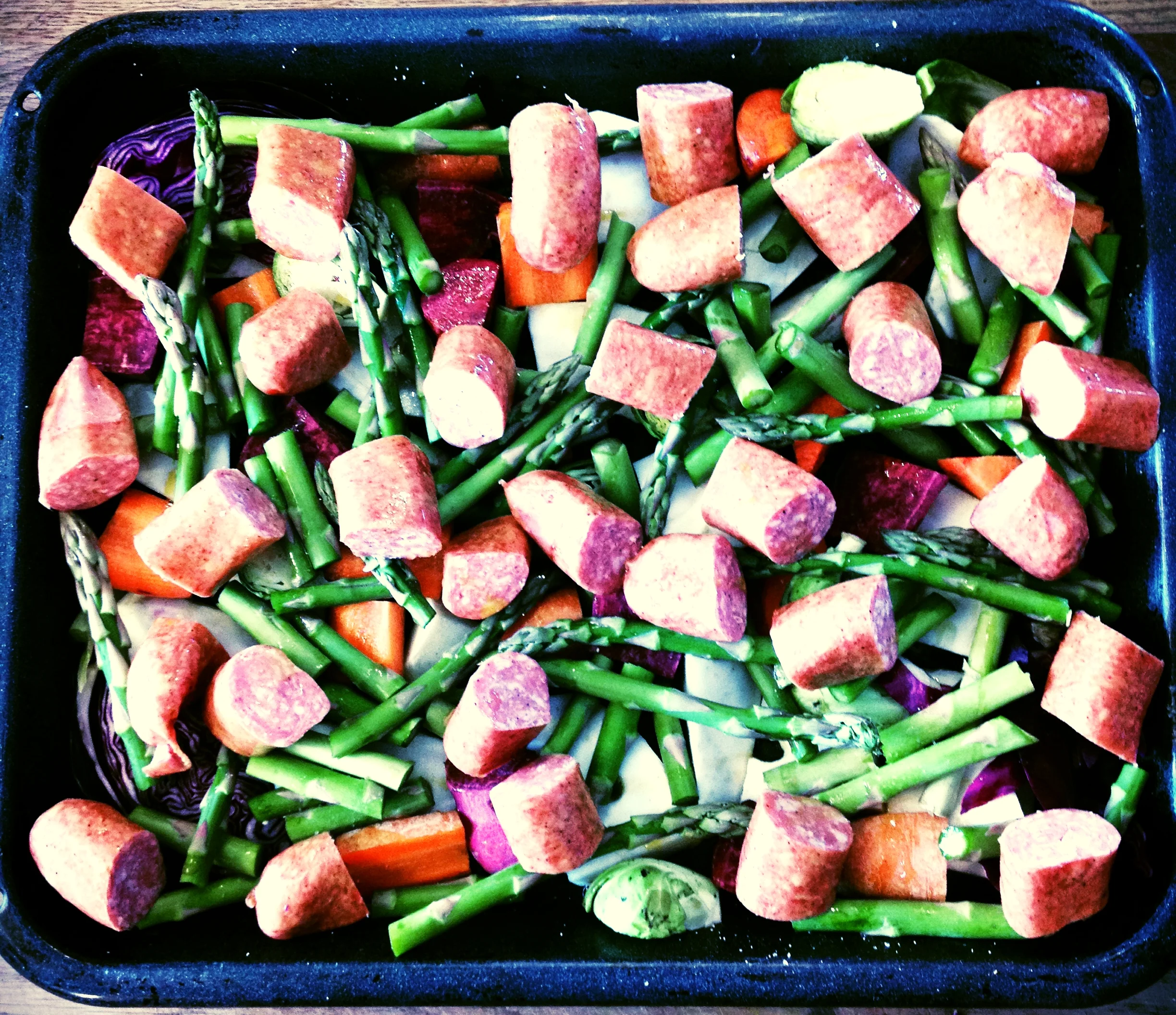
EASY SHEET PAN DINNER
If you have time, turn your oven on to 350F.
If you're in a rush, turn your oven on to 425F.
Slather a roasting pan with a good fat (I love to use bacon fat here, but butter will work or any other fat you have on hand).
Chop the veggies you have in your crisper. I added purple yams here, celery root, carrots, Brussels sprouts, purple cabbage and asparagus. You can also add frozen veggies to the mix. The only limit is your supply and your imagination.
You can add sausage if you like, or chunks of chicken. Chop them into bite size and scatter on top of the veggies.
Drizzle with olive oil (I used a basil flavoured one here from Blue Door Oil + Vinegar)
Sprinkle with salt + pepper, and any herbs if you'd like (rosemary or paprika is good!)
Pop in your oven, if it's at 350F it will take an hour. If it's at 425F, it should take 30 minutes or so.
#JERF
Other easy home-made meals: fry an egg and use it as topper to whatever veggies you got, throw some kimchi on the side for more flavour. Cook some easy veggies in a bit of fat, S+P and finish them by roasting in the oven at 375F. Make your own salad dressing of olive oil + apple cider vinegar, tossed over some shredded veggies like cabbage, green apple, carrots and green onions. Toss some asparagus in melted butter and squeeze some lemon juice over top. Perhaps the easiest and most nutrient dense meal idea: hard boiled eggs with some vegetable sticks. Roast a few chickens at a time, and shred the extras into freezer bags for easy retrieval on those busy weeknights. Toss leftovers together with some stock and maybe a bit of pasta, and flavour with some pesto.
If you're looking for a bit of support as you start easing in to cooking more at home, I urge you to check out Gluten-Free Girl and the Chef, they just recently launched a brilliant service called 'Feeding Our People'. It is a subscription recipe service, where you get one email a week outlining three recipes along with a shopping list. That first recipe is a 'big batch' kind of recipe, it is usually a fairly basic thing (like say, cooking a big batch of beans). The other two recipes show you different ways of using up this batch item you have prepared, making it go for at least three meals. This is a brilliant service, and one that will celebrate cooking simply at home, and making flavourful foods part of your repertoire.
Bon appetit!

MONDAY BASICS: there's a new list in town.
Without fail, I usually share with my clients the list of Dirty Dozen and Clean Fifteen that is put out every year by the folks at the Environmental Working Group. EWG is a non-profit organization that relies on foundations and individuals and a bit of consulting for their income, a group that has been around now for over 23 years. Every year, they put out their latest list of produce that registers the highest pesticide residues (that would be the Dirty Dozen) recommending the reader reach for organic versions of these items when shopping at the grocery store. Simultaneously, the organization puts out the Clean Fifteen list in order to best inform the consumers which produce items register the least amount of pesticides, in order that they may feel confident in purchasing the conventionally-raised items instead. Well kids, they just released their latest version of this list just last week. There's a new list in town.
Without fail, I usually share with my clients the list of Dirty Dozen and Clean Fifteen that is put out every year by the folks at the Environmental Working Group. EWG is a non-profit organization that relies on foundations and individuals and a bit of consulting for their income, a group that has been around now for over 23 years. Every year, they put out their latest list of produce that registers the highest pesticide residues (that would be the Dirty Dozen) recommending the reader reach for organic versions of these items when shopping at the grocery store. Simultaneously, the organization puts out the Clean Fifteen list in order to best inform the consumers which produce items register the least amount of pesticides, in order that they may feel confident in purchasing the conventionally-raised items instead. Well kids, they just released their latest version of this list just last week. There's a new list in town.

This year, for the first time, apples have been booted out of the top spot and strawberries take centre stage as one of the “dirtiest” produce items on the grocery shelves.
How do they figure this out? The folks at EWG analyze results from tests done on more than 35 000 samples of produce items – fruits and veg – samples taken by the U.S. Department of Agriculture (USDA) and the Food and Drug Administration (FDA). They look for what kinds of pesticide residues remain on the fruit after picking, and how much. Strawberries clocked in on average 10 or more different kinds of pesticide residues. The folks at the USDA and FDA assure consumers that the residues that remain on these fruit are acceptable under their guidelines. Doing some research into these residues though, scientists have found that some of these chemicals are known carcinogens.
There is also evidence that pesticides can have a negative impact on our glandular endocrine system. Your endocrine system includes all of your glands that produce hormones; this means your thyroid, adrenals, pituitary, pancreas, and a few more. Just about every function in our body relies on the endocrine system to work optimally: from digestion to metabolism, regulating your cycle to becoming pregnant, regulating your response to stress to getting to sleep, it is imperative we take good care of our inner hormonal system. By reducing the amount of pesticides we ingest, we will be supporting improved function in all organs associated with the Endocrine system.

Our bodies have a lot of toxins to deal with, making our way through the world every day. They come from outside and in, from the air we breathe to the chemicals found on surfaces we touch, and also through the foods we consume. Whether or not we are digesting like a champ also contributes to that toxin load. The foods we eat, the chemicals found within also contribute to this load. And why is this load so important to recognize? Because it's part of what our liver has to handle every day, and clear out.
The liver is always detoxifying, working hard for you. The liver does over 400 jobs in the body; some of its major functions are to regulate hormones, look after metabolism and move toxins out. It cleans the blood, makes bile so we can better break down fats and works intricately with our immune systems too to keep us in tip top shape. You see, your liver loves you. And one of the ways you can love your liver right back is by reducing the amount of toxins it has to deal with.

One of the easiest first steps you can take is to reach for those produce items that are on the Dirty Dozen side of the list, and make sure they're organic ones. Doing so will ensure you are reducing that toxin load already!
And in the interest of keeping things affordable, the good folks at EWG have also provided us with a new list of Clean Fifteen. These are the top fifteen fruits and vegetables that register the lowest amount of pesticide residues on the conventionally grown stuff.
I know what you're going to say: but Luka, they still use pesticides in organic production. I know I know. By choosing organic though, you are drastically reducing the amount of pesticides you could be exposed to and consume. Have you seen this video yet? It's a pretty big eye opener on how quickly things can change with just two weeks of eating organic.

EWG's Dirty Dozen
Strawberries
Apples
Nectarines
Peaches
Celery
Grapes
Cherries
Spinach
Tomatoes
Sweet Bell Peppers
Cherry Tomatoes
Cucumbers
Add to this list their +2 for this year: Hot Peppers and Kale/Collard Greens.
So these are ones you want to reach for organically, when possible. Whether that's 50/50, or 100%, you get to choose. And the choice you make will be the right one for you.

As for the list of Clean Fifteen, these are produce items you can reach for conventionally, comfortable in the notion that the pesticide residues will be fairly low:
Avocado
Sweet Corn (although know that if it is organic, it will not be genetically modified)
Pineapples
Cabbages
Sweet Peas (frozen)
Onions
Asparagus
Mangoes
Papayas (but choose organic to rule out GMO produced stock)
Kiwi
Eggplant
Honeydew Melon
Grapefruit
Cantaloupe
Cauliflower
Because I am not a fan of being alarmist, know this: all of the pesticide residues that are found in foods are below the safe levels as outlined by the US Environmental Protection Agency.
So think of this as a good-better-best scenario.
It's really good to eat loads of fruits and veg. For so many obvious reasons. A diet loaded with these good foods leads to better health and is associated with longer lives.
It's better to reach for organically grown produce items for those dirtiest of the dozen, sticking to conventional for the Clean Fifteen.
And it's best for folks to reach for organic as much as possible in order to reduce the toxin load on the liver, especially for friends whose livers are working extra hard right now.
Now go play with your food.

And maybe plant a garden.

MONDAY BASICS: sleep like a champ.
This week's topic is one that can get overlooked, one that can often fall to the back burner, and one that I am certainly extra guilty on not putting first on my list. Or on top of the list. Or on my list at all some days. Tsk tsk tsk.
This week's topic is one that can get overlooked, one that can often fall to the back burner, and one that I am certainly extra guilty on not putting first on my list. Or on top of the list. Or on my list at all some days. Tsk tsk tsk.

We all know that sleep is good for us. Consistent and regular sleep allows our bodies to do that repairing and restoring work, so imperative to maintaining our organs and bodily systems in good working order. You don't have to look hard to find evidence linking not enough sleep to some pretty serious health issues like diabetes, heart disease and excess weight gain. Sleep is a daily necessity, a time where our bodies do the repair work needed in our endocrine systems, immune system, digestive and nervous systems, musculoskeletal and just about every system there is. A good night's sleep will help us balance moods better, will enhance our memory function and helps your body better manage the stress response. Rest and digest is one of the most important functions our bodies do in order to recoup from stressful situations, inflammatory things going on and any repair work that needs to happen in order for our engines to run clean.

When you don't sleep enough at night, your body doesn't get that proper resting time to do the reparative work from inflammatory things that may have happened during the day. Count in these inflammatory things our body's response to stress in our environment, whether it's real or perceived. When we don't sleep long enough to get that reparative work done, we are further impacting our body's total load, and contributing further to that chronic low grade inflammation going on. With this low grade inflammation, think chronic slow-moving diseases like obesity and weight gain, diabetes, cardiovascular disease, mental health issues like depression and the list goes on. We need our sleep for our adrenals to replenish, having spent the day handling a few saber tooth tigers. We need our sleep in order to allow our bodies to do that repair work from inflammatory processes in the body. We need sleep, good sleep in order to best support our bodies to repair things from the day that just happened, and also so we can get through the next day as well.

A few simple ideas you can easily implement in order to ensure a more restful and rejuvenating sleep
First things first. If you're able to, refrain from bringing your cell phone into your bedroom at night. Search for an old school alarm clock if you're able to. The EMF waves that are coming and going from your phone have been shown to have a disruptive effect on our sleep patterns. This means it's harder for our bodies to sleep deeply. How to prevent that? Nix the cell phone, keep it in the kitchen for the night!
If you absolutely can't do without your cell phone, put it on airplane mode. That cancels the phone's ability to receive and send signals, thus reducing the EMF waves and ensuring a better and deeper sleep, so that reparative work can happen.
Further to this, you may also want to put a timer on your wireless internet router. Same thing! EMF waves can disrupt your sleep patterns; slapping a timer on that box in the basement means these waves will no longer be keeping you from getting your beauty sleep. A bonus here too: if it's set for a reasonable hour every night, and if you're like me, you'll be too lazy to go to the basement to turn it back on, and so you should be getting to bed at a reasonable hour then. Right?

On the subject of screens, turn off your electronics one to two hours before going to bed. The blue light emitted from our screens prevents the proper cascade of hormones necessary to start shutting down our bodies for sleepy time bye bye. This essential hormone to good sleep habits is called melatonin, and computer and phone screens' blue light prevents it from working properly in individuals. Ditch the screens and reach for a good book, or a dimly lit room in good conversation with a loved one. Indulge in good radio! This could be a good time to start a meditative practice too.
To keep that good melatonin production, invest in some good blackout curtains, in order to keep your room darker longer in the evenings, or keep the early morning rays come June from waking you up at 4.30am. You can also treat yourself to one of those fancy eye masks too, if you're looking to really block out all light. And look fancy doing it.
Another helpful tip is to look to include more magnesium in your diet. Magnesium is the calming mineral. As calcium helps our muscles and nerves tense, so magnesium helps them to relax. If you're aiming to get more through food, reach for those leafy greens, add nuts and seeds to your daily regimen, indulge in the dark chocolate (although earlier in the day). You can also opt to take a magnesium supplement; there are a few to try out there, and different formulations work differently for people. Talk to someone at your favourite local health food store to help determine which one would be best suited for you.

Prioritize sleep!
Get into a routine. Your body will come 'round. If you're running on 6 hours a night, aim for 7. If you think you're ok with 7, give yourself an extra half hour for a few days to see how that makes you feel. On average, adults require 7-9 hours of good uninterrupted sleep a night in order to get that reparative work underway. Make some time for good sleep! If it means you get yourself some fancy red onesies, I promise it will be worth it. Your immune system, your adrenals and your brain called: they said they're up for trying this if you are.
If you're looking for further reading on the importance of sleep, and further tips to make your sleep count, make your way to Mark's Daily Apple blog for some good tips.
MONDAY BASICS: soak seeds for smoothies
This post is for those early birds who are regular consumers of smoothies come morning time. This next in the series of #mondayhealthbasics goes over some basic easy steps you can take in order to make that smoothie really count and nourish you from head to toe. Today's tip will ensure you are better able to digest your morning elixir, and what kinds of things to add in order to make that breakfast smoothie sustain you for longer periods.
This post is for those early birds who are regular consumers of smoothies come morning time. This next in the series of #mondayhealthbasics goes over some basic easy steps you can take in order to make that smoothie really count and nourish you from head to toe. Today's tip will ensure you are better able to digest your morning elixir, and what kinds of things you can add in order to make that breakfast smoothie sustain you for longer periods.
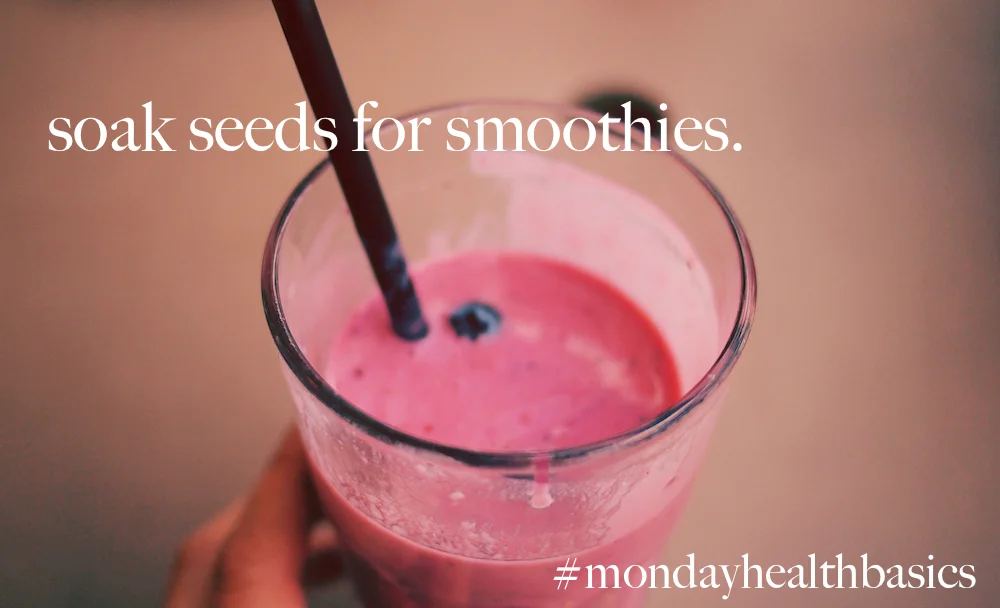
Smoothies come in all shapes and sizes, and the only thing between you and the flavours to wake your taste buds is your imagination. Some folks go for a non-dairy milk as the base: think coconut milk, or flax seed milk, almond milk or coconut yogurt. Others go for the full on dairy, from straight up milk to yogurt to kefir. (I do love me some creme fraiche for my quick smoothies.)
I'm going to offer an alternative to you today:
seeds and nuts as your smoothie base.
Why seeds and nuts, and not their milks you ask? For one, the packaged dairy-alternative milks you find sometimes list carrageenan in their ingredients. For a good primer on just what is this additive we often see listed on the label, check this post. (For folks who may have some digestive issues, this is one of those food additives that may be contributing to irritation and inflammation in the gut.) So omitting it might be a good idea, if you're looking to bring down inflammation in your body. (Have you heard me go on about inflammation yet? Inflammation is really at the root of just about every chronic degenerative disease out there. Find out more about inflammation and how to tame that beast at a talk coming up this Sunday the 10th!)
In order to eradicate this additive from my diet, I just make my own nut and seed milks. But sometimes, I don't know about you, but there is only so much time in the day.
Enter: THE INSTA-BREAKFAST.
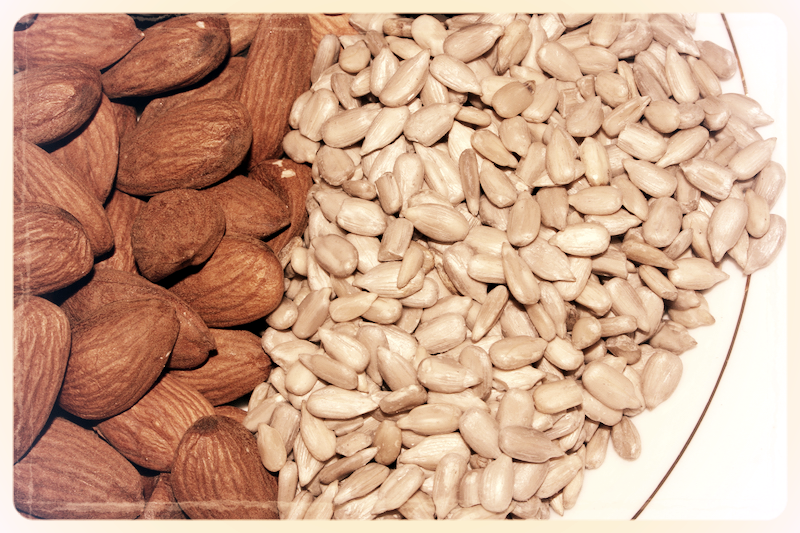
Well, kind of insta-. As insta- as it gets in this house. This is inspired by a recipe from Dr. Carolee Bateson-Koch's book Allergies: Disease in Disguise and serves as a powerhouse of anti-inflammatory fats, good source of minerals like calcium and magnesium. Adding these nuts and seeds to your morning smoothie will also provide your body with satiating protein and fat, helping you go the distance.
But we aren't talking just throwing in some nuts and seeds to the blender when you think of it. No. We're allowing these nuts and seeds to hang out soaking in water overnight before blitzing them into breakfast delicious.
Why pre-soak these nuggets? See, it's all about de-activating the phytic acid and enzyme inhibitors in the nuts and seeds. Enzyme inhibitors and phytic acid are Mother Nature's way to ensure survival, but not for you; rather for the seed making its way through your digestive system. These two compounds are in all nuts and seeds and grains that will one day, make it into a whole plant form.

Imagine a fox. Little foxy is meandering through a field of oats. She takes a nibble from one of the plants and feasts on some oat seeds. She feels good, she feels satiated, so she lies down for a nap. But these seeds she ate? They were full of phytic acid (the plant's way of storing phosphorus) and enzyme inhibitors. As they make their way through the fox' digestive tract, the enzyme inhibitors turn off little foxy's enzymes, which means now she can't break down the seed and thus won't get the nutrients in the seed. (This is all done in order that all of the nutrients and minerals held within the seed/nut/grain can remain in the seed.)
While this non-digested seed winds its way through the fox' gut, the phytic acid also pulls out minerals from her stores, depleting her of important trace minerals necessary to bone building, enzyme production, metabolism, detoxification, I mean the list goes on. When this little undigested morsel of oat seed exits her digestive tract via her stool, that seed (fully intact!) will now be ready to grow into a plant. As it makes its way through her digestive system by "soaking" in the fox' digestive juices, this process deactivates the phytic acid and signals to the seed that it's time to grow. But it's only with time that this deactivation happens. You need a minimum of six hours. (Anybody ever heard of soaking their pea seeds the day before planting? It's the same thing.) Good work, seed!
Sorry little foxy. You were robbed.
How to get around this you ask? We must fool Mother Nature. NO WAIT. We must work with Mother Nature. We need to mimic what she's come up with. This means soaking your nuts/seeds/grains BEFORE you eat them so as to ensure you turn off those enzyme inhibitors found in the seeds. They will no longer be able to prevent you from getting the nutrients found within. Additionally, by properly preparing your nuts and seeds before consuming, you will retain those important trace minerals the phytic acid would have pulled out of you on its way through your system because that compound is turned off.
Sure, sometimes I prepare big batches of nuts and seeds and then store them in freezer bags once they are dehydrated. But I just can't be that far ahead of the eight ball most days.
So here is my shortcut, for the person who'd rather do a small batch for their next morning's breakfast. This one will make two tall glasses of the good stuff.
THE PLAYERS
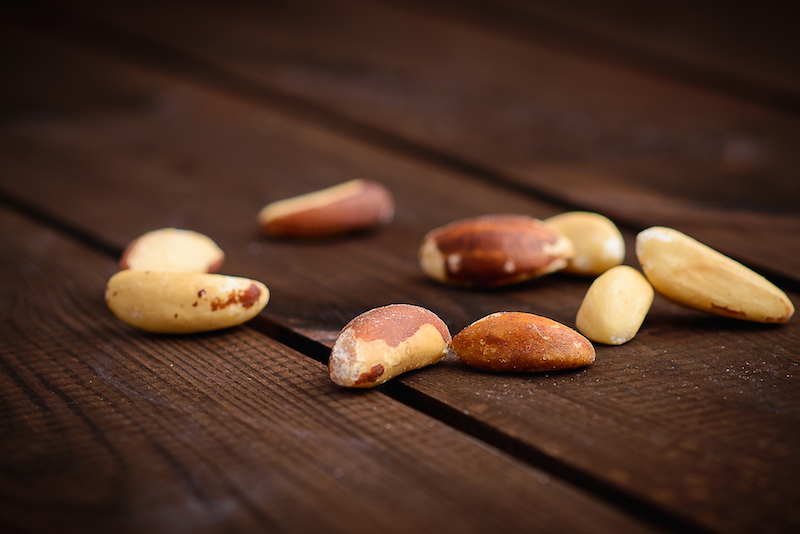
3/8 cup of nuts and seeds, combined (I love pumpkin seeds, sesame for the calcium, flax and brazil nuts but you can use whatever you have on hand)
3/4 cup of filtered water
THE HOW-TO
The morning before you plan to have this smoothie, measure your nuts/seeds mixture into the filtered water, cover and let sit on the counter for 24 hours, until tomorrow's breakfast. For added benefit, I'd add a tbsp of a ferment like kombucha or water kefir, or some whey from yogurt or kefir in my fridge. (Say goodbye, phytic acid! Sayonara, enzyme inhibitors!)
The next morning, blitz this mixture in your blender along with an additional cup of filtered water. You will be consuming the whole seed! No milking required!
You can add whatever you usually add to your smoothies at this point. I usually include about a cup and a half of frozen mixed berries, sometimes a banana, a little bit of maple syrup and voila. Down the hatch. Delicieux.
Of course you could add some swiss chard for the super-greens kind of effect (less of a negative impact on your thyroid than kale ), or an apple for extra fibre. I always make sure I have some good fats in my smoothie, in order to help slow down the absorption of sugars into my bloodstream and help carry me and satiate for longer periods. For me, this usually means creme fraiche, but you could add some coconut butter or coconut oil, or good old butter if you'd like.
Baby steps, my friend. Baby steps.
Soak those seeds for your smoothies. Love your guts. And bones. And liver. And heart. And brain. And every other sweet part of your body is attached to that gut.