

THURSDAY BASICS: reduce the packaged goods.
This whole series is about touching on some keystones that are important in reducing inflammation, and are key contributors to reducing your body's toxin load. All of these posts have been aimed at supporting gut health; loving your guts has a tendency to reverberate outwards, to all other systems in the body. Today, we're exploring why you may want to work on reducing the packaged goods in your pantry, and how to go about it.
Another Thursday, another revisit to the now-rejigged Monday Health Basics from 2016.
This is perhaps one of the biggest needle movers you can introduce. Read on to understand the method behind the madness here, and why it doesn’t have to mean you will be permanently stuck to the kitchen. Read on for some good inspo on the topic.
This week’s topic: REDUCE YOUR RELIANCE ON THE PACKAGED GOODS
COLES’ NOTES:
1. Start slowly, one meal a week if this is brand new to you.
2. When buying packaged foods, check your labels and choose one that lists more real food ingredients, and forego the one that has words you can’t pronounce.
3. A few more tips to make it manageable - keep it simple, meal plan, batch prep, and do your best! Then get on with it.
This is all part of PLAYING WITH YOUR FOOD. I will forever advocate for this method to the madness.
This whole series is about touching on some keystones that are important in reducing inflammation, and are key contributors to reducing your body's toxin load. All of these posts have been aimed at reducing inflammation, nourishing resiliency and so also supporting gut health; loving your guts has a tendency to reverberate outwards, to all other systems in the body.
Today's post is a simple idea, but a big needle mover. We've touched a bit on this concept on the post aimed at J.E.R.F. But today, we're exploring why you may want to work on reducing the packaged goods in your pantry, and how to go about it.

This post is inspired by a short presentation I led a few years ago with a group of young girls aged 8 to 10. There were four groups, and each group's task was to come up with a list of ingredients that they would use to make a specific food item at home.
One group had chocolate chip cookies, another mashed potatoes, one group worked on homemade mac and cheese and a fourth had to come up with the list of ingredients for a homemade chicken noodle soup.
They weren't allowed to rely on anything coming from a box, all of their recipes had to come from the idea of 'from scratch'. The girls all understood the exercise, and had fun coming up with the list of tasty things they could add to make a delicious version of their item. Butter chicken and veggies version of mac and cheese? Yea I'd like that. Homemade meat stock and the how-to, before even making the soup? Oh how I love these kids.
It was great to see how they easily came up with those ingredients that belong in their kind of dish or dessert. I then broke out packaged boxes of those items that were on sale at the local grocery store that day. There were name brands in there, and store brand versions as well.
Next, I invited one girl from each group to read the list of ingredients that went in to the making of these items. They were perplexed at some of those items listed, and wondered what it was their purpose was in the final recipe. I didn't point out what ingredient does what, nor did I want to scare them into thinking that these chemicals with hard to read names were nefarious for them; I just wanted to emphasize the idea that in order for something to come to us in such a pre-packaged state that requires we only add water and stir, it takes a lot more ingredients, ones we don't even know what they are. (Mechanically separated chicken? Mmm. Sign me up. Blerg.)
And then we went on to introduce the idea of balance to this scenario. I didn't want them to fear any foods they may be served in their own homes after our little exercise; I wanted them to be aware and just to start asking questions of their own, and maybe start to develop an interest in making their own homemade versions of cookies or mac and cheese at home. They certainly all seemed to know what types of ingredients it would take.
Why it's important to reduce your reliance on packaged foods
The idea for today's article centres around reducing the amount of irritants to your digestive tract and to your system. It's all about the gut love.
Packaged foods are foods that are chemically produced in a factory. I get that some may think that cookies, if made at home, are made from processed food ingredients. Sure, I'll give you this one: it takes a certain amount of processing to convert grain into ground up flour.
What I am talking about today though, is those ingredients listed on your package that aren't things we have typically consumed in human history except for the last 20 or 30 years. I am specifically talking about additives, preservatives, other chemicals added to the final product in order to mimic the flavours and textures of the real thing, homemade.
Some of these ingredients we are talking about are known to be irritating to the gut lining: things like carrageenan have been studied with animals, and links have been made to inflammation in the gut with consumption of this food-grade seaweed extract. (It comes from food, isn't that enough evidence? Not necessarily. Not in these amounts.)

My number one reason I'd steer away from packaged foods and look to reduce it in our meals at home is because these foods are where manufacturers add in extra sugar to the product, sweetened with sugar and other ingredients that are, for all intents and purposes, more sugar. (High fructose corn syrup, glucose/fructose, etc.) Adding sugar to their product makes it tastes delicious!
We are hard wired to love the taste of sweet.
From an evolutionary aspect, this makes so much sense: before the advent of grocery stores and convenience foods, the sweet taste of a fruit or vegetable was our signal that the plant food at hand was at its peak freshness. When something is at peak freshness, that sweet taste signals to our bodies that it is at its most nutrient dense peak. Eating an under-ripe tomato? Not sweet. Not so much Vitamin C, either. But the sweetest, juiciest, still sun-warmed tomato that is a deep deep orangey red colour? So much Vitamin C. Factoring in evolution, those people who developed a sweet tooth were also better able to choose foods based on that delicious flavour, meaning they had a higher intake of those all important antioxidants that are late to develop on the fruit on the vine. Higher antioxidants meant good fuel to ensure those people lived longer and better lives, and were better able to reproduce and guarantee progeny, therefore survival of the species. Good work body.
But somehow, things went awry along the way. Food scientists figured this piece out, and realized that if they filled their packaged products with sugar, people would love the taste, and come back for more, ensuring consistent sales of their products. That meant the scientists had jobs. (I'm going all conspiracy on you on this one, I know. Stick with me.) But truly, it meant the business would be around, guaranteeing their customer base would stick around and keep them alive. The people behind these food manufacturing companies have figured out the sugar bit, and have tweaked it to the point of understanding how much sugar it takes in a final product to create a dependency on the product. Good work companies. Sorry people who will be eating now more sugar than we were ever meant to handle. (We'd better evolve, and FAST.)
THE INFLAMMATORY LOOP
Why am I not a fan of added sugar? These refined white substances and super processed corn- or other starch- based syrups contribute to blood sugar imbalances, which further feeds the inflammation loop. Yes yes yes: sugars contribute to inflammation. Which is at the root of just about every chronic disease out there.
How do you work to reduce your chances of developing inflammation? Look to reduce your consumption of refined sugars. Check your labels: even your tomato soup may be hiding some sugar! I was quite taken aback when I found it listed on my favourite tetra pack of emergency soup for weeknight suppers. (I still rely on it from time to time, but aim to have more homemade soups now in order to work towards balance.)

With the girls, I pulled out a few different packaged foods and noted how many grams of sugar were in each serving, and had them figure out how many servings there were in the whole package by just reading the Nutrition Facts label on the back of the box. I set my little digital scale up, and had the girls count how many sugar cubes it took to weigh out the amount of sugars listed on the label for each item.
They were quite taken aback at how much sugar was in a little juice box, even though there was no sugar listed on the label! They couldn't believe that sugar was added to tomato soup. What was it even doing in the mix?
And why did they need to add so many cubes of sugar to a can of soda? Could you even drink a glass of water or a cup of tea with that much sugar dissolved in it? It was great to witness their discovery, and the questions that came up afterwards. I expect a few questioning emails from parents any day... (sorry gang! It was in the name of good food and good health, I promise you!)
BUT IS IT EVEN FOOD?
My other beef when it comes to packaged and refined foods is that when you read that list of ingredients, there are a whole lot of artificial ones in the mix. These ingredients are things made up in a lab, created to help develop the flavour or mouth-feel of the product, make it seem closer to the real thing. These chemicals are not foods as recognized by our digestive tract necessarily; they too can contribute to our liver's toxin load, that work it has to do to move stuff out. (Read up on this article to remember what that toxin load is, and how important it is we look after moving that stuff out.)
These chemicals may be there acting as preservatives, or they could contribute to the colour, or the flavour profile. They may also help develop the texture in order to try to mimic the real thing. (When was something meant to mimic ever as good as the real thing?)
Not only that, but some words like 'artificial flavour' or 'artificial colour' are industry labels that mean 'a proprietary blend that we are legally bound to keep secret so that no one copies what it is we are making'. Who knows how many more chemicals are making up a part of that 'artificial colour'. To be clear, all of these chemicals do have to pass rigorous testing in the food industry; they all have to be deemed 'safe' by the Canadian Food & Drugs Act & Regulations division of Health Canada. But when it comes to choosing our foods, I tend to err on the side of what types of foods people have been eating for centuries including my ancestors, as opposed to relying on a recipe dreamed up in a chemistry lab meant to mimic the real thing.
THE FAT OF THE MATTER
My other beef with processed foods is their use of hydrogenated vegetable oils and soybean oil. These types of oils are contributing to our body's inflammation by throwing the balance between omega 6s and omega 3s right off. Ergo, processed foods can exacerbate any kind of inflammation already going on! I invite you to read this earlier post on what fats are the good kinds, and why certain fats should be avoided.
These processed foods are typically also quite low in nutrients when you compare them to the real version. Manufacturers need to make a living, and so they tend to use cheaper ingredients in order to turn a profit. Don't we all need to turn a profit? I get it.
But at the expense of my health and that of my family's? I choose no.
Cheaper ingredients may have relied on the use of glyphosate in their growing season; glyphosate is a chemical that show evidence of disrupting the gut bacteria. It is this gut bacteria we want to keep happy, as they are key players in keep inflammation at bay and supporting healthy digestion.

The packaging used in these processed foods are also contributing to the picture here. There are endocrine disruptors in the plastics and in the lining to cans that we come across in our day to day life; this means they mess with your hormones, negatively impacting many of our bodily processes. All processed foods come in some sort of packaging; the ingredients found in those foods can pull some of those chemical compounds out of the packaging and into the foods we the consume. Choosing to eat real food instead will drastically reduce those harmful effects from the possible endocrine disruptors. Opt to purchase anything tomato-based or with any fat content from a glass jar: a much safe non-BPA and non-BPS bet.
Your secret to improved health then?
Reducing your reliance on processed foods, and doing so gradually (in order to make it do-able!). Cook from scratch. Eat more simply. Meal planning can help. Choosing a box of prepared food whose list of ingredients is much shorter than that found on the other box on the shelf next door. Read your labels!
Do a bit of digging to find a product that lists a pretty clean list of ingredients, like this Calgary-based manufacturer of delicious Butter Chicken and other curry sauces. These are often on our menu for those busy weeks; and they're delicious!
Check out your grocery stores and health food stores that take a special interest in stocking their shelves with local specialty items, or those shops who look to facilitate your success in the kitchen with health first and foremost. I saw some harissa sauces in glass jars with a pretty clean list of ingredients at the grocery store last week: you can bet your bottom dollar I'll be dreaming these up into recipes in my future instagram posts!
Here's a round up of ideas I pulled together for you to get you started:
use soaked seeds and nuts as protein in your smoothies instead of a protein powder
do one batch cook item a week for the meals at hand for the coming week
make your own curry pastes! So easy! So delicious! So much more flavour!
make your own electrolyte drinks! Ditch the funky coloured super sugary drinks
great link here to use homemade mayo and ghee as a base for low carb sauces
make your own meat stock or bone broth for nutrient density!
look here for a compendium on harvesting ideas I culled in 2015 (good ideas here on lots of things)
Keep it real my friend, and keep it do-able.
Knowledge is power; read your labels, and opt for those packages that are lower in chemicals. If your body is working extra hard on health things, know that providing it with more nutrient dense foods and reducing the toxins found in packaged foods may be of benefit to you at this time. Most of all, please do play with your food.
THURSDAY BASICS: Practice Mindfulness Before a Meal
This week's blog post is about engaging in mindfulness when sitting down to a meal, big or small. See, the digestive process is a pretty work-heavy job your body has to do. It takes a lot of steam! As part of the series of chemical processes and reactions that go on in your body in order to best prepare you for the nourishment that is about to be served, your body goes into 'rest and digest' mode. This requires your Parasympathetic Nervous System (PNS) to turn ON. (The opposite, aka 'fight or flight' requires the autonomous nervous system (ANS). This is not the system you want turned on when supper is being served. Read on to understand why.)
Kittens. It’s dive into the vault day to pull out a blog post from that ole series Monday Health Basics from back in 2016, but reworked.
If you’re new to this re-posting of ideas, THEN YOU’RE IN LUCK! This is the perfect place to start. Because Digestion is E V E R Y T H I N G . . .
This week’s topic: Mindfulness at Mealtimes
COLES’ NOTES:
1. Important to turn on ‘rest + digest’ mode in order to optimize digestion.
2. Keep chaos at bay come mealtimes.
3. Few other people-things to help make sure you digest like a CHAMP!
All in the name of supporting your ever lovin gorgeous bod, dear one. Go de-chaos-ify mealtimes, will ya? (That sounds more complicated than it is, trust me.)
In this weekly Monday/Thursday Health Basics series, we take a look at some simple tasks you can implement into your regular routine in order to best support optimal health. I post a reworked short write up every Thursday, and the topics vary from nutritional things, with lifestyle ideas and information as well as resources to help you on your wellness journey.
This week's blog post is about engaging in mindfulness when sitting down to a meal, big or small. See, the digestive process is a pretty work-heavy job your body has to do. It takes a lot of steam! As part of the series of chemical processes and reactions that go on in your body in order to best prepare you for the nourishment that is about to be served, your body goes into 'rest and digest' mode. This requires your Parasympathetic Nervous System (PNS) to turn ON. (The opposite, aka 'fight or flight' requires the autonomous nervous system (ANS). This is not the system you want turned on when supper is being served. Read on to understand why.)

That fight or flight kind of mode your body goes in is the kind that allows you to run like the dickens in order to escape that saber toothed tiger; the hyper-alert mode your brain goes into when you see those flashing lights in the rearview mirror. That's a stress reaction. This kind of reaction actually shuts down the PNS in order to concentrate on getting away as quickly as possible. So stress = digestion turned off!
The kind of mode we're looking for here in order to best support your body's task of digesting, is that Rn'D mode, Rest and Digest, the polar opposite. When the PNS is activated, there are some pretty wonderful things that happen: digestion and breakdown of foods into nutrients takes precedence. Your body also goes into detox mode, does some re-building of tissues, and your immune system does some really important stuff in this mode. If your adrenals have had a bit of a rough ride that day, this is the time where they just slow down enough to do that rebuilding work that needs to happen for the next time a stressful event shows up unannounced.
In order to turn the PNS on, one needs to be feeling calm, cool and collected. Chill. At peace. Bliss. Doesn't matter what you call it, you need to be in a good space in order for that system to be activated so that you can best digest the meal in front of you.
Contrary to your body's reaction when that fight or flight mode gets activated, this kind of state takes a bit to get in to. Simply put, you need to relax. And sit in that quiet moment. Doing so will ensure your PNS is fully engaged so that you can take that time needed to properly digest, break down and assimilate the nutrients found on your plate before you.
Here are some ideas to help rev up your digestion, engage in mindfulness in order to turn the PNS 'ON' during meal times:
keep chaos at bay during mealtimes (chaos brings on a stress reaction, which will shut your PNS to OFF)
share a meal with loved ones, as it has been shown to help bring stress levels down
eat without distractions (the 'ping' of an email notification on your phone can also bring on a stress; if your brain is focusing on a book or television show, your PNS will not be in full working order)
don't eat lunch at your desk (distractions! shiny things! check Facebook! ugh. Turn off PNS.)
find a quiet table for your meal, and share with a coworker
if you're able to and the weather permits, think of having your meal outside
as you sit at the table about to enjoy a meal, take a moment to use all of your senses except that of taste, and notice 5 things around you (the smell of the meal? the light on the table? the birds in the back yard? the sound of a car on the road outside?)
say a quick word of thanks or a verse before tucking in to your meal; doing so over the course of time will train your body to turn the PNS 'on' as it will be anticipating the meal
pay attention to the meal you are consuming, explore the flavours and textures in order to keep that PNS 'on'
for some people, it helps to put their cutlery down on the table in between bites in order to slow down on the meal
if you are sharing your meal with a loved one, remain at the table a little bit longer and engage in friendly conversation; this will keep that PNS going for improved digestion

Have a great week, lovely peeps!
THURSDAY BASICS: flavour your water.
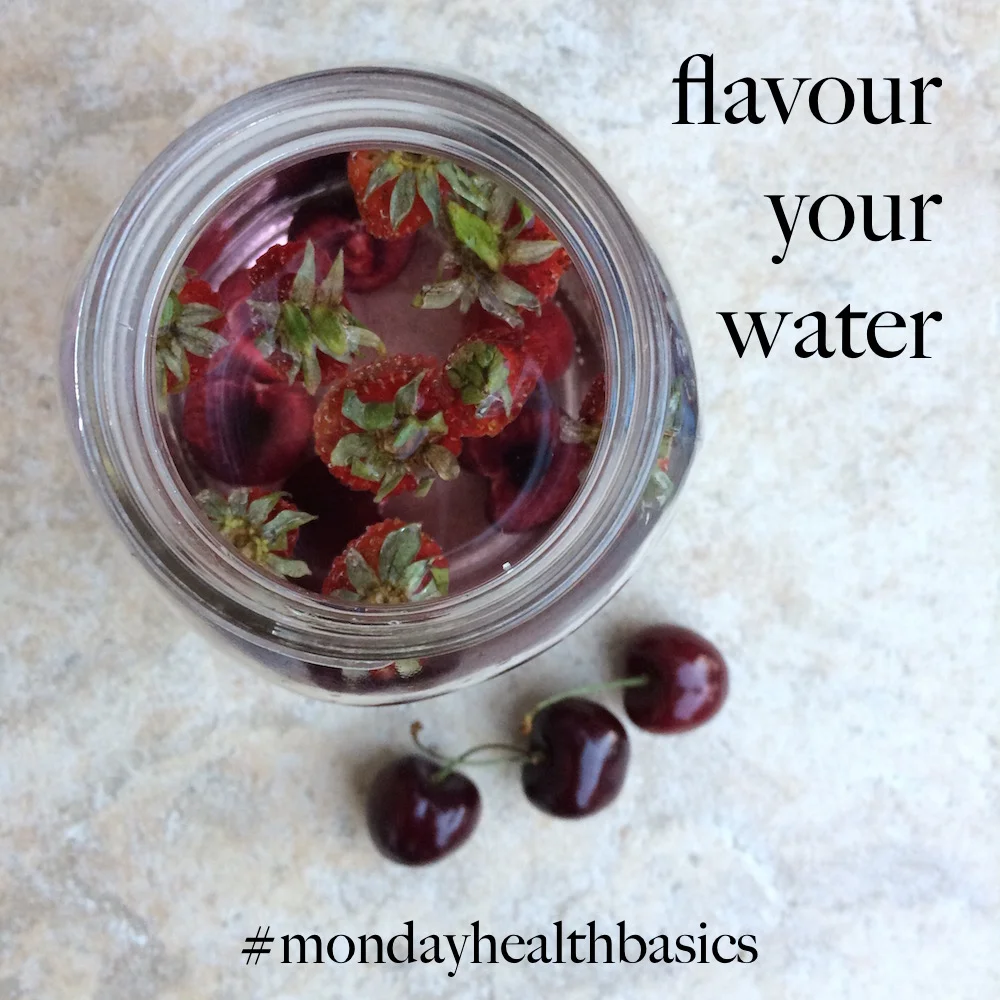
Water is just all-round good for you. But sometimes plain water just doesn't cut it. Today's #mondayhealthbasics post explores good alternatives to plain-jane-water in order to wake up those tastebuds and inspire you to guzzle the good stuff. Your liver + detox work in the body called and asked for the delicious help, see.
Kittens. It’s dive into the vault day to pull out a blog post from that ole series Monday Health Basics. Following last week’s post on water, I wanted to offer you another idea on keeping things delicious while working on hydration!
This post was originally dreamed up in the heat of summer. Consider this my intention-setting to bring back the heat and usher in Lady Spring. I know, I know. I’ve lived in Southern Alberta for almost 20 years now. I know Spring is a wisp of an idea, but a girl can dream, right?
This week’s topic: FLAVOUR THAT WATER!
COLES’ NOTES:
1. This is a roundabout way to get you to ditch the high sugar drinks and hydrate with some delicious sugar-free flavours. A method to the madness!
2. Keep the tops of your strawberries and cucumber ends to make for delicious flavoured water!
3. Look for other ideas like The Sun Infuser, The Watermelon Quencher or The Ice Cube Method for those who, like me, need all the help they can get.
All in the name of supporting your ever lovin gorgeous bod, dear one. Drink up.
The heat is coming back to the prairies this week. I'm sure it's close to cranking up where you are at as well, dear friend. When the thermostat starts going up, it's time to increase the water intake, mon amie. This is to replenish those fluids lost in sweating, in order to keep our temperature in the safe zone.
Never mind the heatwave, water is just all-round good for you. But sometimes plain water just doesn't cut it. Today's #mondayhealthbasics post explores good alternatives to plain-jane-water in order to wake up those tastebuds and inspire you to guzzle the good stuff.
First and foremost, let's be clear: water is so very good for you. My very first #mondayhealthbasics post touched on the importance of consuming water in your day, talking about the timing of your intake as well. You can find MHB post #1 right here. (Key point: stop drinking 30 minutes before a meal, try to reduce your water consumption in meals to none at all, and wait one hour afterwards to resume your drinking.)
It should also be noted that reaching for filtered water or spring water will be of benefit to you, as opposed to tap water. Find that MHB post here.
The third time we explored the importance of water, it was in the spirit of supporting your liver and detox function. Find that nugget here.
For this fourth time talking about this most integral component of our body's functioning, necessitating its daily consumption, we're going to look at easier ways to get that stuff down the gullet.
I personally love water, but I do find aiming to consume two litres per day can sometimes feel like a bit of a chore. Spiffing up the flavours of the water encourages my daughter to reach for a beverage more often. ... OK truth be told, not just her. Let's go over some ideas then, to get you started. I look forward to hearing the flavour combos you will dream up!
Stretching The Strawberries
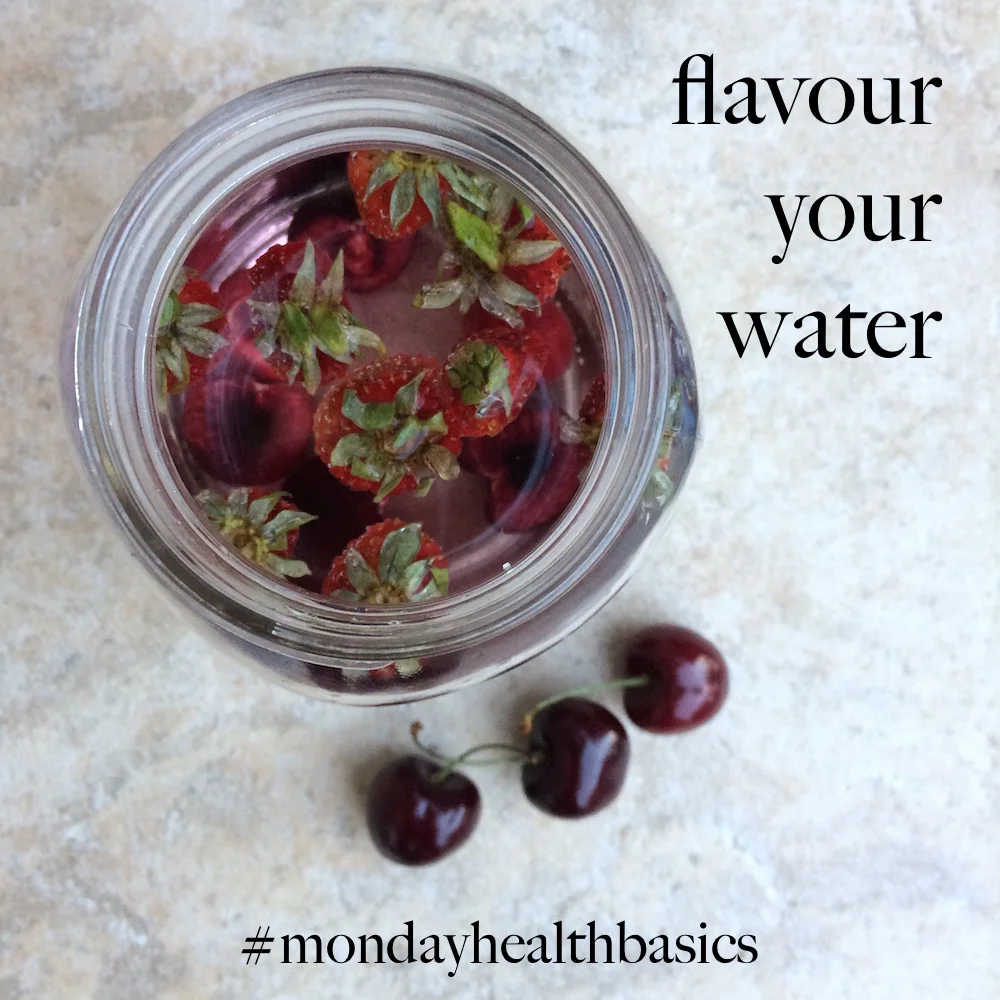
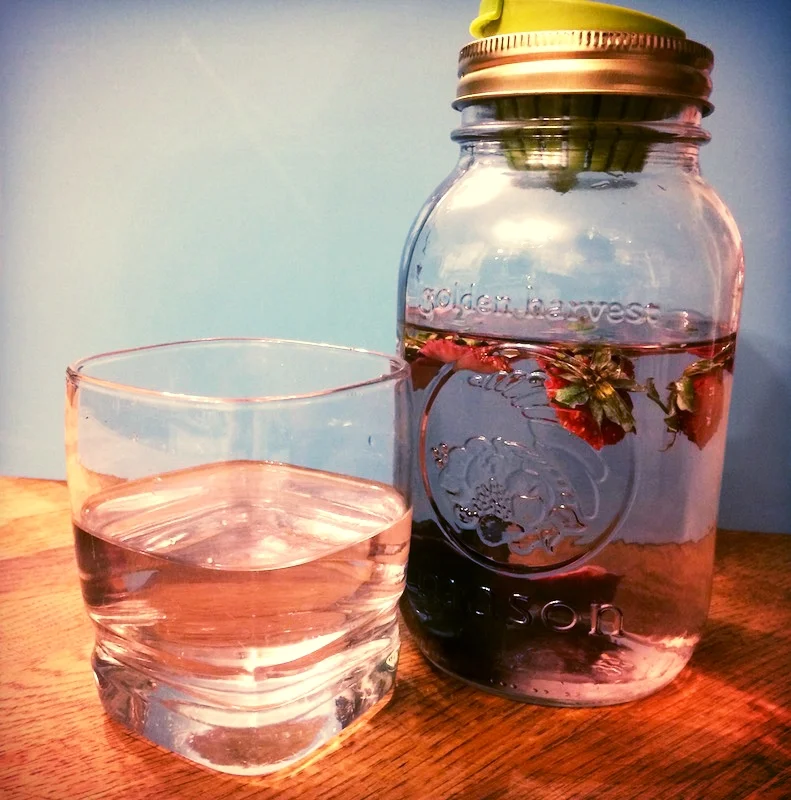
Berry season is soon upon us, and who doesn't love gorging on these delicious fruit when they are at their peak? I am a frugal one, and so this is how I like to stretch this abundant season, using up every morsel: after I wash the berries and before consuming them, one needs to trim the tops off, yes? I simply pop those in a jar, and top up with filtered water and tuck the jar in the fridge. Next day, yummy strawberry-flavoured water awaits.
You can also add other fruits or herbs to the mix here, fresh or dried. Imagine strawberry and basil, wouldn't that be yum? You can toss in a few chopped cherries to the mix too, a pinker hue shall ensue.


Minty Cuke Refresher
This combo is perhaps one of the most popular ways of adding zing to your plain-jane-water. Simply toss a few leaves of mint at the bottom of your jar, up to 1/4 cup if you are going for a full litre of water. Using the back of a wooden spoon or a proper muddler, bruise the leaves in order to release those volatile oils; this is the trick to really enhancing the flavour. Add in half a cucumber cut into rounds, and fill up the brim with filtered water and again, tuck in the fridge overnight. Tomorrow morning's water will have everyone at the office jealous of your tastebuds.
I grow a few different kinds of mint every year for just this purpose. It isn't too late to add a pot to the deck, and pick up a few interesting flavours of mints at your favourite local garden centre. This year, I planted Pineapple Mint, Chocolate Mint and Orange Mint. Yum!
Liver Loving Lemon + Citrus Delish
It may seem tried and true, but it's a stalwart for a reason: lemon is probably one of the most refreshing flavours out there. Double bonus, you get to take in some additional vitamin C whenever you add citrus to your drinking water! Lemon is a great liver-lover, helping you detoxify as the day goes on. (Remember that MHB post?) A good rule of thumb is to aim for about half a lemon per litre of water. You can juice it yourself, or slice the fruit up into quarter or rounds.
If you want to try something new, add some lime slices to your beverage. Or switch it up and toss in a few rounds of orange slices. Better yet, toss in all three and make it a citrus-y kind of day! Wouldn't grapefruit be incredible here? Best combo for the hottest day of the year, or for toting around to the events at Stampede or for Folk Fest.
Watermelon Quencher
I have a friend who used to bring her water bottle filled with watermelon to yoga classes. I was always jealous, and then I tried it myself. And realized sheesh it's as easy as pie, why hadn't I thought of this before?
Slicing up some watermelon, honeydew or cantaloupe into cubes adds an almost ice-cream kind of flavour to the water. You will get bonus points for adding fresh basil or mint to this combo.

The Tropical
So the heat is rising, and you start to wonder if you haven't ended up in the tropics: there's a drink for that. To your litre-sized glass jar, add a handful of fresh pineapple cubes along with your water, and allow to mellow in the fridge before consuming.
Want to jazz it up a bit? Grate some fresh ginger in the mix. Or toss in some cucumber here too. Could be a fool-proof way for your littles to get the water down in order to save them from heat stroke, keeping them cool!
The Sun Infuser
You don't have to simply use fresh things and allow them to meld in the cool of the refrigerator. Why not add a few dried hibiscus petals to your litre of water and allow to brew under the heat of the sun on your back deck for the day? Pop it in the fridge to cool it down, and consume this zinger over the course of the next day. Bonus again here, extra vitamin C for your sweet self. Why not try this way with any kind of flavoured tea brew or herbs? One of my favourites these days is the Okanagan Rooibos blend that I purchase at my favourite local health food store. It screams summer, mon amie.
The Ice Cube Method
Another option might be to blitz some fruit together a bit until chunky, and toss in an ice cube tray in the freezer. When fully frozen through, pop them out and tuck into a freezer bag and when you are ready to consume, simply toss a cube or two in some water first thing in the morning, allowing them to melt right into the water. A great way to prep for 5 minutes for a week's worth of flavoured water.
Combos I'm thinking of right off the top of my head: frozen mango and raspberries; lime and blueberry; peach mint and blackberries. The flavours are only limited by your imagination! I have some rosemary growing on the deck, I wonder what kind of fruit will work with it... rhubarb maybe? I'll have to report back. What about adding edible flowers to your ice cubes? Violets are gorgeous, and yummy.
Fizzy Water
There are no hard and fast rules here, other than aiming towards that 2-litres-of-water-a-day rule. Sure you can use filtered water or spring water, but why not try some mineral water for extra fizz? Might just hit the spot, plus give you that mineral boost.
And why stop at fizzy? Coconut water might be a delightful vehicle as well.
It is my intention to present you with some frugal and delicious ideas in today's blog post, in order to help veer you away from those powder packets they sell to you to add to your water. They're full of chemicals and sweeteners or 'alternatives' to sweeteners which really, are just chemical poop-storms.
This post is hopefully enticing you to also try something as an alternative to pop or juice; they too are full of added chemicals and white refined sugars. Say nay friend, to those nefarious drinks and say yay to the infused waters. Your body has been asking for you.
Go play with your bevvies!
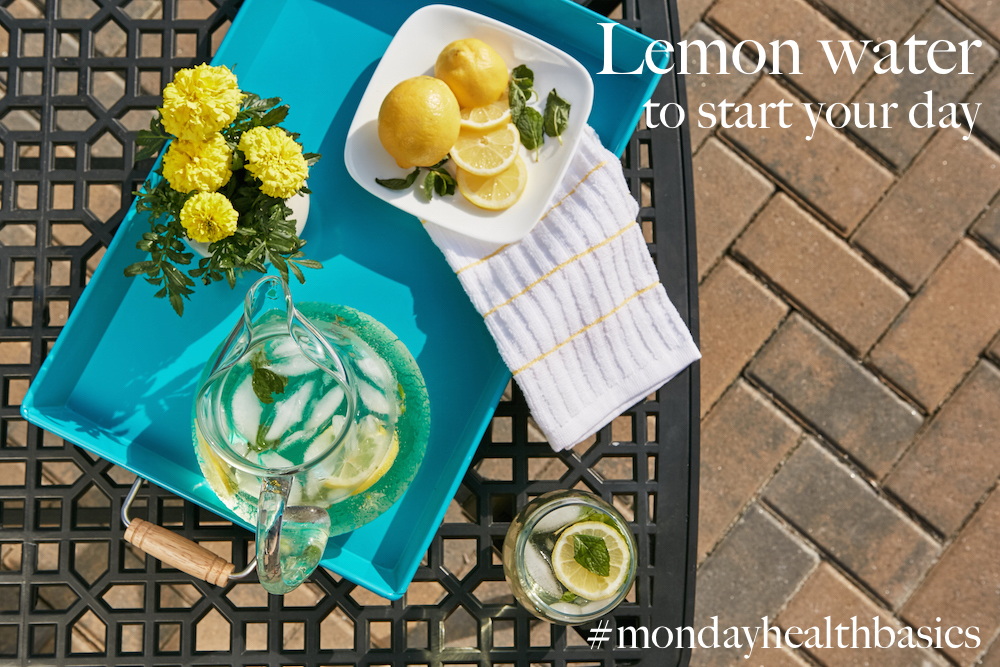
THURSDAY BASICS: Lemon water to start your day
This latest weekly easy upgrade for better health is a pretty simple one. It takes all of 3 minutes of prep once every two or three weeks, and a little forethought every night before hitting the hay. We're talking the pros of starting your day with a glass of lemon water.
Good Thursday to you! We continue on this revamping of the 2016 series I called Monday Health Basics. 52 new ideas to implement in to your daily life, one good thing at a time.
This one’s a gooder, especially if you have lost your morning appetite, or need some liver lovin. It’s also great to help wake up a sluggish digestive system. Plus, it tastes pretty darn DELICIOUS.
This week’s topic: Lemon Water to Start Your Day
THE COLES NOTES:
1. Get a bag of lemons, and blitz together in to a paste.
2. Freeze in ice cubes.
3. Take one out at night, drop in a glass, leave on your nighttable for first thing tomorrow morning.
Now go forth and support vitality, will you?
This weekly-easy-upgrade-for-better-health is a pretty simple one. It takes all of 3 minutes of prep once every two or three weeks, and a little forethought every night before hitting the hay.
We're talking the pros of starting your day with a glass of lemon water.
Omit the ice cubes for improved benefits. I just liked the colour here.
There are so many benefits to kicking your day off on the right foot with this lemon water business. This recommendation is one that just about every client I see on an individual basis will get early on in our work together. The benefits are many, as you will see by the list below.
But first, the how-to:
There are a few ways to do this. It's a good-better-best kind of deal if you simply add a tablespoon of bottled lemon juice to a glass of room temperature water first thing upon waking in the morning. Upgrade that to a freshly squeezed half lemon for even more benefits in the same glass of water.
Want to really knock this one out of the park? Purchase a bag of organic lemons and run the lot through your stand mixer or food processor in order to reduce them to a mushy paste. Yes, skin, rind, seeds, pith and all.
Pour this paste into ice cube trays and tuck in the freezer for easy retrieval. Before heading to bed at night, pop one of those lemon ice cubes out of the tray and toss in a glass of filtered water, and set on your night table so that come morning, that lemon will be melted into the water. Down the zesty drink first thing before even getting up, and you've done your body a good deed already. And your feet haven't even touched the floor yet! GOOD WORK.
Now go about your morning routine, washing up, getting dressed, packing lunches, feeding others, and preparing your breakfast. Getting the water down the hatch first thing will allow your body to absorb that water and give a good 30 minute buffer before your breakfast is ready to eat. This buffer means that the water will not dilute your hydrochloric acid, and thus will not hinder your digestive prowess first thing in the morning. Again, GOOD WORK.
But why?
The reasons for implementing this daily ritual are many. First things first: after a good night's sleep, your body can be leaning towards dehydration as it hasn't consumed any water for a long period of time. Starting the morning with room temperature water will help rehydrate, and the added lemon will get your digestive system started. As our body does its restorative work during our sleep, starting the day with this bitter beverage will induce the liver to do a very gentle cleanse first thing, flushing out toxins and getting bile flowing. (Truly, the only ‘cleanse’ you will ever hear from me.)
Water is the main component of our lymph system, and so by consuming this glass of water in the morning we are further supporting our body's natural detoxification job in moving toxins and antigens out.
As is well documented, citrus fruits are also good source of Vitamin C: this crucial antioxidant plays an important role in supporting the liver, a main player in immune and a necessary nutrient for supple skin and health for connective tissue (we need it to make collagen in our bodies).
And let's not forget the adrenals, they too rely on Vitamin C and so think of this as a good support for you to better be able to handle stress. Vitamin C is also a big player in keeping free radical damage at bay, and so of good support to skin.
As an added bonus, citrus fruit have been well documented to contribute to reducing overall inflammation be it systemic, chronic or acute in nature. What's not to love?
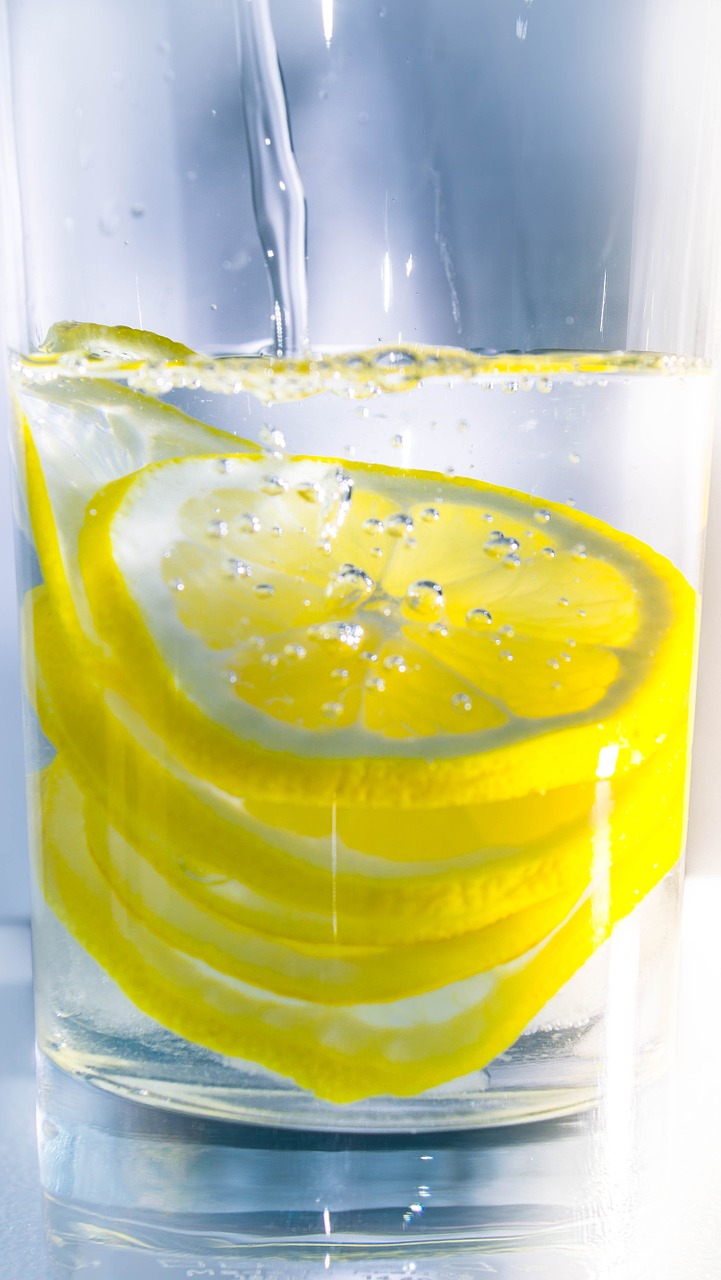
Extra tips
Make sure your glass of water is either at room temperature or a bit warm, as cold water will shock your system and reduce the benefits you may be seeking here. This is part of the reason why I recommend you prepare this morning wake up the night before, to ensure the temperature won't slow down the benefits we're seeking here.
If you're worried about any negative effects on the health of your teeth when consuming lemon water on a daily basis, you may want to consume your water through a straw, bypassing your teeth entirely.
Just adding this one easy task to your morning routine can bring support to your liver, lymph system, skin, digestive system, connective tissue, reduce inflammation, neutralize those free radicals and help rehydrate your body. It's really an easy add-on with myriad benefits, including supporting a balancing of hormones too. Try this one out, and let me know how you feel one week in!
THURSDAY BASICS: Switch to Filtered
I am going over one of the first and most basic changes I recommend to my newest clients: SWITCH TO FILTERED.
We're talking water, of course. We're talking nix the straight up tap water, instead filtering it so it's of gentler support to your body. There are lots of reasons, first and foremost because of chlorine. This chemical is found in our tap water and thank goodness it is – to be clear, this prevents our water supply from contamination which means it saves us from disease and infection from bacteria that could be found in our water supply. Adding chlorine to our drinking water means we can prevent getting sick from water-borne diseases like cholera, E.coli and Giardia. Really quite brilliant, yes. But all of this disinfecting comes with a price.
Every Thursday here, we dive in to a new concept (rather, a revisit of a series first published in 2016). This is one I just about put at the top of the year, the first thing I’d recommend you put in place if you haven’t yet incorporated the ideas presented in this Thursday Basics series thus far.
On Water.
COLES NOTES
1. Our water in Calgary is pretty dang clean - Lucky Us! BUT.
2. Chlorine + Fluoride mess with your microbiome.
3. Chlorine + Fluoride mess with proper thyroid function.
Switch to filtered, kittens.
In this Monday Basics Series, I have touched on the importance of water consumption and the timing around that consumption. We’ll dive in to more as the year progresses, but today it’s about one of the first and most basic changes you can make for which you will reap great rewards: SWITCH TO FILTERED.

We're talking water, of course.
We're talking nix the straight up tap water, instead filtering it so it's of gentler support to your body.
There are lots of reasons, first and foremost because of chlorine. This chemical is found in our tap water and thank goodness it is – to be clear, this prevents our water supply from contamination. This means it saves us from disease and infection from bacteria that could be found in our water supply. (I don’t need the trots, thanks very much!)
Adding chlorine to our drinking water means we can prevent getting sick from water-borne diseases like cholera, E.coli and Giardia. Really quite brilliant, yes. But all of this disinfecting comes with a price.
CHEMICAL REACTIONS
Chlorine reacts chemically with other substances naturally found in our water or ones that are in our bodies to form dangerous toxins that have been linked to certain human illnesses like asthma, eczema, cardiovascular disease and bladder issues and linked to damaging effects of many organs and systems including the heart, kidney and central nervous system. These byproducts contribute to free radical buildup and damage in our bodies too, which can contribute to cell damage and setting the stage for cancer.
We are all biochemically unique individuals, and so how much each person is affected by the chlorine in our drinking water differs from one person to another.
FOR THE LOVE OF YOUR MICROBIOME
Another big concern with chlorine is that it is just that, a bacteria-erasing chemical. Your guts have microflora or probiotics or good gut guys, whatever you want to call them. Good work!
HOWEVER.
This chlorinated water is going to eradicate the microbiome you are trying to cultivate. Having good microflora in our gut (or a balanced microbiome) is essential to overall optimal health and immune support. So by filtering our water, we will be ensuring a more hospitable environment where our gut microbiome can thrive and in turn, look after us. Win-win, kids, win-win.
(Not sure yet what is this mysterious microbiome? Look no further.)

As well, the chlorine (and when it’s there, fluoride) in water has been shown to have a negative effect on the thyroid. In the body, the chlorine molecule looks a lot like the iodine molecule; if you look on the periodic table of elements, chlorine and fluoride are in the same column as iodine, and the same one as bromine. Studies now show that ingesting these chemicals can run interference with organs that depend on iodine, chiefly the thyroid. There is even some suggestions to add a chlorine filter to our shower heads!
SOURCING OUR WATER
As water is fundamental to our body's function and living, it is imperative we ensure our water source is the cleanest possible, and that we pay attention to limiting the negative effects of some of the chemicals that can be found in our water.
Our best choice? For drinking water, go with spring water as this natural unprocessed water source is controlled and measured for any volatile compounds or contamination from local agricultural or industrial sources.
But ensuring spring water as your main drinking source is not a possibility for everyone; my second best recommendation would be to invest in a good water filter. There are many options out there, find the one that will best fit your budget. Shop around, ask friends what they like.
Check to see if your refrigerator's water supply came with a filter! If it did, make sure you're changing your filter on a regular basis.
If you're going for a stand-alone filtering system, there are jugs or stand systems with charcoal filters that are great at removing chlorine, some particulate matter and some of the heavy metals as well as some bacteria, parasites and most viruses. But these carbon filters can be a breeding ground for bacteria: make sure to change your filters on a regular basis. They do remove the majority of chlorine but won't take out fluoride. Not a concern in Calgary, as our city has since removed the fluoride that used to be added to our water. For those in Calgary who would like to know more about our water supply, follow this link.
Reverse osmosis systems may be the way to go for some, as it takes out 100% of all organic matter including the minerals; know that you should consider re-incorporating minerals into that water for drinking purposes. Adding a pinch of sea salt to your jug of RO water may be just fine, or running it through a system that will re-introduce minerals may work for you too. What system you choose is a personal choice; do your own research to find which one best suits your needs and budget.
Because your thyroid, your gut called and your immune system all called. They say thanks, in advance.

I often have gut and thyroid based talks on the go, make sure to check on the Events page to see if something is on the horizon. You might find the information presented useful!
For those who ferment at home, getting a water filter of sorts will be of great benefit to you, as chlorinated water also halts or may hinder the fermentation process. Think of the doors that will open up with this new filter in your life!