
MONDAY BASICS: Eat your EFAs
Welcome to February, sweet one. This week's Monday Health Basics topic is one that I think about every live long day, and it involves choosing foods that will support just about everything going on in your body. Let's talk ESSENTIAL FATTY ACIDS.
This Monday Health Basics topic is one that I think about every live long day, and it involves choosing foods that will support just about everything going on in your body. Let's talk ESSENTIAL FATTY ACIDS.
I will work on keeping this one shorter and sweeter, dear reader. Talking FATS is a big ole conversation I have on a regular basis, and one that is tough to navigate. Today though, I just want to tackle ONE GOOD THING YOU CAN DO TODAY. And that thing, starting this week, is adding some essential fatty acids in the form of Omega 3s to your daily regime! (Skip to the image of the sweet cows if you just want to get WHAT foods you should reach for.)
Now, let's make this clear: omega 3s are EFAs (essential fatty acids) which means they are necessary for our bodies to do their thing. We aren't able to make these omega 3s out of anything, we need to rely on our diet to supply them in order that we may utilize them in a myriad of biochemical processes in the body. Why may someone be deficient in the omega 3s, you ask? There can be so many different answers to this question from exposure to toxic chemicals, to someone who smokes or is surrounded by second hand smoke; someone who is battling a health condition that is utilizing the precious Omega 3s. If someone's digestion is compromised, they may not be able to get the nutrients they need in order to get the Omega 3s where they need them to be and for the chemical reactions to take place in order to get them working in the body. This compromised digestion may also play a role in preventing a person from getting the micronutrients needed for those chemical reactions to take place, things like magnesium, zinc, vitamins E, C and B6. There are studies out there that point to a correlation between a deficiency in EFAs with a diet where there was an abundance of foods containing trans-fatty acids. (Say no to soybean oil! ALWAYS! And other things. Come to the talk on Navigating Fats.) Of course, seeing as it is an essential that needs to be there in the diet, it goes without saying that a deficiency can also be as a result that the person in question just isn't consuming enough.
There are a few different kinds of Omega 3 fatty acids, and in the interest of keeping it brief, I will say the main ones are ALA (alpha-linolenic acid), DHA (docosahexaenoic acid) and EPA (eicosapentaenoic acid). ALA is the one that we cannot make, we need to get it from our diets. The other two, if our bodies are in good working order, we are able to manufacture them out of ALA. But in this day and age, it's tough to do that conversion work because of toxins in our environment, decreased digestion, chronic conditions or chronic inflammatory statuses.
It's About Balance
One of the things you need to know here is how the Omega 3s play with other fats, or rather, how other fats play with Omega 3s. There are other EFAs out there, Omega 6s being one of them. Omega 6s and Omega 3s work in tandem in our body to do lots of things, but especially working at keeping our overall inflammation in check. In order for this process to work properly, we need a ratio of 2:1 of Omega 6: Omega 3s. (This means that for every 2 Omega 6 molecules, our body needs 1 Omega 3 molecule.) The problem here is that with the way we eat in North America, our diet tips us more in the direction of 20:1 for Omega 6: Omega 3. With this big of an imbalance, the anti-inflammatory work just can't happen. Not only that, but an over-abundance of Omega 6 fats can contribute to an increase in inflammation, kind of like adding insult to injury there. So yes, I will talk food sources for the Omega 3s, but know that by reaching for real food and reducing the processed foods, you will be working already on improving the ratio.

The foods that best serve as excellent sources of these essential Omega 3s:
flax seeds and flax seed oil (be sure to keep it in the fridge, and buy in small quantities; if it smells or tastes rancid, toss it)
caviar
sardines
salmon and other cold water fish like anchovies, mackerel, herring (buy only wild fish, as farmed fish will not contain any Omega 3s!)
pastured or grass-fed beef (not conventionally raised beef)
pastured or grass-fed bison
wild game (deer, moose, venison)
shrimp
fish broth (homemade from scratch!)
walnuts
chia seeds
avocado (my favourite! Have 1/2 an avocado a day!)
olives and olive oil
Brussels sprouts
cauliflower
broccoli
sea plants and seaweeds like Irish moss
eggs
any dairy products produced from cattle fed on grass (butter, ghee, cheese)
pumpkin seeds

It's as easy as adding walnuts and cheese
If your body is compromised in any way, or if digestion isn't your strong suit, you may be having a hard time converting that plant form of Omega 3 fats to an animal form. (You are an animal. You aren't a plant.) In the case of someone like this, I would recommend reaching for the animal versions of Omega 3 fatty acids, in order to give your body that which it cannot make, taking some of the pressure off. Taking a fish oil supplement may be of benefit to you. Why not make it do double duty, and pick up some cod liver oil instead? This contains those important EPA and DHA forms of the omega 3s we need, but it also contains other beneficial fat-soluble vitamins like one of my all-time favourites Vitamin A (retinol), necessary for all skin including mucosal linings like your intestinal lining; it's also a good source of Vitamin D, needed for strong bones, robust immunity, hormone manufacturing, mood balancing, thyroid work, and the list goes on.
The Why
Last, but certainly not least, I wanted to let you know that you need to reach for these foods every day, indeed ensure they're at the table for every meal. Here is why: these EFAs are critical components in our immune system function; they lower the risk of heart attack, stroke and hardening of the arteries; they are essential to skin and are of benefit to people with psoriasis, eczema, acne and other skin eruptions. They are critical for someone who is suffering from arthritis; necessary to cushion joints and ligaments; important to lubricate the colon and improve our ability to move the poop on down the line; they reduce blood cholesterol; they help to prevent cancer; they are necessary to brain and heart function. Omega 3s are an essential nutrient for your eyeballs. They're also needed for your thyroid and adrenals. You need them for strong bones. Mood regulation. They reduce your risk of death in just about everything under the sun. Including effects from the sun. They help reduce the risk of dementia and Alzheimers'. Most important: THEY ARE NECESSARY TO PROTECT YOUR EVER LOVIN BODY FROM INFLAMMATION. Eat them, dear friend, consume them. Make them a part of every meal.
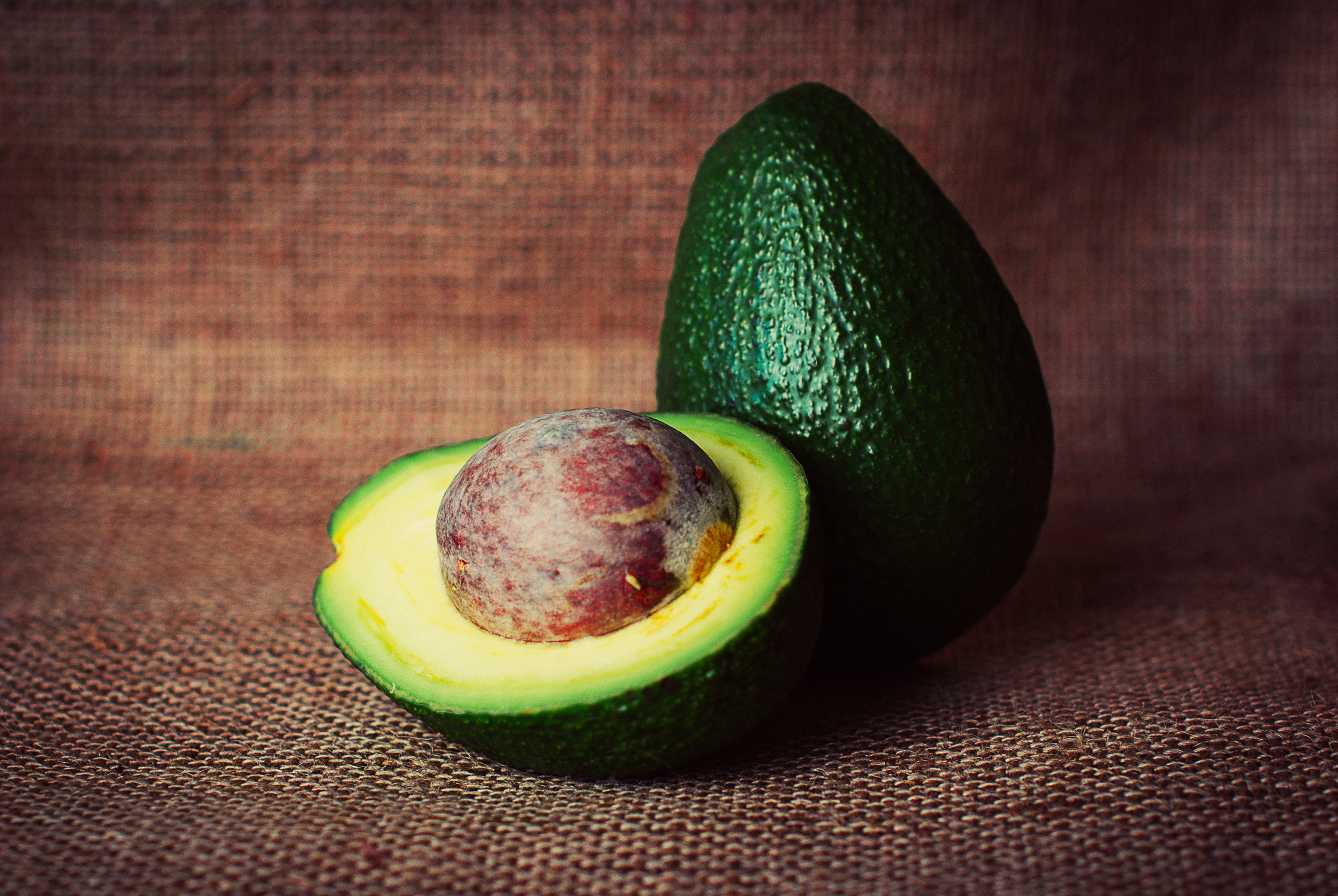
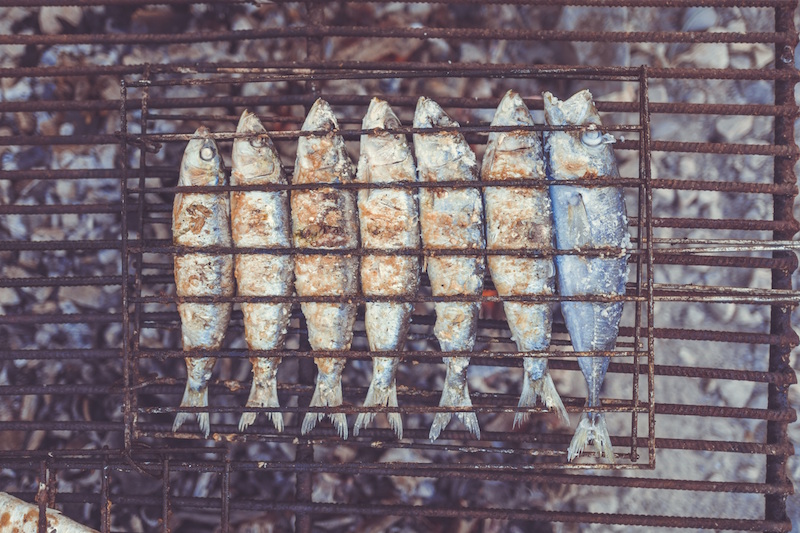

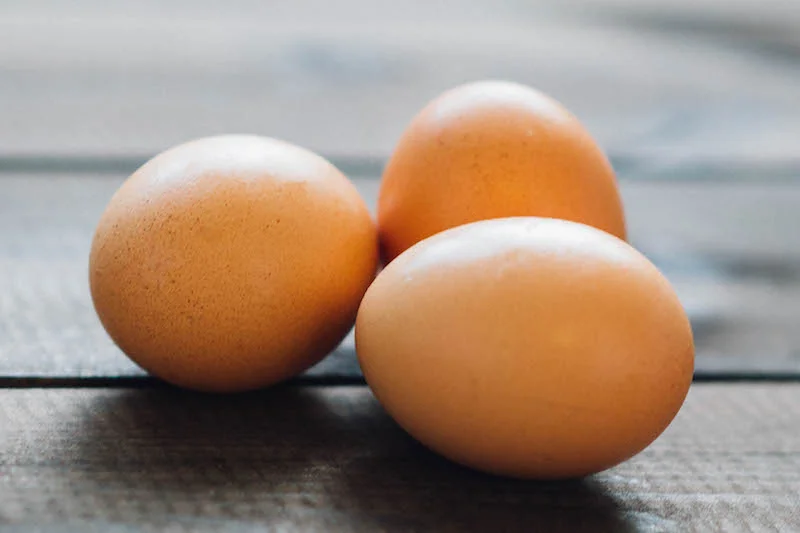
And eat in health. Good food is here, and it's got Omega 3s written all over it. Now go eat half an avocado stuffed with sardines, and drizzled with olive oil for lunch, will you?
(Oh and, did I mention yet that inflammation can show up as low moods? Depression? Anxiety?)
Goodness I'm verbose for a Monday morning. This topic isn't a short one, thanks for reading this far. #mondayhealthbasics
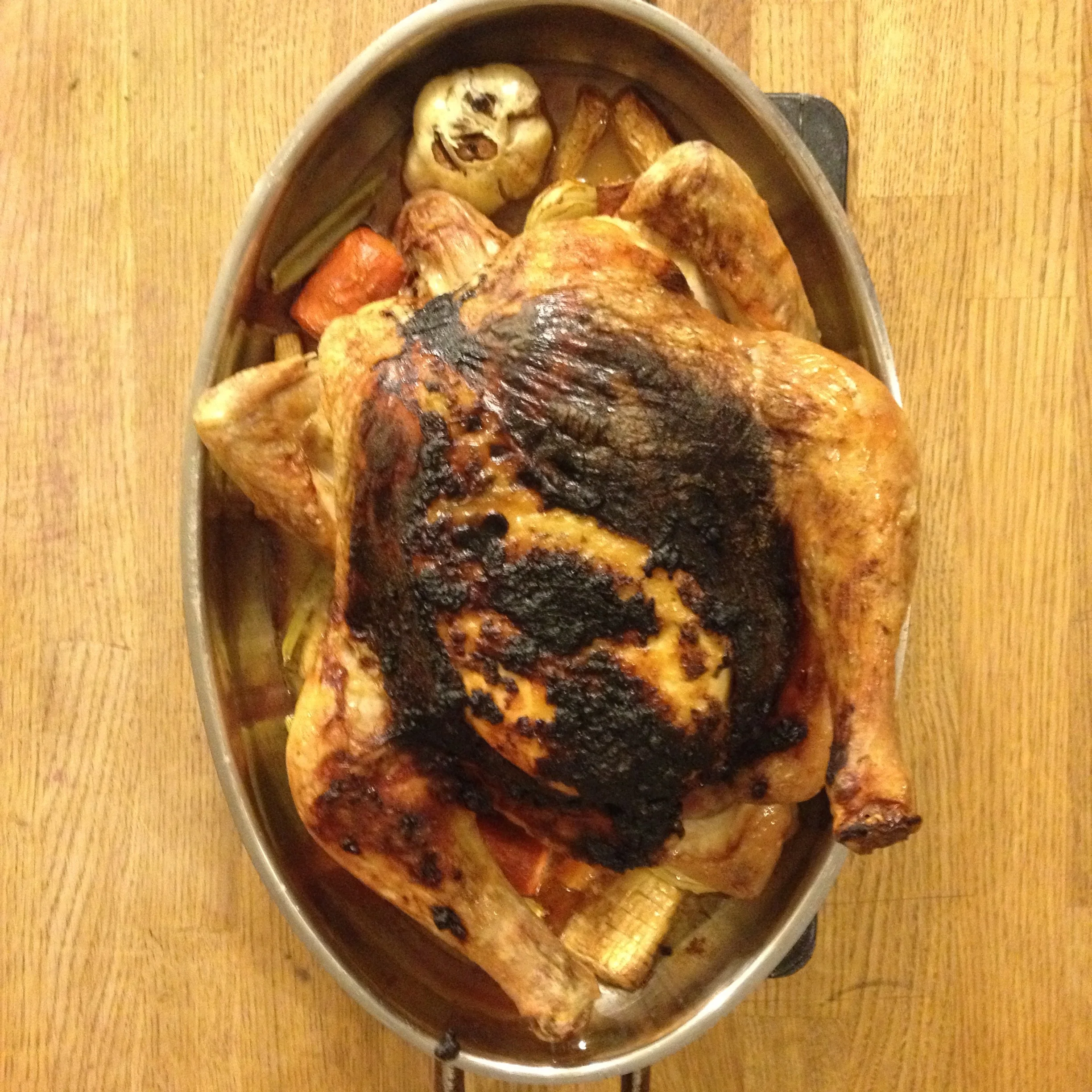
Miso Sage Roast Chicken
Sometimes you just need to roast a chicken. Am I right? Here's a delectable tasty thing to pull together for a fancy night with company, or a fancy night with your own company. You are definitely worth it.
Sometimes you just need to roast a chicken. Am I right? Here's a delectable tasty thing to pull together for a fancy night with company, or a fancy night with your own company. You are definitely worth it.
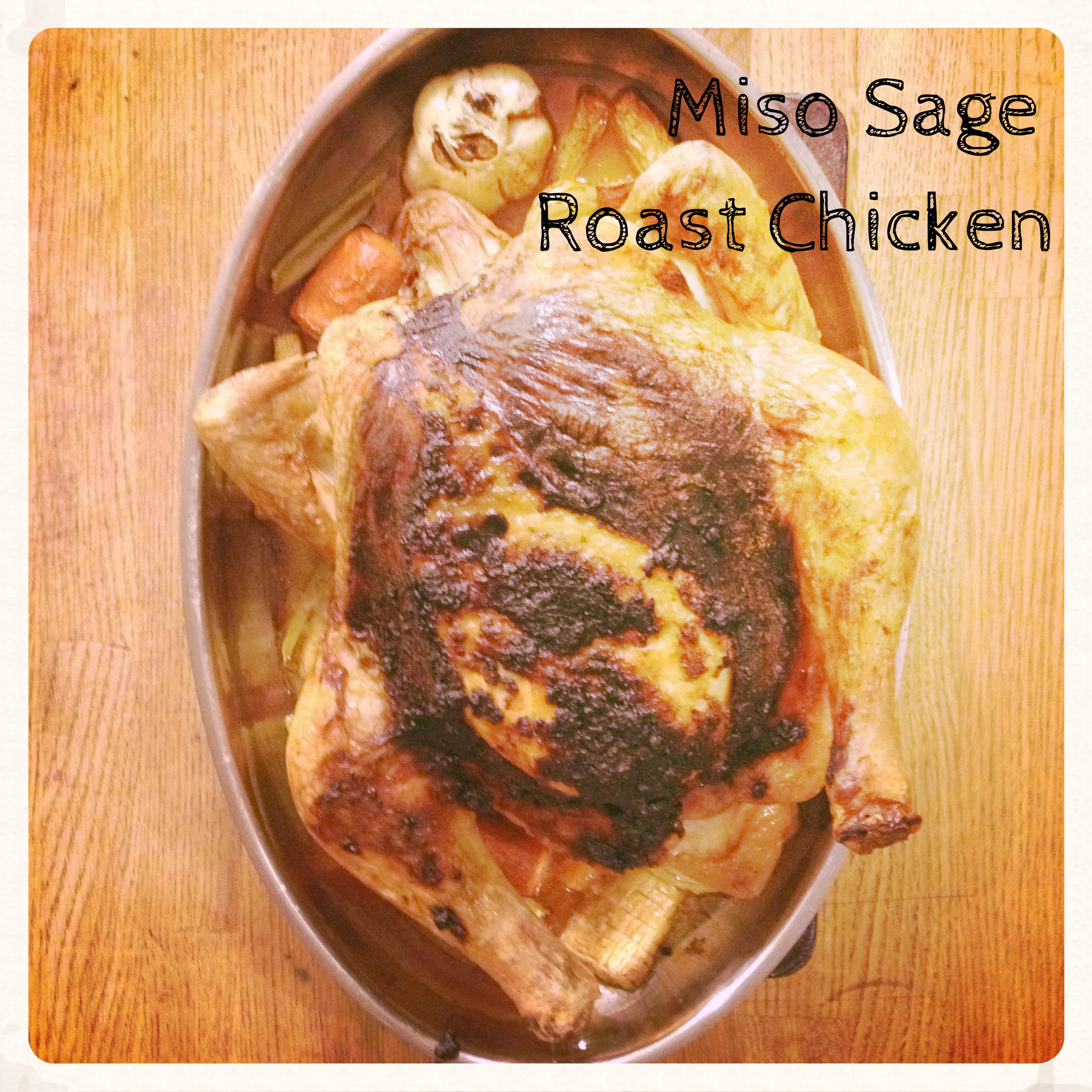
Miso Sage Roast Chicken, fresh out of the oven. So juicy.
Sure, there are lots of super foods here. I won't go into the details of what's good for what here. Listen, it's just food. Real. Good. Food.
MISO SAGE ROAST CHICKEN
yep it's an original, tweaked I'm sure from my years of perusing food magazines and thinking of flavours
Because I'm a fan of making gravy with roast meats, know that this one is one that should be good to go for everyone at the table. No one will be left out of this one.
THE PLAYERS
one whole chicken, preferably pasture-raised
1 small onion
1 lemon, juiced
2 tbsp miso (I used this one but you can find a few different kinds in a few different spots in town)
18 leaves of sage, fresh
2 tbsp Harissa Olive Oil (this one came from the good folks at Blue Door Calgary)
1/4 cup ghee or butter
paprika
THE VEG TRIVET
this is the first layer you'll lay down in your roasting pan, it will cook under your chicken and become your scrumptious gravy
2 parsnips, chopped in big chunks (swap for 1-2 carrots for GAPS)
1 carrot, chopped in big chunks
1 onion, peeled and quartered
3 celery sticks, chopped in big chunks
1 head of garlic
Thyme Fused Olive Oil (a limited edition item from Blue Door Calgary)
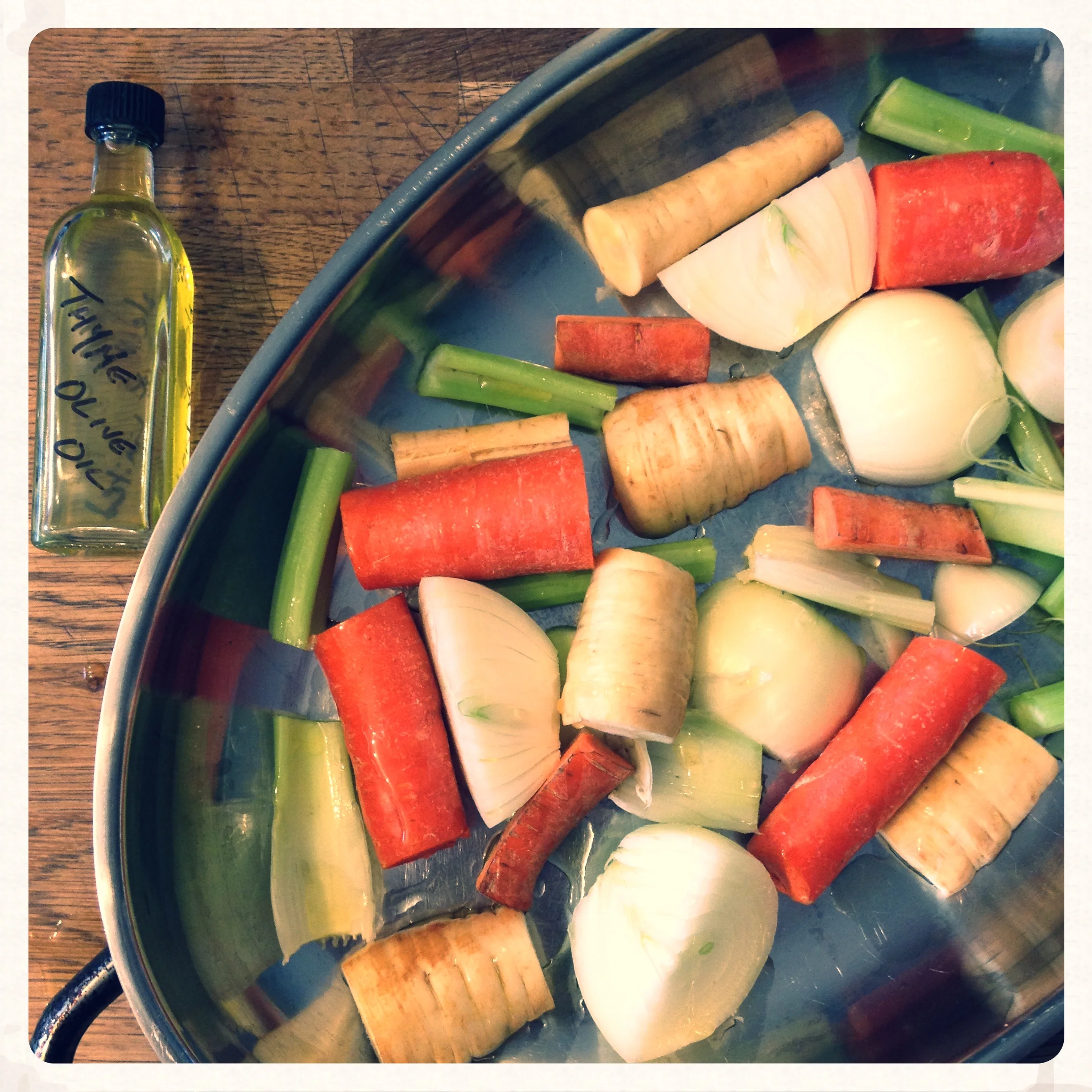
the veg trivet
THE HOW-TO
- Pre-heat your oven to 475ºF.
- Chop your vegetables for the veg trivet, and scatter them on the bottom of a good roasting pan, including the whole head of garlic (keep it whole, just trim a bit off the top). Drizzle your Thyme Fused Olive Oil on top of all veg. Set aside. (Thyme and chicken and veg. Kind of a match made in heaven, wouldn't you agree?)
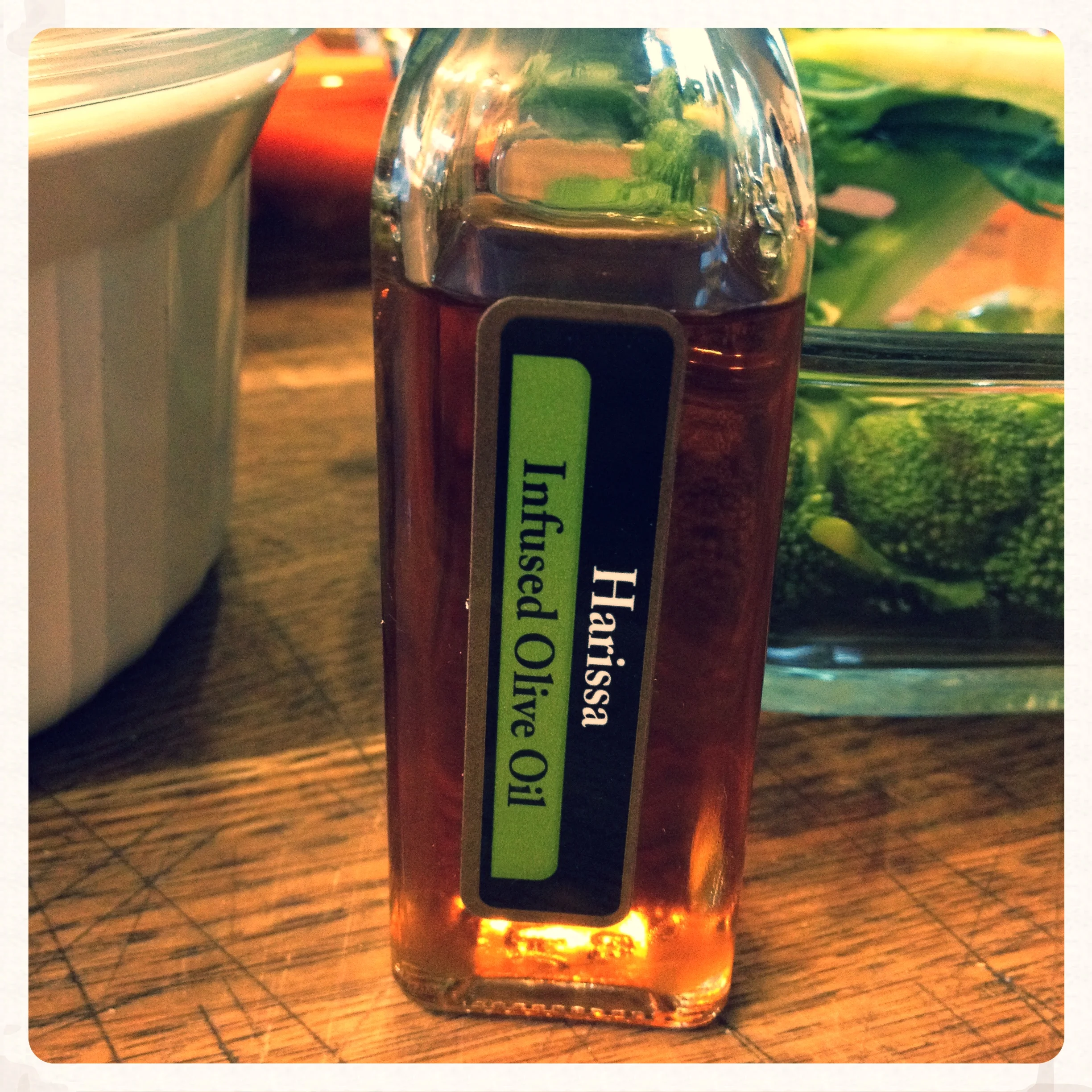
this one's got KICK
- In a small blender or using your hand blender, blitz together the small onion, the lemon juice, miso and sage leaves along with the Harissa Olive Oil. Set aside.
- Set your ghee or butter in a small pan and heat just to melt.
- Pop your chicken on top of your veg trivet, tucking the wings underneath the chicken. Using your hand, slip under the skin on top of the chicken, and separate the skin from the breast meat. You will need to gently pull it away from the meat, especially in between the two breasts where there is a sort of seam. Once it is separated, fill the space between breast and skin with your blended miso/lemon/sage/harissa paste, getting all that good paste right to the top corners. This will infuse your chicken with a most delicious flavour, and ensure it stays juicy. It will also influence the flavour of your gravy! Yum.
- Wash your hands. Drizzle the melted ghee or butter on top of the skin, and sprinkle with a dusting of paprika on top.
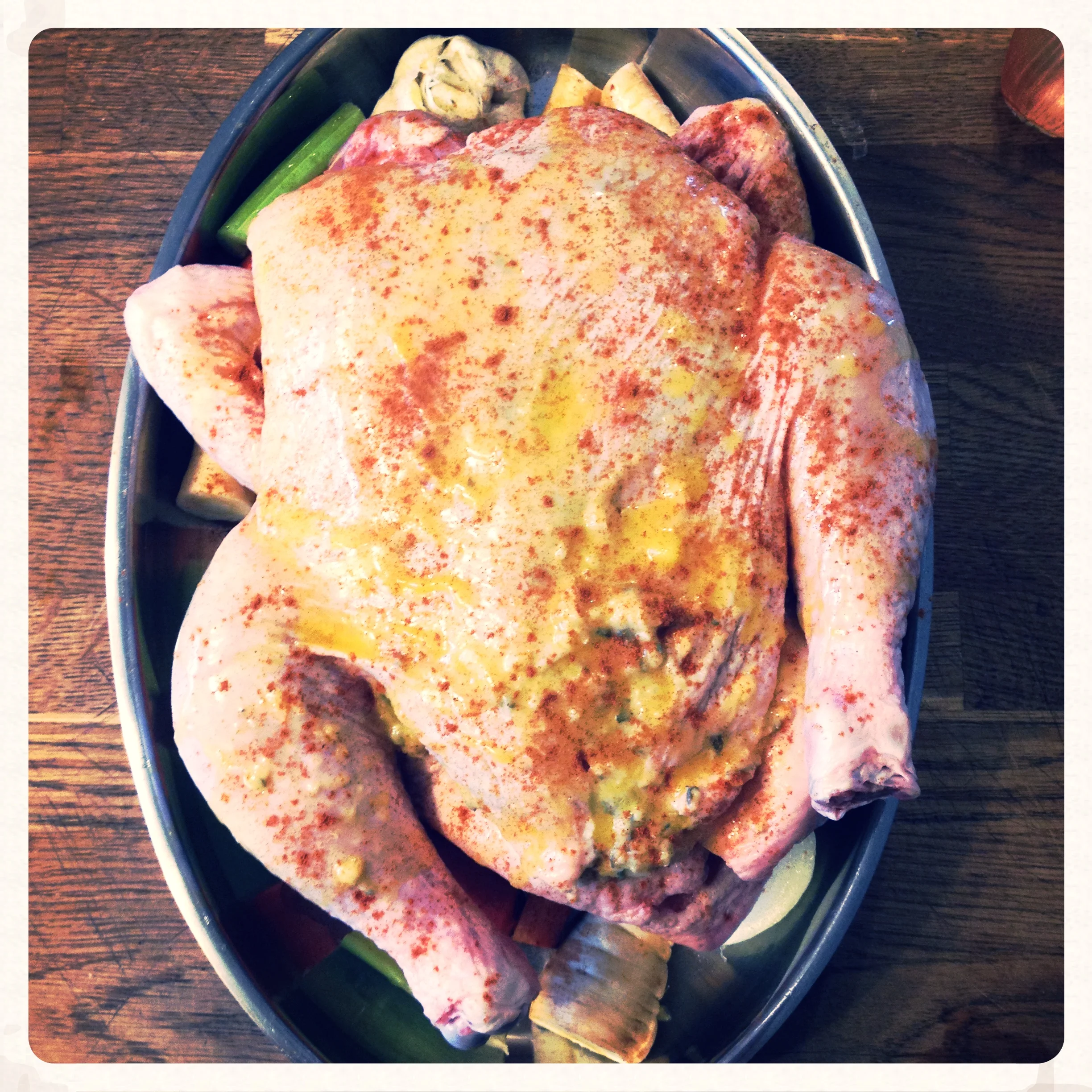
It may not be pretty, but it sure promises to be pretty delicious.
Tuck your roasting pan in the oven and close the door, reducing your heat immediately to 400ºF. Let it roast until it is cooked through, temperature reading of 165-170ºF on your meat thermometer. I'm not as adept at knowing when the meat is done as my mom is (comes from working in a commercial kitchen where you HAD to ensure the chickens were roasted to an appropriate temp in order to make sure no one would get inadvertently sick) but my mom swears by jiggling the leg, and if it seems loose in the joint, your chicken is done. (For a 3-4lb chicken, you are looking at approximately 1.5 hours of cooking time.)
Take the chicken out and pop on a plate, top with foil in order to keep it warm and let it rest for 15 minutes in order to distribute the juices. Slice either at the table for that fancy dinner effect, or simple prepare just before serving. While the chicken is resting, return your pan to the stovetop with your veggies and pull out the head of garlic and set aside. Using a hand blender, blitz the veggies together with the juices that have accumulated in the pan. Squish out the roasted garlic out of the paper, and add to your gravy, blitzing again and adding water if it's too thick for your liking. Adjust the flavours with salt and pepper and if you'd like more of a punch of flavour, you can add some more paprika too.
And hey, because I like to multi-task, once your chicken is in the oven, you can prepare the side veggies that will go along. I put a medium pot of water on to boil, chopped some carrots into carrot sticks and broccoli into 'trees', blanched them separately in the boiling water until softened just a bit. Once they were soft, in an oven-proof dish they went and drizzled on top with a bit of fat and some flavour. For the carrots, my fat was a plain olive oil and the flavour was a maple balsamic vinegar, S+P. For the broccoli, I used ghee and a lemon-pepper spice blend with just lemon and pepper with a smattering of sea salt. Make sure to tuck these babies in the oven with the chicken for that last half hour of cooking. Yum!
Bon appetit!
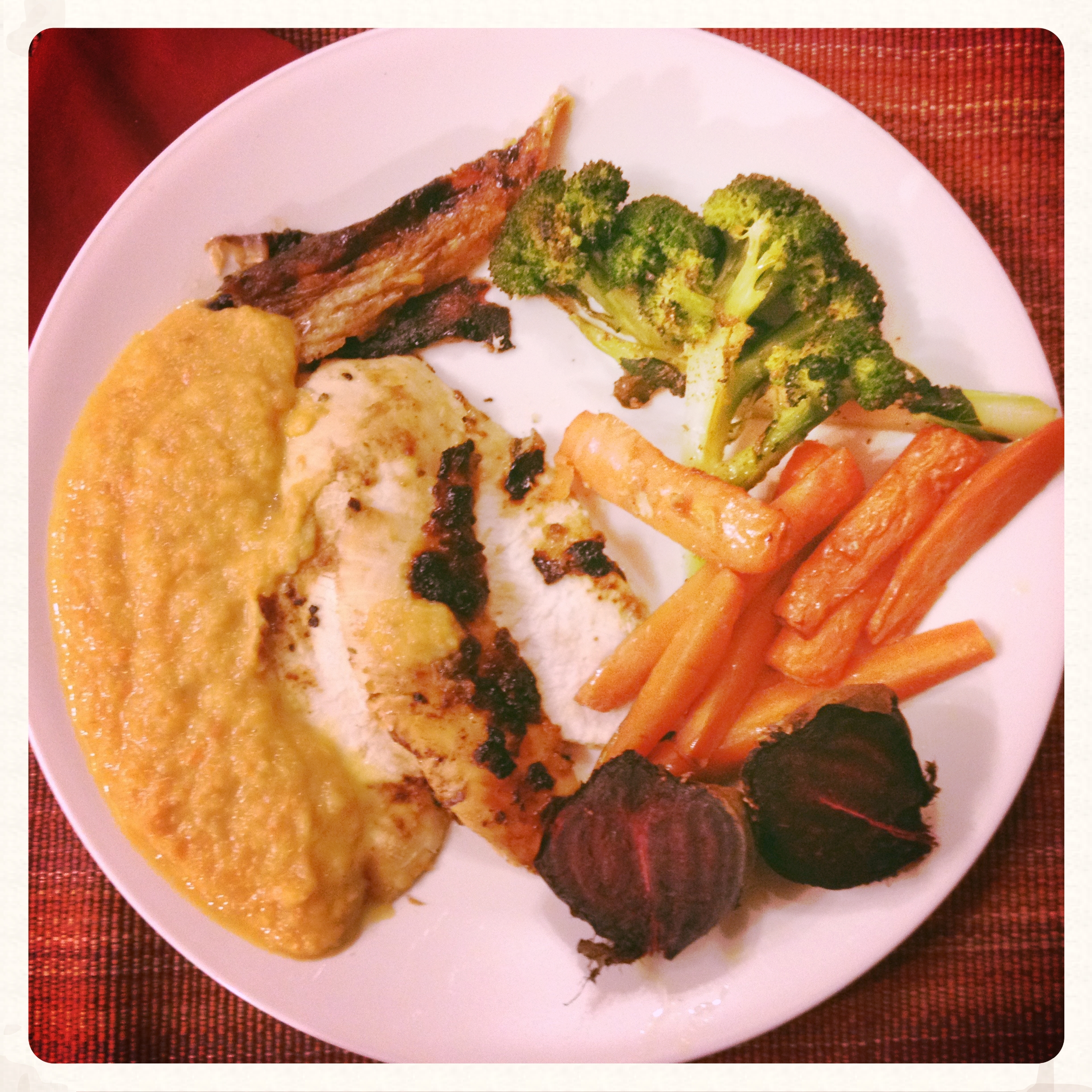
Make sure to have some of the skin, it's delicious! Miso Sage Roast Chicken.
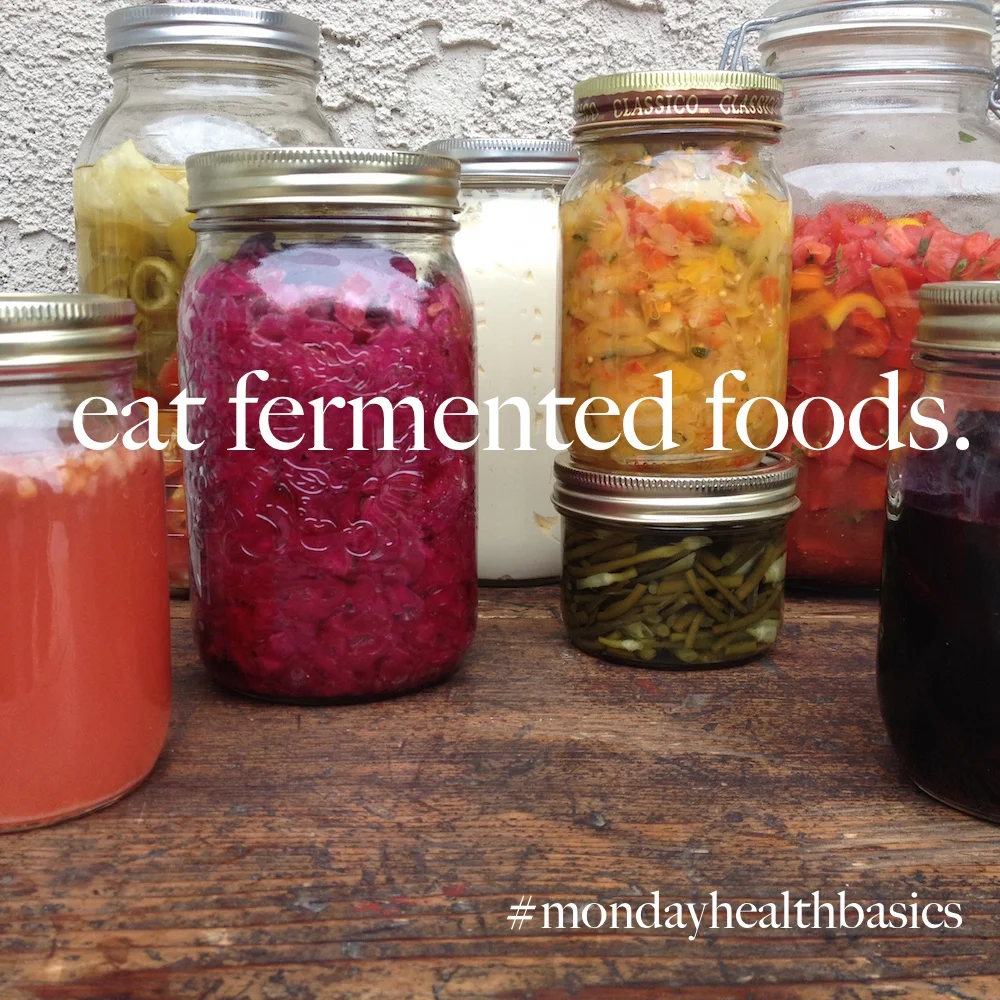
MONDAY BASICS: Eat Fermented Foods
For this last Monday Health Basics post of January, I am talking all things fermented. Partly because I have seen such big health improvements for myself since introducing these yummy things over three years ago, but also from anecdotal tales from clients and class participants about how much fermented foods have benefited them on their trails. Not to mention, ferments are seeing a kind of renaissance these days, it would seem! And with good reason. Read on for more.

For this last Monday Health Basics post of January, I am talking all things fermented. Partly because I have seen such big health improvements for myself since introducing these yummy things over three years ago, but also from anecdotal tales from clients and class participants about how much fermented foods have benefited them on their trails. Not to mention, ferments are seeing a kind of renaissance these days, it would seem! And with good reason. Read on for more.
This is one of those fundamental changes that will slowly and irrefutably support increasing your digestive function, thereby improving how you assimilate those foods you eat (meaning you'll get more goodies out of the food you're eating, so making your food dollar go even further!). Fermented Foods are a cornerstone of my practice, and including them in your day's food choices will be a critical component to supporting your sweet self to improved health and vitality.
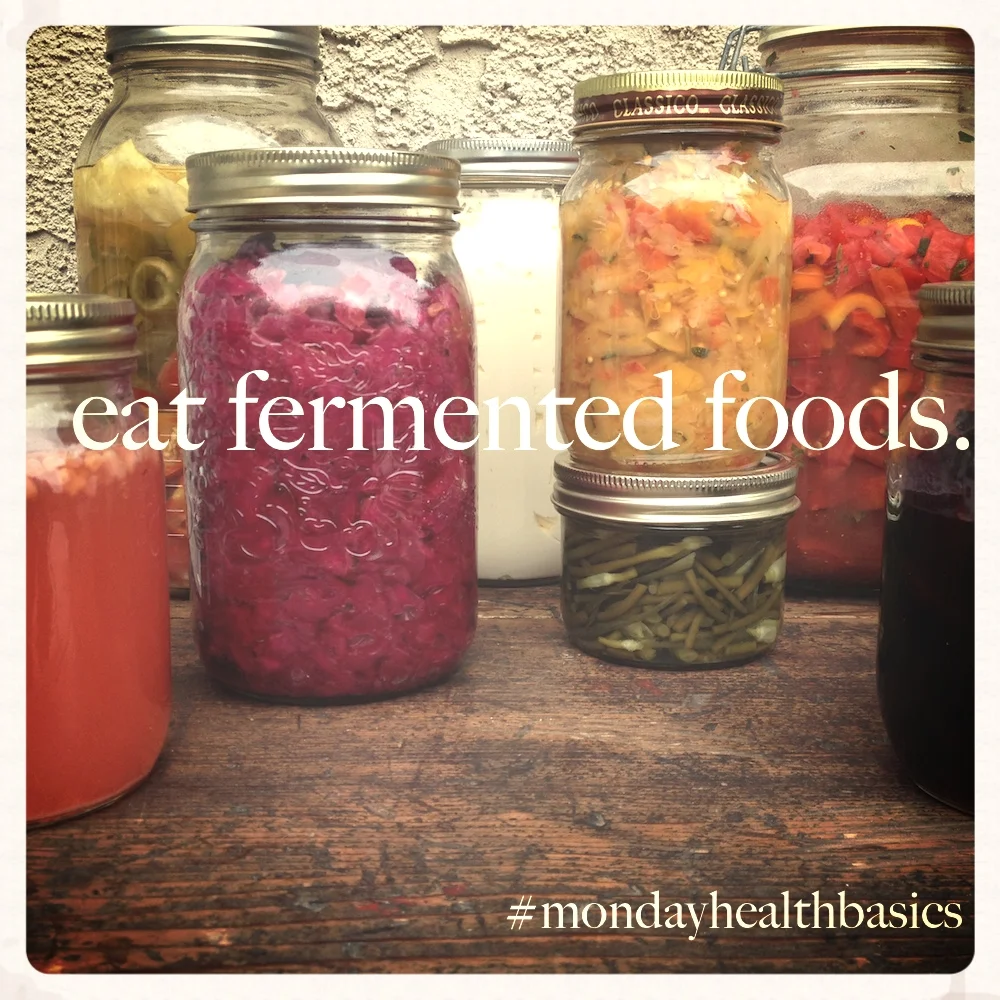
Adding fermented foods to your regimen will help in myriad of ways, from supporting your immune system (85% of which lives in your gut!), to lowering inflammation in the body, to helping break down foods; they also boost the vitamins and mineral content of your food by freeing up more of those nutrients, and producing some of those all-important Bs as a side benefit of hanging out in your guts. People have been fermenting for millenia, tracing back even to the ancient Greek. Fermentation has been a steady way of the traditional life in just about every nook and cranny of this earth. People were doing this before they had freezers or had figured out how to can things. It was the original food preservation method that ensured that when the 187 cabbages ripened all around the same time in your Bubbie's garden, she could toss them in a barrel with enough salt to taste 'just so', leaving time to do the magic and alchemy. Over time, this cabbage would sour just right, and be the perfect accompaniment to a warm stew or pot roast in the middle of winter. Trying to eat those 187 cabbages all before they would go bad? Not possible. Talk about spoilage. Talk about waste. But salting and packing them so no air could spoil the lot? Turned them into delicious morsels that would ensure veggies could get you through winter. She was smart, your Bubbie.
Fermenting cabbage and other cruciferous vegetables keeps the indole-3-carbino intact, a well researched cancer fighter that has also been shown efficient in removing excess estrogen. Fermentation by-products also nourish our intestines and colon and contribute to increased nervous system health, including moods and hormone regulation (important for all bodily processes). They also help regulate dietary fat absorption, and help facilitate energy production. Oh and one of my favourite things, these good gut guys also chelate out heavy metal toxins! Crowd out the bad bacteria! Produce loads of the B vitamins as a thank you for giving them a place to hang out! They help prevent kidney stones and help detoxify endocrine disruptors! As if that weren't enough, they help neutralize the negative effects of pesticides. I mean come on, right? The list really does go on and on.
We are outnumbered 10 to 1, bacterial cells to human cells on every surface of our body. The palm of your hand holds more bacteria than the entire current human population on earth! Wouldn't you want a say in what kinds of bacteria reside there?
WHERE DO YOU GET FERMENTED FOODS?
You can make your own, of course. Bubbie would be proud. If you're keen to get going on your own, you might want to visit some recipes on my blog for a few ideas, just click on ferments when on the blog's home page to find them. (I am new to this blogging and recipe posting thing, so bear with me as I grow my catalog of recipes.) Of course you can purchase these foods in natural health food stores, or in the natural health aisle of your favourite grocery store. Be sure to purchase ones that indicate that they are still live or contain probiotics! A good tip in order to find them is to first look in the refrigerator section. Typical fermented foods to look for: yogurt, kefir, sauerkraut, pickles, relish, horseradish, kimchi, kombucha, water kefir, some preserved lemons, some sour creams, cheese, buttermilk, quark, creme fraiche.
You may also be interested to know that I host fermenting classes. It is easy to do, couldn't be more fun to host a gaggle of friends in the comfort of your own kitchen and learn first-hand how to make these cultured foods for pennies a serving. Check out this page on my blog to get the full run down on how to host your own.
This is just a perfunctory look at the benefits of fermented foods. If you'd like a broader discussion on the topic, learn how to safely introduce these foods in to your regime and some tips and tricks on how to make your own probiotic-rich sauerkraut at home, I'd like to invite you to a seminar I'm leading this Friday night, a collaboration with the good folks at Elan Family Wellness in Bowness. You will find the full details here.
Now go play with your food and make some fermenty fun, will you?
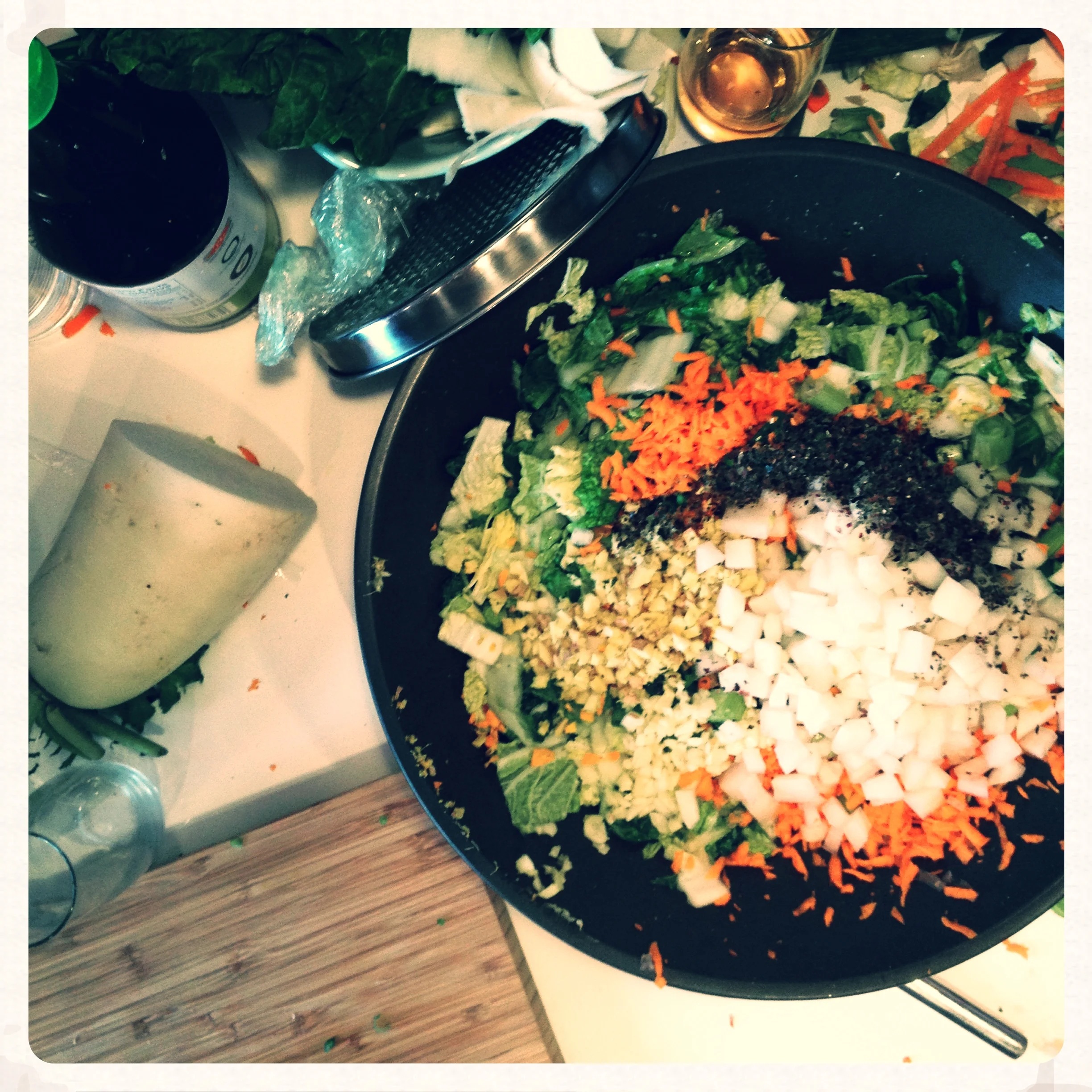
making kimchi
MONDAY BASICS: Practice Mindfulness Before a Meal
This week's blog post is about engaging in mindfulness when sitting down to a meal, big or small. See, the digestive process is a pretty work-heavy job your body has to do. It takes a lot of steam! As part of the series of chemical processes and reactions that go on in your body in order to best prepare you for the nourishment that is about to be served, your body goes into 'rest and digest' mode. This requires your Parasympathetic Nervous System (PNS) to turn ON. (The opposite, aka 'fight or flight' requires the autonomous nervous system (ANS). This is not the system you want turned on when supper is being served. Read on to understand why.)

In this weekly series, we take a look at some simple tasks you can implement into your regular routine in order to best support optimal health. I post a short write up every Monday, and the topics vary from nutritional things, with lifestyle ideas and information as well as resources to help you on your wellness journey. If you're curious to catch up on the ones you've missed so far, follow the tag at the bottom that says monday basics.
This week's blog post is about engaging in mindfulness when sitting down to a meal, big or small. See, the digestive process is a pretty work-heavy job your body has to do. It takes a lot of steam! As part of the series of chemical processes and reactions that go on in your body in order to best prepare you for the nourishment that is about to be served, your body goes into 'rest and digest' mode. This requires your Parasympathetic Nervous System (PNS) to turn ON. (The opposite, aka 'fight or flight' requires the autonomous nervous system (ANS). This is not the system you want turned on when supper is being served. Read on to understand why.)
That fight or flight kind of mode your body goes in is the kind that allows you to run like the dickens in order to escape that saber toothed tiger; the hyper-alert mode your brain goes into when you see those flashing lights in the rearview mirror. That's a stress reaction. This kind of reaction actually shuts down the PNS in order to concentrate on getting away as quickly as possible. So stress = digestion turned off!
The kind of mode we're looking for here in order to best support your body's task of digesting, is that Rn'D mode, Rest and Digest, the polar opposite. When the PNS is activated, there are some pretty wonderful things that happen: digestion and breakdown of foods into nutrients takes precedence. Your body also goes into detox mode, does some re-building of tissues, and your immune system does some really important stuff in this mode. If your adrenals have had a bit of a rough ride that day, this is the time where they just slow down enough to do that rebuilding work that needs to happen for the next time a stressful event shows up unannounced.
In order to turn the PNS on, one needs to be feeling calm, cool and collected. Chill. At peace. Bliss. Doesn't matter what you call it, you need to be in a good space in order for that system to be activated so that you can best digest the meal in front of you.
Contrary to your body's reaction when that fight or flight mode gets activated, this kind of state takes a bit to get in to. Simply put, you need to relax. And sit in that quiet moment. Doing so will ensure your PNS is fully engaged so that you can take that time needed to properly digest, break down and assimilate the nutrients found on your plate before you.
Here are some ideas to help rev up your digestion, engage in mindfulness in order to turn the PNS 'ON' during meal times:
keep chaos at bay during mealtimes (chaos brings on a stress reaction, which will shut your PNS to OFF)
share a meal with loved ones, as it has been shown to help bring stress levels down
eat without distractions (the 'ping' of an email notification on your phone can also bring on a stress; if your brain is focusing on a book or television show, your PNS will not be in full working order)
don't eat lunch at your desk (distractions! shiny things! check Facebook! ugh. Turn off PNS.)
find a quiet table for your meal, and share with a coworker
if you're able to and the weather permits, think of having your meal outside
as you sit at the table about to enjoy a meal, take a moment to use all of your senses except that of taste, and notice 5 things around you (the smell of the meal? the light on the table? the birds in the back yard? the sound of a car on the road outside?)
say a quick word of thanks or a verse before tucking in to your meal; doing so over the course of time will train your body to turn the PNS 'on' as it will be anticipating the meal
pay attention to the meal you are consuming, explore the flavours and textures in order to keep that PNS 'on'
for some people, it helps to put their cutlery down on the table in between bites in order to slow down on the meal
if you are sharing your meal with a loved one, remain at the table a little bit longer and engage in friendly conversation; this will keep that PNS going for improved digestion

In case you missed it, last week I posted a few quick recipes on my Facebook page. Have you 'liked' my business page over there yet? I also dropped a few quick and easy recipes on my Instagram feed. Might want to check them out.
Have a great week, lovely peeps!
MONDAY BASICS: Swap your table salt for sea salt
This Monday Basics series is a new thing up here on my blog, meant to be a quick read on one manageable task you can implement in order to best support optimal health. This week's topic is one that is a pretty basic change that is fairly easy to implement, but is one topic that also raises many questions and controversy. We're talking SALT.

This Monday Basics series is a new thing up here on my blog, meant to be a quick read on one manageable task you can implement in order to best support optimal health. This week's topic is one that is a pretty basic change that is fairly easy to implement, but is one topic that also raises many questions and controversy. We're talking SALT.
Without getting too analytical about it, (although if you're interested, there are some fascinating articles here, here and here if you'd like to read up on interesting studies and conclusions that have been drawn) salt is really an essential nutrient to life. We need it. We wouldn't be alive without it. We came from the ocean, evolutionarily speaking; our insides are virtually a delicate balance between water and salt. For those in a rush, here's my take home message: toss your table salt, and swap it out for a good high quality unrefined sea salt. Read on if you want to know more.
There are many reasons to go the sea salt route; chief among them, sea salts have a mineral profile much richer than that found in table salt, from some 60 to 80+ minerals, depending on the variety you are purchasing. These minerals are essential to our wellbeing; you will find calcium, magnesium, sulfur, zinc, iron, iodine, silicon, phosphorus and vanadium to name a few, and small amounts of iodine in addition to the potassium and chloride, which make up roughly 84% of the salt.
But in table salt? You will find present solely potassium and chloride as minerals, making up a bit more than 97% of the salt's content. Every other mineral has been stripped from this salt in the manufacturing process. Table salt is made from crude sea salt that has been heated to 1200ºF; in this process, most minerals are stripped away and other additives are thrown in the mix and the original structure of the salt is altered, making it harder for our body to identify it and use it. You'll find some aluminum derivatives, anti caking agents to keep the salt from clumping; you may also find either MSG or small amounts of white sugar in the mix to make up that +2% remainder.
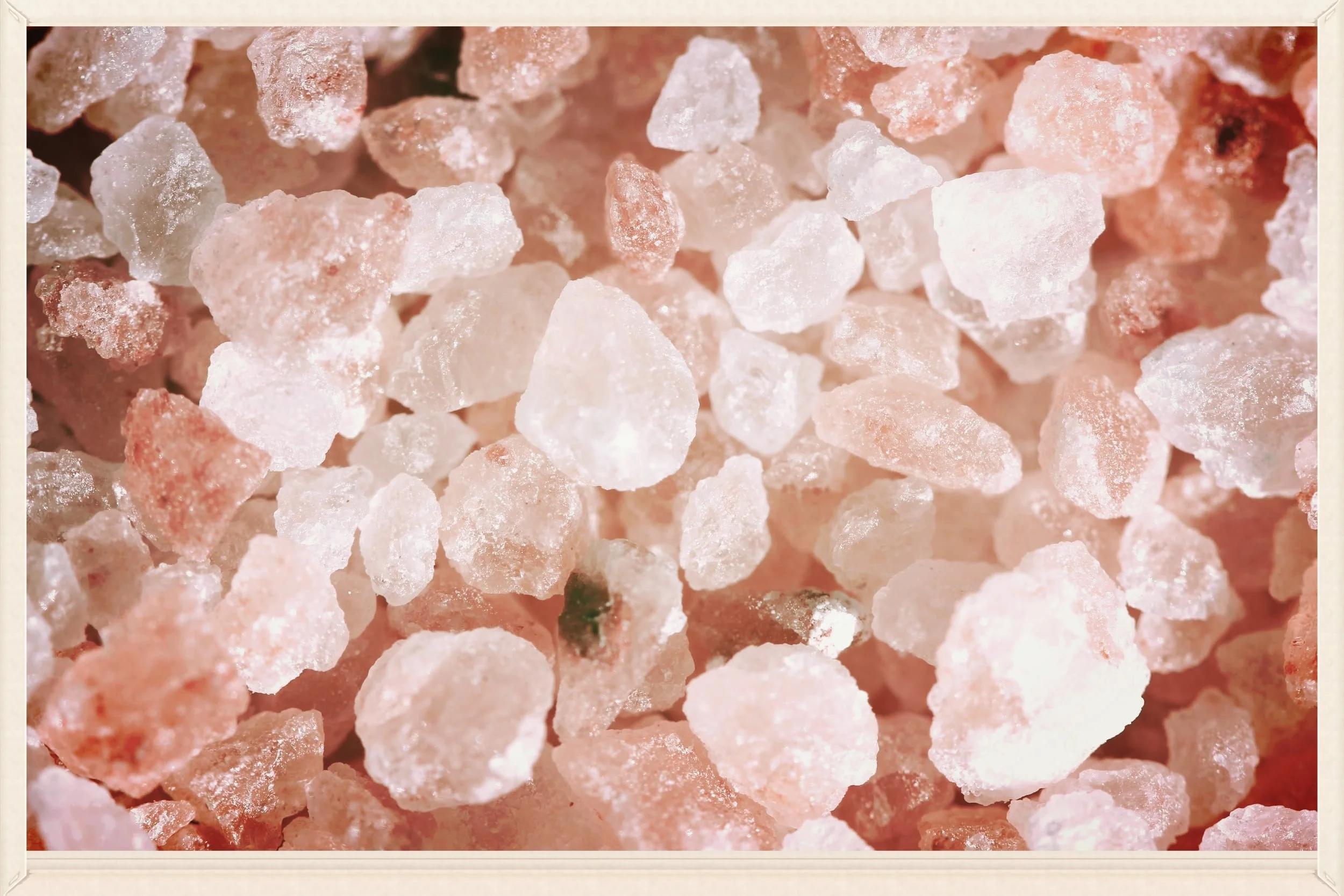
Himalayan sea salt crystals up close
Why do we need salt? In the sea salts, you will find some vital minerals that are necessary to proper adrenal and thyroid function as well as immune and brain function. If you're craving salty snacks, it may be your body's way of requesting more of the minerals found in sea salts, indicating you may need some adrenal or thyroid support. We need salt for our digestion as some of those minerals found in sea salt are needed for enzymatic reactions in the body in order for us to break down foods we are ingesting. These trace minerals also help us stay hydrated, they also ensure our itty bitty sodium-potassium pumps found in each cell are in good working order, needed for our energy cycle called ATP. These trace minerals also help maintain our blood's pH in a normal range; they are needed to help balance blood sugars, necessary to good brain function and supporting our immune systems. And let's not forget the heart! These trace minerals help regulate our heartbeat and blood pressure and are a major component of blood plasma! Magnesium is a big one found in unrefined sea salt, and this mineral is needed to maintain good bone health, regulate nerve and muscle impulses helping to prevent muscle cramps.
One comment I hear often when the subject of table salt vs. sea salt comes up is iodine, and this is an important thing to talk about. Iodine is integral to our body's healthy thyroid function; manufacturers started adding iodine to their table salt to help prevent the occurrence of goiters. As our soil levels of iodine have been depleted over the last century, so have the iodine in our food sources gone down (you just can't make iodine out of thin air!). Problem is, table salt has such a high amount of iodine that it ends up having a negative impact on the thyroid. If you are concerned about losing your iodine intake by going the sea salt route (know that there is some iodine found in sea salts), the idea then would be to reach for food sources that are still rich in iodine: think seaweeds, any fish or shellfish hailing out of the ocean.
SALT IS AN ESSENTIAL NUTRIENT TO LIFE. Here is how to add this nutrient to your daily life:
choose a good high quality product, looking for the words 'unrefined' or 'not treated' on the package. (good varieties include 'celtic', 'himalayan', or Utah's 'RealSalt')
salt your food to taste (everyone's tastebuds will require different amounts!)
if the sea salt is white in colour, really read the package as most of the time, the salt will have been stripped of some of the minerals in order to make it look appealingly white
your salt should have colour; it is this colour that indicates what minerals are found within
check with your medical practitioner if you have heart disease, high blood pressure or kidney troubles before making any changes to your diet especially in regards to salt
because I have a hard time deciding, I actually purchase three kinds of sea salts in bulk, and mix them all together in order to get a balance of minerals
because I'm saying unrefined sea salt is good for you, don't think it's reason you can go hog wild; eat it in moderation (use your noggin)
if you're concerned about not getting enough iodine, reach for seaweed, choose fish or shellfish that are wild caught (not farmed)
Incidentally, if you're curious to know more about adrenal health, (where yes, indeedy, I will be talking about swapping your table salt for sea salt) I am leading a workshop on Tuesday January 12th on Loving Your Adrenals. Follow this link if you'd like more information on how to get tickets.