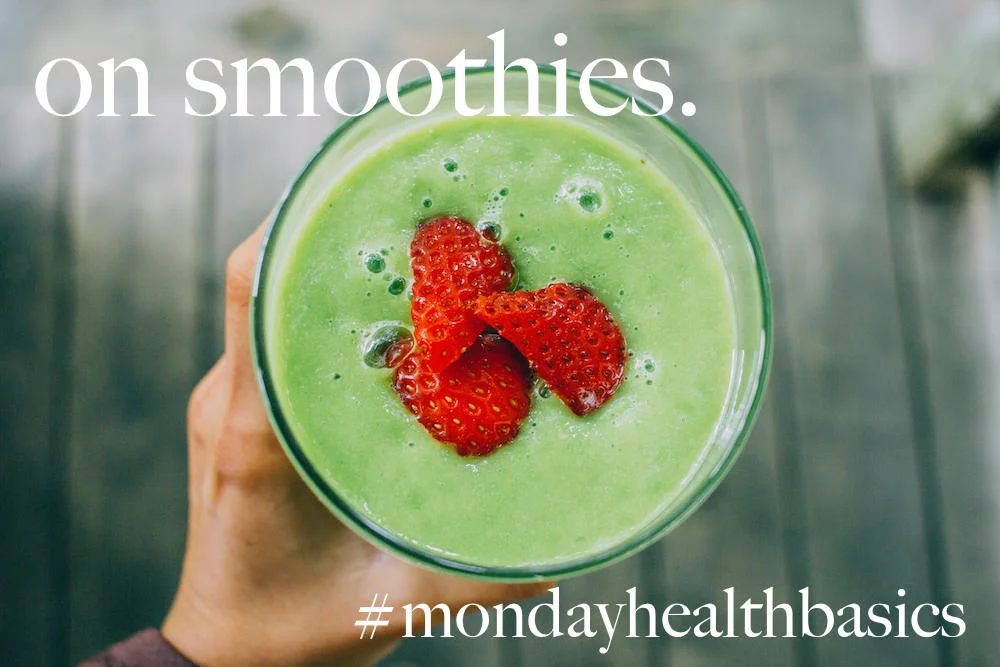
MONDAY BASICS: on smoothies.
This week's Monday Health Basics blog post (albeit a day late) is zeroing in on one of the most oft questions I get: what do I think of smoothies? How do I build a good smoothie?
For you, my bullet-breakfast loving friend, here is my spiel on smoothies.
Happy Thanksgiving to you, my dear reading friend. I hope the weekend that was saw you gathered around some good food with some good folks for some good times. And some great phone conversations with those from away.
This week's Monday Health Basics blog post (albeit a day late) is zeroing in on one of the most oft questions I get: what do I think of smoothies? How do I build a good smoothie?
For you, my bullet-breakfast loving friend, here is my spiel on smoothies.
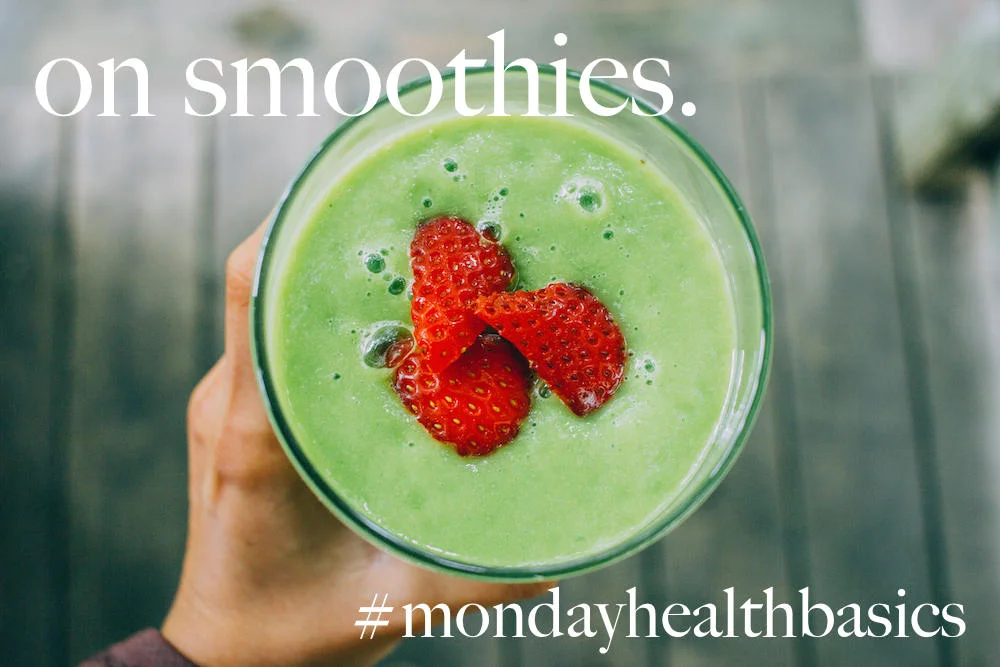
There are clearly two camps when it comes to smoothies: those that say 'yea' and those that say 'nay'. I sit on the fence. I really do.
I think they can be fantastic vehicles for nutrient density; I think they can carry lots of goodies if you're looking to increase your intake of fruit and veg for those all important nutrients, vitamins and minerals to best help support a body.
I wonder how much we are by-passing normal parts of digestion when we just 'drink up' our breakfast (or snack or meal). I mean, I think we have teeth for a reason. I really believe we were always meant to chew our food; chewing activates the proper cascade of events we need to go through in order to optimize digestion. And if you know me, you know what I'm going to say: you are what you assimilate. If you aren't digesting properly, you will have trouble getting nutrients out of the foods you're eating. Our bodies utilize nutrients after all; not food. We need to be able to properly break down our foods in order to get at the nutrients within.
If you look back in history, no one, nowhere was making smoothies. We were all chewing what we had on hand, what was in the larder, and what we found or hunted on the field or in the woods. Or kept in the coop out back. It was all slow food all the time. So I really think there is something to the business of chewing our breakfast, and taking our time for that important first meal of the day.
Digest well
My recommendation here then is, if you're going to make a smoothie for breakfast or for a snack, you should aim to chew it in your mouth in order to start the digestive process properly. Really swish it around your mouth so that you can start building what is called a bolus: from the greek, meaning a soft, roundish mass or lump, especially of chewed food. You need to work your saliva in the mix here in order to help initiate that important breakdown of carbohydrates.
Know that if your smoothie is cold, the temperature can halt or hinder digestion. It is best to warm it up a bit before you consume it in the morning. You can warm it up by adding a spot of hot water, or a mugful of tea!
The Fat of the Matter
It is important to ensure your smoothie is loaded with the good stuff. I do a breakdown of what to include and why, and offer suggestions below. One of my key recommendations to anyone who makes smoothies for meals, is to ensure you have a good fat and/or protein in the mix. This is essential to slowing down the release of sugars found within the smoothie (which can make its way into your system so quickly if your food processor or thermomix has blitzed it in to such small particles).
I have talked before about the addition of full fat at length, and invite you to read up on past Monday Health Basics posts for the refresher. I focus on going full fat (esp. dairy) here, ensuring your animal fat sources come from grass-fed and grass-finished animals. You'll find an earlier post on navigating fats here, and a wee write up on the importance of including the all-important Essential Fatty Acid Omega 3 in your diet here. All good reasons and explanations behind including those good fats.
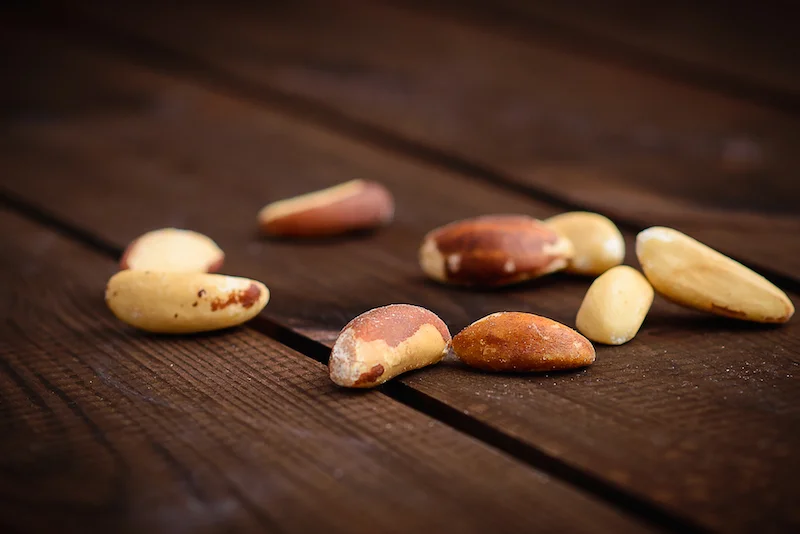
You may recall a write up earlier in the summer where I spoke about the importance of soaking your nuts and seeds before using them as a base for your smoothie. You can find that write up here, including an easy recipe and how-to for pre-soaking your nuggets. I love using nuts and seeds in a smoothie: they add wonderful healthy fats, give a good plant-based hit of protein and offer some vital vitamins and minerals that are essential to the body's functioning. As if that wasn't enough, they are also good sources of fibre, helping to bulk up your stool and move spent metabolic waste and toxins out of your body so that your engine can run clean. GOOD WORK.
Smoothies are an integral part of the Wahls Protocol, a protocol developed by a Functional Medicine Doctor in the United States named Terry Wahls who was diagnosed with Multiple Sclerosis a number of years ago. She did extensive research into how diet and nutrition could play a role in her health and wellness; she developed a protocol based on nutrient density and foods that would help 'mind her mitochondria'. Dr. Wahls is a big believer in loading up on a variety of colours in your fruit and veg, and ensuring the good things are in the mix here.
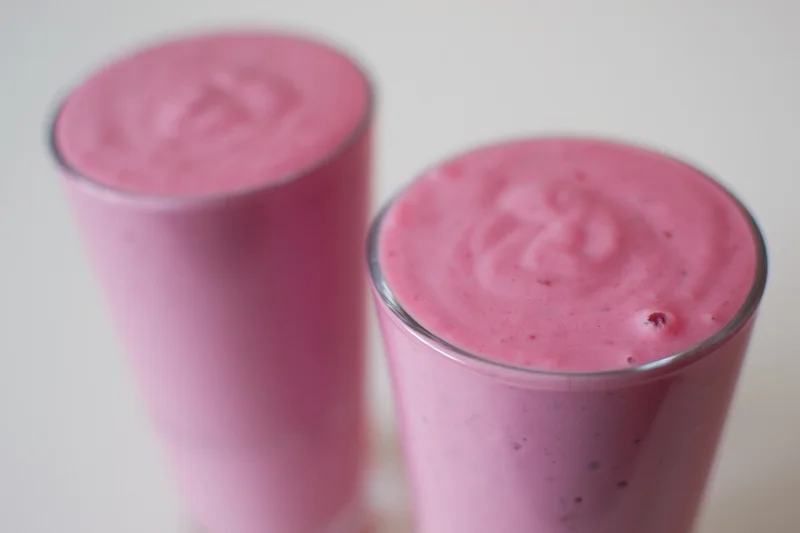
So let's break down the template, shall we? Here is my smoothie equation for you:
Greens + Berries + Fat + Fibre + Extras
+ The Liquid
Let's go item by item to get the gist of what this means.
GREENS
This is an important part of the smoothie, and a great way to boost the nutritional content in your smoothie. You can find an extensive write up as to why greens are good for you here at an earlier MHB post. These foods are mineral rich and offer great support for detoxification and overall lowering of inflammation. Including a handful of greens or a cup of chopped greens or herbs in your smoothie is a super idea.
If you have a thyroid condition, consider using swiss chard instead of kale or spinach, as these last two foods have goitrogens, which have been shown to slow down your thyroid's function. Reach for romaine, or add some herbs as greens. Mint imparts a most delicious flavour, and ensures those minerals you are looking for here.
Smoothie-approved greens (1-2 cups):
kale
collards
spinach
swiss chard
lettuce
parsley
sprouts
bok choy
beet greens
sorrel
dandelion greens
nasturtium leaves
borage leaves
Organic is always best, as greens have been shown to have a pretty high pesticide residue and so are listed on the 'Dirty Dozen' list as ones you should pay the extra dollar for. Find that information here.
Another idea you can try is to dry your own greens and mince them up, adding a tablespoon of them to your smoothie. Find the how-to here.
BERRIES
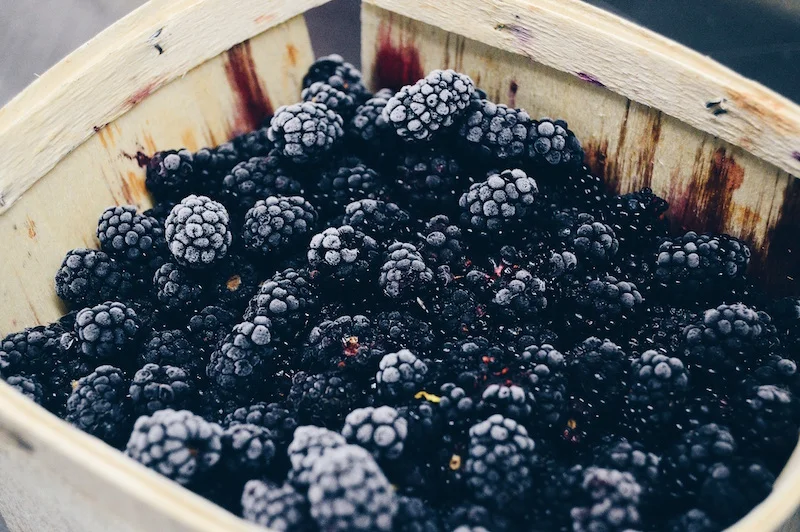
Smoothies are typically sweet tasting. Adding fruit is a wonderful idea and a brilliant natural way to add that sweet taste. My recommendation here though is to stick to low glycemic load fruit, things like berries, or maybe apples or pears. I highlight berries because they're easy to keep in the freezer. They don't spoil as readily when purchased frozen. I love the idea of frozen berries too, seeing as they typically freeze freshly picked berries close to where they were picked. (True for other fruit and veg as well.) This allows the berries to fully ripen on the vine, which ensures a more nutrient-dense end product. Go for frozen berries.
And add a good cup or cup and a half per serving.
Vary your berries from one purchase to the next, in order to offer a variety of nutrients. You should know, most berries are fairly high in pesticide residue as well; it is something you may want to purchase organically. Read up on the why here.
Another benefit to berries is the high fibre content, and also the high amount of antioxidants found in these deeply hued berries. These antioxidants help neutralize that free radical damage that happens in our bodies, especially helpful in slowing down the aging process and protecting our cells from the inside out. These nutrients are of tremendous support to the liver in keeping your engine running clean.
FAT
In addition to the points mentioned above, fat is also incredibly important in helping balance hormones, and keeping us satiated. Fats are key providers of nutrients necessary to reduce inflammation.
My fave smoothie go-to-fats (choose 1 or 2):
1 tablespoon of coconut oil, cacao butter, nut or seed butter or straight up butter/ghee
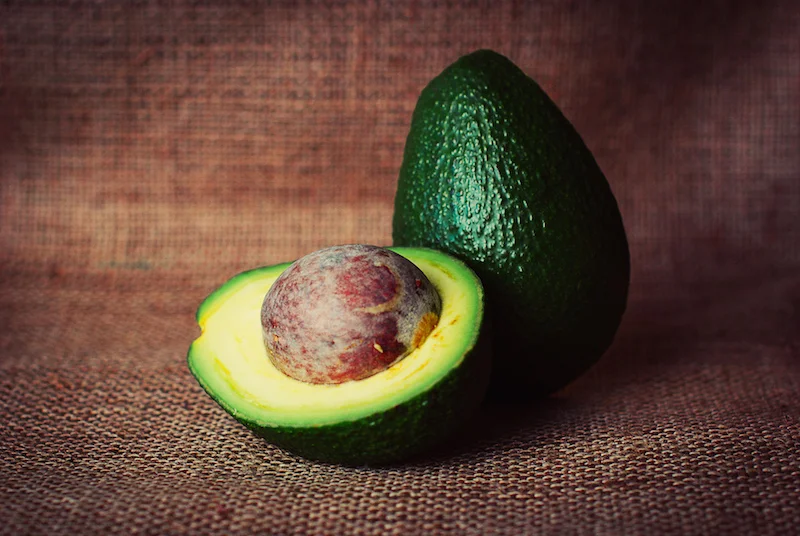
keep it plant-based by adding a half of an avocado (they freeze beautifully)
1 tablespoon of olive oil; delicious flavours at Blue Door Oil + Vinegar
a handful of nuts or seeds (pre-soaked of course!)
you can use 1/4 cup to 1/2 cup of homemade creme fraiche (the how-to is here)
1/2 cup of homemade greek yogurt (read up on why it's wise to make your own here, including full instructions)
FIBRE
Fibre is just so integral to helping usher out spent metabolic waste and toxins our body is looking to get rid of. I did a wee blog post on the importance of including fibre here. The seeds listed below also happen to have a good amount of omega 3 fatty acids, which will help in reducing inflammation.
I recommend here you include 1-2 tablespoons per person:
chia seeds
hemp seeds
flax seeds
EXTRAS
This is where you get to be creative. Depending on what kind of health concerns you are currently working through, seeing a Holistic Nutritional Consultant may be of benefit when it comes to figuring out this piece. I know a gal. I can hook you up.
These are all optional; you can pick none, or one, or three to add to your final smoothie. Look for these at your favourite local health food store, or check out The Light Cellar on Bowness Road in the NW of Calgary. (* denotes you should only add at the time you are blitzing the smoothie together)
1 tsp matcha green tea powder or 1 tsp moringa leaf powder– great for adrenal support!
1 tsp minced seaweed – extra mineral boost, liver support (spirulina is my fave)
1/2 tsp to 1 tsp of cinnamon
1/2 tsp to 1 tsp of fresh minced ginger – liver support, reduces inflammation
1/2 tsp to 1 tsp of fresh minced or dried turmeric – anti inflammatory
1 tsp of vanilla powder – antioxidant support
1 tsp of cocoa powder – if it's raw, extra antioxidant support
1 tsp colostrum – immune and gut support
1 tsp of medicinal mushroom powder – good write up found here on The Light Cellar's website
1 tbsp of dried nettle leaves - liver and inflammation support
1 tsp of holy basil loose leaf tea (aka tulsi tea) – excellent support for histamine intolerance issues, migraines, inflammation and adrenal support
1/2 tsp bee pollen - for inflammation, although not recommended for pregnant women or women hoping to get pregnant
a scoop of collagen powder* - for gut support (this one is my preferred)
a raw egg yolk* – make sure your chickens were pastured; conventionally raised eggs have possible contamination issues like E.coli and salmonella
1-2 tsp of cod liver oil – nutrient density at its finest, good for your entire body (find a lemon flavoured one - the best)

My medicinal mushroom tea with reishi, chaga, astragalus, ginger, cardamom, turmeric, pepper
THE LIQUID
You obviously need to add some liquid to make this a smoothie. To the blender, I would add 1 cup of any of the following:
water (warmer is better - filtered is de rigueur)
tea – dandelion root, rooibos, rose hip, ginger, green tea, nettle, lemon tea
kombucha
water kefir
any non alcoholic fermented beverage you have on hand – excellent way to include probiotics
milk kefir (or coconut kefir if you can't tolerate dairy)
a cup of any of these liver-loving teas (medicinal mushroom brew recipe included)
Make a big pot of medicinal mushroom tea, and stash in the fridge once it is complete. You can pull from this stash for a week at least.
BATCH PREP IS KEY
Batch cooking really is key here to making this a do-able thing. I recently spent a full day with a friend preparing meals for her freezer for easy retrieval; she was about to undergo major medical treatment and wanted some ready-made easy-prep things in her freezer to pull out in order to ensure proper nutrient density for those days when food wouldn't necessarily be so appealing, nor would the energy be there to prep a meal.
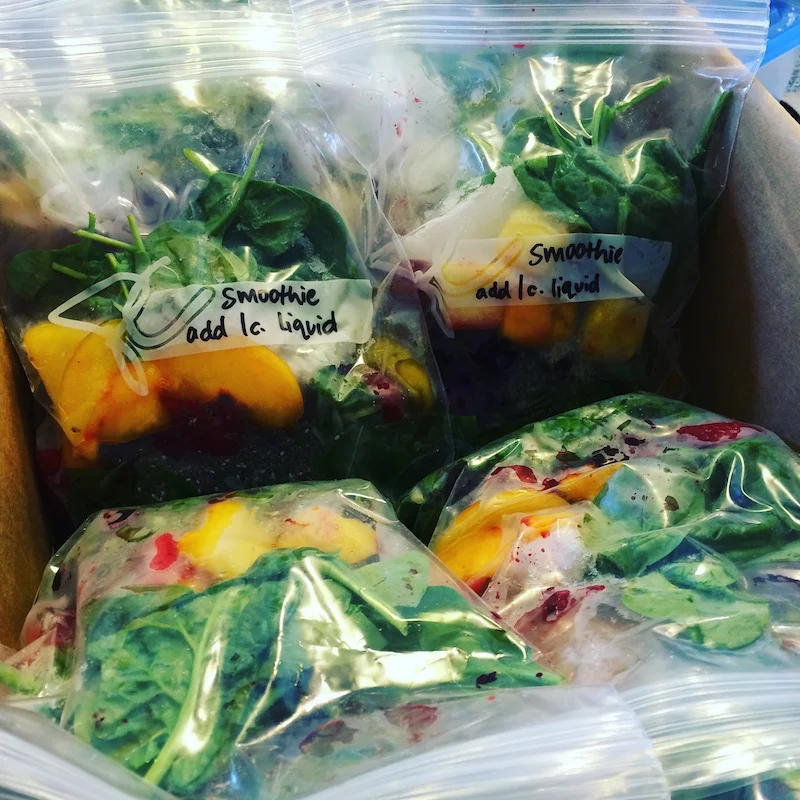
She purchased big containers or bags of greens, berries, ensured she had good fats, seeds for fibre and some tasty extras. We assembled about thirty little freezer bags of smoothie essentials. It took all of 15 minutes to put it all together. We set medium-sized freezer bags propped open in a box, and dumped a handful of spinach in each bag, a handful of slivered chard (without the stems), a cup of berries, a few slices of peaches, a tablespoon of coconut oil, a tablespoon of chia seeds, a teaspoon of matcha green tea powder. We wrote on the bag to include some creme fraiche and a cup of kombucha for the day she will be using the baggies. Easy peasy.
On days where she wants a nutrient dense easy meal, all she has to do is take it out of the freezer, add in some liquid, some warm tea and blitz the whole thing in her blender. Voila. Talk about good fuel for her days, and her body's work ahead.
This is a wonderful gift you can put together for a friend in need, or for a loved one about to undergo extensive medical treatment. New moms would love the ease of a quick nutrient-dense meal like this. Your older parents may love the idea of an easy breakfast at hand to go along with their daily buttered toast. Your kiddos away at university may find this saves them on their early mornings. Your littler ones may enjoy helping put together a batch of these baggies so they can start making their own breakfasts in the mornings.
This was a long post. Phew. Extensive. But I hope you find the template a do-able thing, and an easy thing to follow.
Greens + Berries + Fat + Fibre + Extras
+ The Liquid
Now go play with your food.
The information provided in this post is not intended to replace your doctor's advice. This is for educational purposes only. If your current health status is giving you cause for concern, it is best to seek out the support of your Medical Team before consuming any of the foods mentioned in this post.
MONDAY BASICS: go full fat.
This week's post is meant to help make sense of the info swirling about in regards to fat. Don't be wary, my friend. Go full fat.
This week's post is meant to help make sense of the info swirling about in regards to fat. Don't be wary, my friend. Go full fat.

I have talked about fat quite a bit in this here blog series, the Monday Health Basics. So today will act part fat-roundup, part explanation on why you need to ditch the zero percent and go full fat.
Why They Went Low Fat
Many a year ago, the food industry took a bit of a left turn, based on evidence from a study led by Ancel Keys. This study, “the lipid hypothesis” (erroneously) found that saturated fat was at the root of heart disease. The trouble is, this study was never able to be replicated in laboratories, not even remotely. In fact, many studies since have refuted Keys' original claims, outlining that in fact saturated fats are protective to not only the heart, but also the liver.
There is an interesting article that recently came out about the role the Sugar Industry played in this whole scenario. NPR did a comprehensive round up of the information; I urge you to read this article. See, in helping to influence the national debate and persuade their nation's population to eat low fat in order to (again, erroneously) ensure health, the fat that was taken out of foods would have to be replaced by something else. Can you guess what this would be?
SUGAR.
Yes yes, sugar. Consumption of sugar after the 'low fat' craze first exploded went up a third per person than what was consumed prior to these claims surrounding low fat. (It's one of the main reasons I argue we should Just. Eat. Real. Food., in order to reduce additives and hidden sugars.) And too much sugar? It contributes to inflammation in the body.
As you can imagine, in the days following the 'low fat! 0%!' craze, sugar intake went up, fat intake went down. Funny though, average weight per person did not go down; in fact, quite the opposite. The rate of chronic diseases went up, occurrences of diseases with an inflammatory component went up and are still on the rise. (For a more comprehensive and lengthy look at the importance of including fat in your diet, please visit this article I posted previously, “eat good fats”. Further reading: it is no surprise that I am a big believer in butter. Yes please, eat butter. Put that s**t on everything. Need more convincing on the importance of including good fats in your diet? Let's talk anti-inflammation with EFAs.)
The main idea of why fat is important
Why then, do we need fats? The Coles Notes: for the fat-soluble vitamins found within, vitamins A, D, E and K. These vitamins are fat-soluble, which means we need them to be attached to fat in order to get them in to our bodies. (If you are interested in reading up on the importance of including these all important vitamins, head to this article for a comprehensive look.) And it is these important vitamins that we need in order to reduce inflammation in the body, and maintain cell wall integrity in the gut. These nutrients go miles in helping balance hormones, better supplying fuel to our brain and adrenals and ensure an even keel for your body. They are essential.
The fat component of these foods is also critical in again helping balance our blood sugars, which goes miles in keeping inflammation at bay. These fats supply the ingredients we need to make all of our hormones, support brain health, protect our hearts and livers, balance hormones and the list goes on.
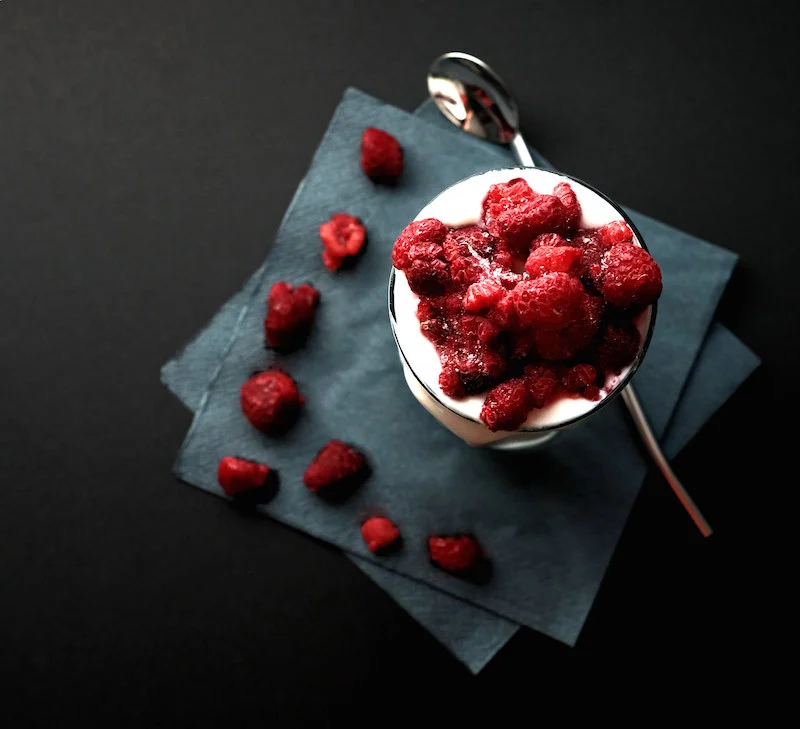
The goods
Let's get down to the nitty gritty. Most of the foods we are talking about in today's post are dairy products from the grocery store: think milk, yogurt, ice cream, sour cream, cottage cheese, cheese, cream, kefir, cream cheese, etc.
This rule though also applies to other commonly purchased ingredients: salad dressing, mayonnaise for starters. There are quite a few packaged items that are now coming out with 'low fat!' claims or '0 fat!' claims.
My recommendation to you is to ditch the low fat version and reach for the one on the shelf indicating a higher fat percentage.
Instead of the 1% cottage cheese, find the 5%! If skim or 1% milk is what your family drinks, aim to move up the fat percentage over time. Can you start with 2%, and go up to 3.25% over time?
Get rid of the 0% ice cream; they just rounded out the taste of the ice cream with more sugar. Yes, that's right: flavour, as we experience it, is locked in fat and sugar. Take one of those away, and you have to up the other!

Using 5% cream in your coffee in the mornings? Consider going a higher percentage. Whipping cream! Why not? You'll only need a little bit. I put whipping cream in my morning cuppa. In fact, I have a whole write up on how fat can be of service if you're a regular coffee drinker; find that article here.
Love that store bought greek yogurt, but now realizing it's 0%? Learn to make your own, using full fat yogurt. Head to this article for the how-to.
I know a few readers will think they're scott free seeing as their houses do not have any dairy in the fridge. I urge you to reconsider any packaged food items with 'low fat' claims; think mayonnaise jars with 'low fat' promises, 'fat free' salad dressings. The reason we add real fats to our salads? The reason we use real olive oil and delicious vinegars to our salads? Those fats ensure we are better able to absorb the minerals found in the vegetables of said salad. Head over to this article to get the lowdown on how to make your own salad dressing – a surefire way to up that nutritional ante and support optimal health.
Want to learn to make your own mayo at home, without the rancid oils found in the jars at the store? I will point you to this easy recipe.
If you are someone who regularly consumes more egg whites and less yolks because of the fat content, I urge you to reconsider. Eat the whole egg, yolk and all. In addition to the good fats found in the yolks, you may be interested to know of the vitamin content of the yolks. Read up on eggs at this article I wrote a few months back.

And so my kitten, repeat after me.
Ditch the skim. Go Full Fat.
Now go play with your food.
MONDAY BASICS: on eggs.
This Monday Health Basics post centers on one of my favourite foods: EGGS. These nourishing morsels of goodness have been unjustly disparaged in recent years. Today's blog post aims to get you on board the egg train. Eggs: nutrient density at its finest.
This Monday Health Basics post centers on one of my favourite foods: EGGS. These nourishing morsels of goodness have been unjustly disparaged in recent years. Today's blog post aims to get you on board the egg train.
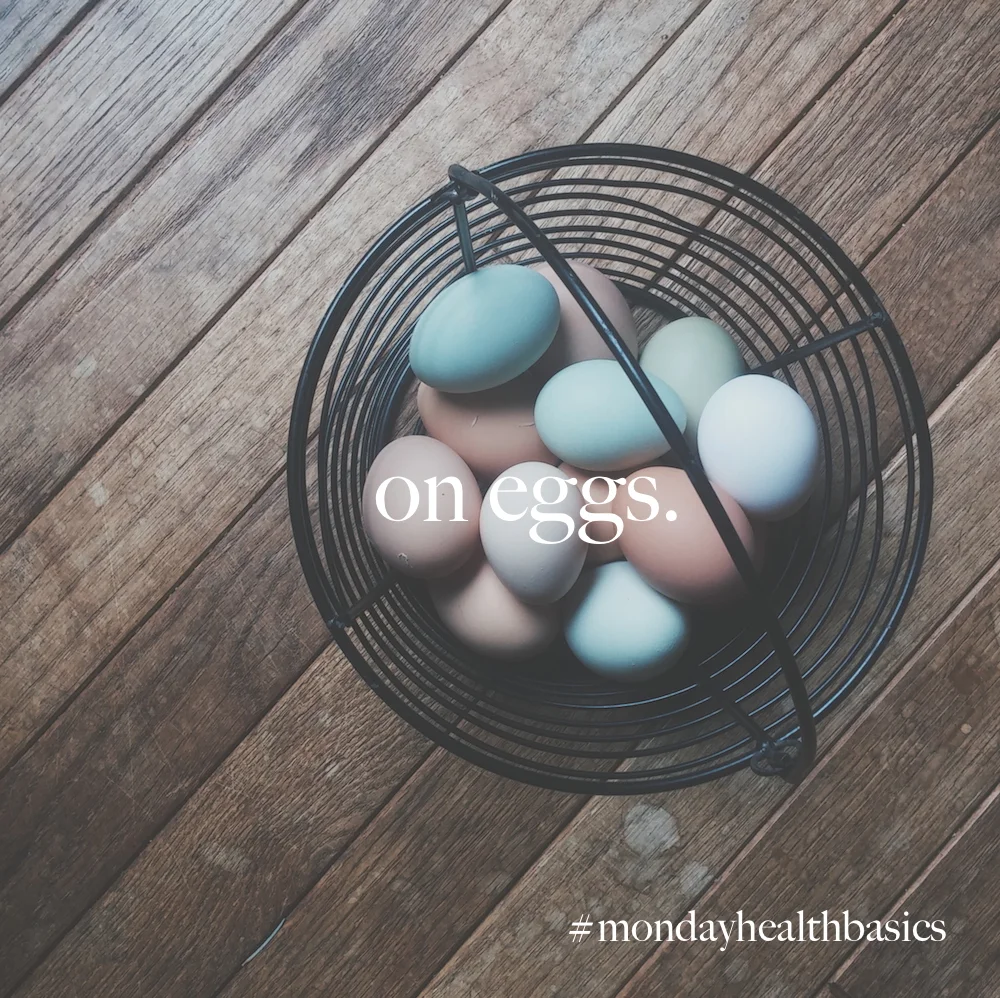
Eggs are one of my favourite foods, for so many reasons.
My favourite: they're pretty affordable! It must be said that not all eggs are created equal, however. Lisa Leake, the author behind the brilliant cutting-out-processed-foods book 100 Days of Real Food (and the blog of the same name) gives a complete rundown in both her book and her blog on what to look for in terms of words on the label. Go on over to get the rundown on what means what.
Eggs are my faves because they're usually quite easy to prepare, in good time. Eggs are a perfect busy-night kind of anchor to your meal. Toss veg in your hot pan with a good fat, add some flavours, and toss an egg on top and pop under the broiler for 10 minutes or so. Voila! Dinner is served.
Not sure which kind of eggs to buy for your family? I like to advise my clients to purchase the eggs they can best afford. With eggs, it really is a question of you get what you pay for. It's one of those foods that you really should budget to include the better kind on your grocery run. I myself tend to ask questions of the staff at my grocery store, wondering which kind they best recommend in terms of nutrition and bang-for-your-buck. You can also ask questions of folks working the stalls at the Farmer's Market too, they will be able to provide you with those important factors that will help you make your best informed decision on which eggs to purchase.
As for me, I have lucked in to two egg co-ops in town where we purchase the eggs from the farmers directly. I feel confident in supporting these smaller producers, knowing the product I am getting is from chickens that have safe access to the outdoors (free-range, pastured), with a nutrient-dense feed that best supports their lives as well. After all, you are what you eat eats. As Joel Salatin says, we must allow the chicken “to express its chickenness”. In so doing, we allow the animal to live as it should, which means it will produce nutrient-dense eggs as it should.
An animal that lives under stressful or unnatural conditions will produce far inferior eggs, lacking in those nutrients our bodies require to do the work of being and staying well.

I include eggs in our every day here at the house for nutrient density reasons. They are a wonderful source of complete protein, readily offering up those building blocks necessary for our body's building and repair work. The entire egg, both the whites and yolks contain protein, but it is interesting to note that the whites are mostly strictly protein. Protein is one of those important macronutrients you want to aim to include in every meal in order to help balance blood sugars, a key component to keeping inflammation at bay and supporting your adrenals.
The yolks are my favourite part of the egg, however. Do not toss those out! They contain those all-important fat soluble vitamins A, D, E and K. These vitamins play important roles in the maintaining the integrity of your intestinal lining which goes miles in keeping systemic and chronic inflammation at bay; they are key players in mental health and brain health. They are also key to healthy bone and teeth building, density and maintenance. These vitamins keep your skin healthy, and your heart and cardiovascular system pumping like a champ.
Lots of water-soluble vitamins are also found in the egg yolks. Look for B12, the vitamin linked to energy. Choline is also plentiful in pastured eggs – a crucial vitamin in the B family that we need to build cell membranes, keeping our cells as safe as Fort Knox. Choline is a key player in mental and nervous system health, as it is the precursor to important neurotransmitters, playing important roles in muscle control and memory.
Your eyesight benefits from regular consumption of eggs: they contain the antioxidants lutein and zeaxanthin. These beta-carotene powerhouses have been studied and show that they have protective effects for the eyes, reducing your risk of developing things like macular degeneration and cataracts.
Eggs are a fabulous source of cholesterol. This word is one that can ignite people, either for or against. I have two feet firmly planted in the pro-cholesterol-in-foods camp. The negative rap given to cholesterol (and saturated fats, of which there are loads in eggs!) was based on a research paper published by Ancel Keys in the 1950s that has since been disproven. It is a hot button topic, and one that may be a bit too big for a Monday Health Basics post. For a concise article outlining the health benefits of cholesterol, I invite you to read this article by Dr. Mercola, in order to get the goods. Suffice it to say, in conclusion, the cholesterol we eat does not have a big impact on the cholesterol levels in our blood.
Cholesterol is an integral component to all cell walls, keeping them rigid and strong. Cholesterol is an integral component to all hormones, as well as a part of every bile acid your body produces. Without adequate cholesterol, your ability to digest may suffer. And if that isn't enough, 60% of your brain is made of cholesterol. You need this cholesterol to form and retain memories, and to learn new tricks. Ergo, eggs are a BRAIN SUPERFOOD!
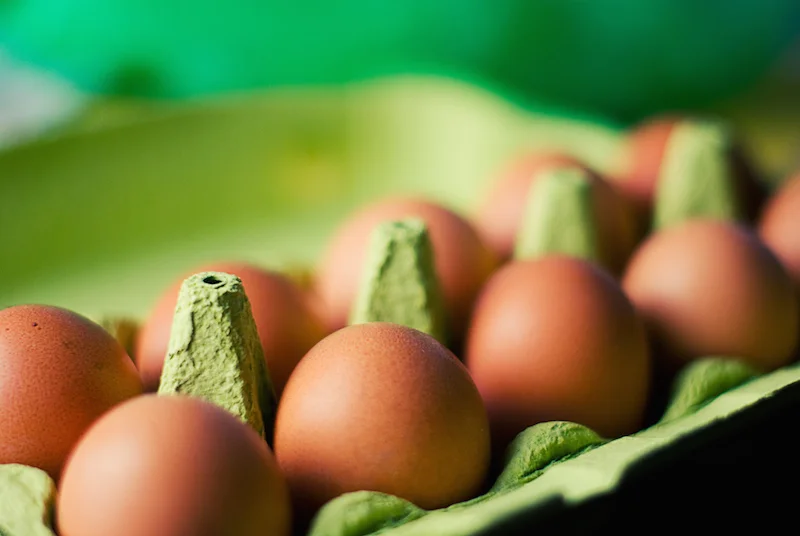
Speaking of brain food, if you are buying your eggs from a good pastured source, you can also count on those nuggets to contain the all-important Essential Fatty Acids! (EFAs). These are the fats we need to keep inflammation at bay, and our brain running like the well oiled machine it is. EFAs also contribute to healthy skin, improved digestion + elimination, heart health and eyeball health too. And liver health. Oh geez, those EFAs.
In case this needs mentioning again, healthy sources of fat like those found in eggs help mitigate the negative effects of blood sugar spikes, keeping all things level. This means then that including good fats in one's diet will go miles in supporting adrenals, and in keeping low-grade chronic inflammation at bay. Yay fat!
Lest we forget, eggs offer us a gamut of essential minerals in our diet, especially those that may be a bit tricky to find. They offer us a good source of selenium, an essential antioxidant that also plays a key role in our thyroid health. Iodine is also provided here, supporting the thyroid and helping protect against certain cancers, especially breast cancer. Iron is another important mineral readily available in eggs, helping replenish the iron stores for women during their monthly cycle, and a mineral essential to energy. As if that wasn't enough, you'll also get a good hit of zinc in your meal if you are having eggs, an important antioxidant integral to immune health and digestive wellbeing.
How to know if your eggs are top shelf?
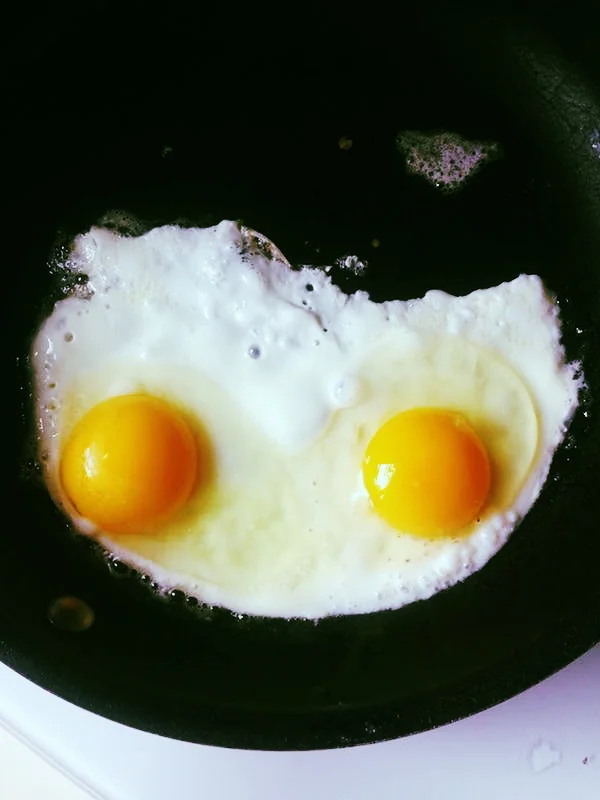
You want to make sure your egg yolk is closer to orange in colour as opposed to yellow. Hens that have access to the bugs and grass outside will have a richer complement of nutrients, which will translate to a more orange-hued yolk.
Have a question about white egg vs. brown egg? The colour of the shell has nothing to do with the nutrients found within. Rather, it has to do with different breeds of chickens; some produce brown eggs, others white, and yet another kind will give you a greener hued egg. Or pinky. Really, it's all the same. As long as you are sourcing eggs from hens that have been able to have safe access to the outside world, and given a protein-rich feed, you are good to go.
How best to prepare your eggs:
You want your yolk to be as runny as you can take it. Allowing it to stay runny means it will be closer in nutrient content to the raw yolk, which is the most nutrient-dense way to consume eggs. Cooking the yolk alters the content of the yolk, but it is still good! Just aim to be on the runnier side when making your eggs tomorrow morning, and you will be well served. (We call them eggs with yellow sauce at our house. Yum.)
I have had the chance to lead a group of Junior High students in a weekly cooking class for the last two years. Our first class is always about the humble egg; I must tell you we always start with Russian Custard, a raw yolk and honey delight. So far, no one has refused to try it! And they have all enjoyed the rich and satisfying taste of this easy peasy snack, save for one student. My caveat here, if you are consuming raw egg yolks, is to make sure it is from eggs that have been allowed out on pasture; conventionally-raised eggs carry a higher risk of salmonella poisoning.
I used to work with a fellow who was well versed in food and nutrition things. He said he thinks of his eggs as his source of multi vitamins; he aims to have at least two a day, in order to best supply his body with those nutrients necessary to optimal health. On the GAPS protocol, a gut-supportive protocol that profoundly affects my practice as a Holistic Nutritionist, the author Dr. Natasha Campbell-McBride recommends daily consumption of eggs once the initial Intro stages are done. She recommends one can consume up to 8 eggs a day, once you are able to safely digest them.
Eggs. Nutrient density at its finest.
How do you prepare your eggs?
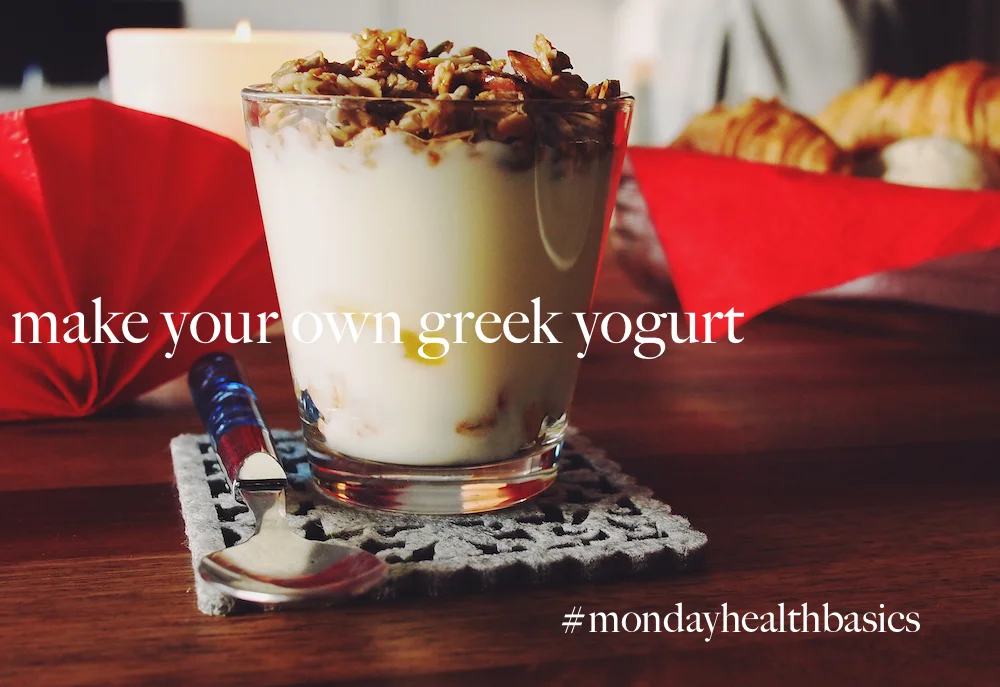
MONDAY BASICS: make your own greek yogurt
Good Monday morning! This week's Monday Health Basics post is a quick and dirty one – and one close to my heart. It talks about two of my favourite things: dairy and fermentation. This blog post is for you if you like dairy. This blog post may also be for you if you are saying to yourself right now “Well Luka, I can't do dairy because I'm lactose intolerant”. It may also be something you want to check out if you find yourself reaching for that greek yogurt at the grocery store.
Yep, I'm a DIY kinda gal. Yep, I'm a good food kinda kid. Today's post is about how to maximize that probiotic hit, lowering the lactose and making sure that greek yogurt in your breakfast bowl is best going to support you through the day ahead.
Good Monday morning! This week's Monday Health Basics post is a quick and dirty one – and one close to my heart. It talks about two of my favourite things: dairy and fermentation. This blog post is for you if you like dairy. This blog post may also be for you if you are saying to yourself right now “Well Luka, I can't do dairy because I'm lactose intolerant”. It may also be something you want to check out if you find yourself reaching for that greek yogurt at the grocery store.
Yep, I'm a DIY kinda gal. Yep, I'm a good food kinda kid. Today's post is about how to maximize that probiotic hit, lowering the lactose and making sure that greek yogurt in your breakfast bowl is best able to support you through the day ahead.
First things first.
For people who have a hard time with dairy, it is usually due to one of two things. Either you have an issue with the protein found in yogurt (casein), or the lactose (sugars) is causing you ills. And discomforts. And just not usually worth it. If your issue is with casein, this is not a blog post for you. Sorry friend. Return next Monday for something entirely different.
But you say lactose may be the culprit of your turning away from dairy? I may just have a wee trick up my sleeve for you.
Store-bought yogurt is fermented anywhere from a short stint of thirty minutes to six hours. The timeline depends on the company's manufacturing process, and also on the strains of probiotics they are using to do the fermentation. Depending on the manufacturer and their methods, at this point they add their extras (sugar, agave, fruit, honey, artificial or real flavours, sometimes colouring, in some cases a thickener, sugar disguised as something else) and then packageit up and off to the stores they go. (If you want a more well-rounded version of this process, you may want to check this article out.)
If you are not yet aware of the magic of fermentation, might I send you here for a primer. The beauty of fermentation when it comes to dairy products is that the process itself takes care of the lactose, conjugating it out of the mix. What this means: the probiotics that are introduced to the milk get in there and cleave apart the double sugars or disaccharides called lactose, leaving behind two simple sugars or two monosaccharides, namely glucose and galactose. Poof, like magic, no more lactose! Well, sort of. It all depends on the amount of time the milk and probiotics have together in a warmed environment in order to do that work. And in that short time of a half hour or even six hours, that is just not enough time to get all the lactose converted into the simpler sugars glucose and galactose. So what can we do to make that yogurt we purchased a lactose free delicacy? Read on, yogurt loving friend.
First off, get yourself some delicious yogurt. Make sure it is plain, with no additives thrown in to alter the chemical make up of your yogurt. Vanilla yogurt does not count here. Vanilla is a flavour. PLAIN JANE. You want to choose a yogurt that has no fruit, no sugar, no colours, and a yogurt that still has the bacteria alive in there; in other words, you want your yogurt to be probiotic.
How to make sure it's a probiotic yogurt: somewhere on the label, you will read the word 'live' or 'probiotic' or 'with probiotic cultures'. It may also list the strains of bacteria that were used in the fermentation process. Even better. (The discussion on whether or not to purchase yogurt made from milk that has been homogenized or not is a question for another day. But I would caution you to reach for organic yogurt whenever possible. Curious as to good brands to find in Alberta? Point your browser here to Organic Alberta.)
Now that you've taken home your plain jane probiotic yogurt, you are going to leave it on the counter.
Yes, on the counter in the kitchen. Pop your lid a smidge, just to let it breathe should the container expand during the extra fermentation process. You are going to allow this container of yogurt to remain on the counter for a full 24 hour period. If you purchased a still-live yogurt product, this is a perfectly fine thing to do. As the product is fermented and still contains those live cultures, your yogurt is a very stable product, and will not be prone to developing funky things or harbour bad bacterial cultures. After that full 24 hour period, you are going to seal up the yogurt container and put it in the refrigerator.
What you have allowed in that 24 hour period is an opportunity for the probiotics found within the product to further ferment, thereby increasing the numbers of probiotics. (That means more bugs. More probiotics.) And not only that; those good bugs went through and cleaved even more of the lactose molecules, freeing them up into those simple sugars that are easily recognizable and good fuel sources for the body and your brain. GOOD WORK. And thank you probiotics.
Incidentally, if you are a DIY yogurt maker at home, after that initial incubation period, allow your yogurt to remain on the counter to finish up a twenty four hour cycle in order to allow those lactose molecules to be broken in two.
Voila, just-about-lactose-free yogurt!
IF YOU ARE A GREEK YOGURT LOVER, READ ON.
So now that you have the lactose free bit, you're ready to add another tool to your arsenal of tricks.
Greek yogurt seems to be just about everywhere these days. The main reason people reach for this thicker yogurt is for the higher protein content. Folks also like the thicker consistency; it makes for a pretty yummy and substantial smoothie first thing in the morning. I challenge you to read your labels though: take a gander to see what is included in the list of ingredients on that greek yogurt container. I bet you the list will include things like skim milk powder, or corn starch, or carrageenan, or some other kind of stabilizer, emulsifier or thickener thrown in to keep it just-so. I am not a big fan of additives, as they aren't things that have been traditionally found in our diets. I just don't think we're able to evolve fast enough in order to assimilate and utilize the additives we ingest. And I don't want to leave it to chance, in the hopes that I can evolve fast enough.
Here are my issues: skim milk powder is a by-product of food manufacturing. It is a processed food. And not lightly so: the whole process of making skim milk powder involves quite the protocol, and the end result is that the cholesterol naturally found in milk ends up becoming oxidized cholesterol. Oxidized cholesterol has been shown to contribute to the production of plaques in the arteries, or atherosclerosis. Carrageenan is derived from seaweed (which I love) but it is in such quantities that it has been shown to contribute to increased inflammation in the body, creating havoc in the digestive system.
I like my food as it was meant to be: food. And so my dear thick-yogurt-loving-friend, I have an easy DIY way for you to make it at home.

MAKING YOUR OWN GREEK YOGURT
Line a sieve with a clean doubled-over tea towel. (*make sure the tea towel hasn't been thrown in the dryer with any dryer sheets – the chemical residue is not something you want to ingest!)
Dump the container of yogurt into the strainer, allowing it to separate at room temperature. (This can be a part of your 24 hours on the counter timing if you are aiming for a lactose-free final product.)
What will drip through to the bottom of the bowl will be a yellowish-clear liquid: this is your WHEY. Don't throw this goodness out! I will speak to this in a moment.
The milk solids remain in the strainer; when the yogurt/milk solids are a consistency to your liking, this is when your DIY greek yogurt is ready. Scoop it out with a spatula, and tuck it into a container of sorts in to your fridge, it is ready to consume. And nary an additive to be found!
As for the remaining whey that dripped through the tea towel, this is liquid gold. It is protein-rich, and a fabulous addition to your morning smoothies; you can use it to help sprout, soak or 'activate' nuts / seeds / grains / beans / legumes. You can add it to soup stock in order to increase the protein and add probiotic benefits (but only do so after you have taken the soup off the heat). Whey is full of probiotics that help improve and support optimal digestion, and provide your body with the precursors to glutathione, helping your liver to do the detoxification work in the body.
Put that greek yogurt on everything.
It's yummy mixed in with berries and maple syrup. Try a big dollop on top of protein pancakes. Mix it in to your butter chicken instead of using cream, and now your lactose-intolerant friend can partake in dinner! Blitz it with a bit of honey and some lemon juice, and you have yourself the perfect salad dressing. Slap it together with some chopped strawberries and some granola, and breakfast will now render you a champion. I mean you can't go wrong, amiright?
MONDAY BASICS: soak seeds for smoothies
This post is for those early birds who are regular consumers of smoothies come morning time. This next in the series of #mondayhealthbasics goes over some basic easy steps you can take in order to make that smoothie really count and nourish you from head to toe. Today's tip will ensure you are better able to digest your morning elixir, and what kinds of things to add in order to make that breakfast smoothie sustain you for longer periods.
This post is for those early birds who are regular consumers of smoothies come morning time. This next in the series of #mondayhealthbasics goes over some basic easy steps you can take in order to make that smoothie really count and nourish you from head to toe. Today's tip will ensure you are better able to digest your morning elixir, and what kinds of things you can add in order to make that breakfast smoothie sustain you for longer periods.
Smoothies come in all shapes and sizes, and the only thing between you and the flavours to wake your taste buds is your imagination. Some folks go for a non-dairy milk as the base: think coconut milk, or flax seed milk, almond milk or coconut yogurt. Others go for the full on dairy, from straight up milk to yogurt to kefir. (I do love me some creme fraiche for my quick smoothies.)
I'm going to offer an alternative to you today:
seeds and nuts as your smoothie base.
Why seeds and nuts, and not their milks you ask? For one, the packaged dairy-alternative milks you find sometimes list carrageenan in their ingredients. For a good primer on just what is this additive we often see listed on the label, check this post. (For folks who may have some digestive issues, this is one of those food additives that may be contributing to irritation and inflammation in the gut.) So omitting it might be a good idea, if you're looking to bring down inflammation in your body. (Have you heard me go on about inflammation yet? Inflammation is really at the root of just about every chronic degenerative disease out there. Find out more about inflammation and how to tame that beast at a talk coming up this Sunday the 10th!)
In order to eradicate this additive from my diet, I just make my own nut and seed milks. But sometimes, I don't know about you, but there is only so much time in the day.
Enter: THE INSTA-BREAKFAST.
Well, kind of insta-. As insta- as it gets in this house. This is inspired by a recipe from Dr. Carolee Bateson-Koch's book Allergies: Disease in Disguise and serves as a powerhouse of anti-inflammatory fats, good source of minerals like calcium and magnesium. Adding these nuts and seeds to your morning smoothie will also provide your body with satiating protein and fat, helping you go the distance.
But we aren't talking just throwing in some nuts and seeds to the blender when you think of it. No. We're allowing these nuts and seeds to hang out soaking in water overnight before blitzing them into breakfast delicious.
Why pre-soak these nuggets? See, it's all about de-activating the phytic acid and enzyme inhibitors in the nuts and seeds. Enzyme inhibitors and phytic acid are Mother Nature's way to ensure survival, but not for you; rather for the seed making its way through your digestive system. These two compounds are in all nuts and seeds and grains that will one day, make it into a whole plant form.

Imagine a fox. Little foxy is meandering through a field of oats. She takes a nibble from one of the plants and feasts on some oat seeds. She feels good, she feels satiated, so she lies down for a nap. But these seeds she ate? They were full of phytic acid (the plant's way of storing phosphorus) and enzyme inhibitors. As they make their way through the fox' digestive tract, the enzyme inhibitors turn off little foxy's enzymes, which means now she can't break down the seed and thus won't get the nutrients in the seed. (This is all done in order that all of the nutrients and minerals held within the seed/nut/grain can remain in the seed.)
While this non-digested seed winds its way through the fox' gut, the phytic acid also pulls out minerals from her stores, depleting her of important trace minerals necessary to bone building, enzyme production, metabolism, detoxification, I mean the list goes on. When this little undigested morsel of oat seed exits her digestive tract via her stool, that seed (fully intact!) will now be ready to grow into a plant. As it makes its way through her digestive system by "soaking" in the fox' digestive juices, this process deactivates the phytic acid and signals to the seed that it's time to grow. But it's only with time that this deactivation happens. You need a minimum of six hours. (Anybody ever heard of soaking their pea seeds the day before planting? It's the same thing.) Good work, seed!
Sorry little foxy. You were robbed.
How to get around this you ask? We must fool Mother Nature. NO WAIT. We must work with Mother Nature. We need to mimic what she's come up with. This means soaking your nuts/seeds/grains BEFORE you eat them so as to ensure you turn off those enzyme inhibitors found in the seeds. They will no longer be able to prevent you from getting the nutrients found within. Additionally, by properly preparing your nuts and seeds before consuming, you will retain those important trace minerals the phytic acid would have pulled out of you on its way through your system because that compound is turned off.
Sure, sometimes I prepare big batches of nuts and seeds and then store them in freezer bags once they are dehydrated. But I just can't be that far ahead of the eight ball most days.
So here is my shortcut, for the person who'd rather do a small batch for their next morning's breakfast. This one will make two tall glasses of the good stuff.
THE PLAYERS
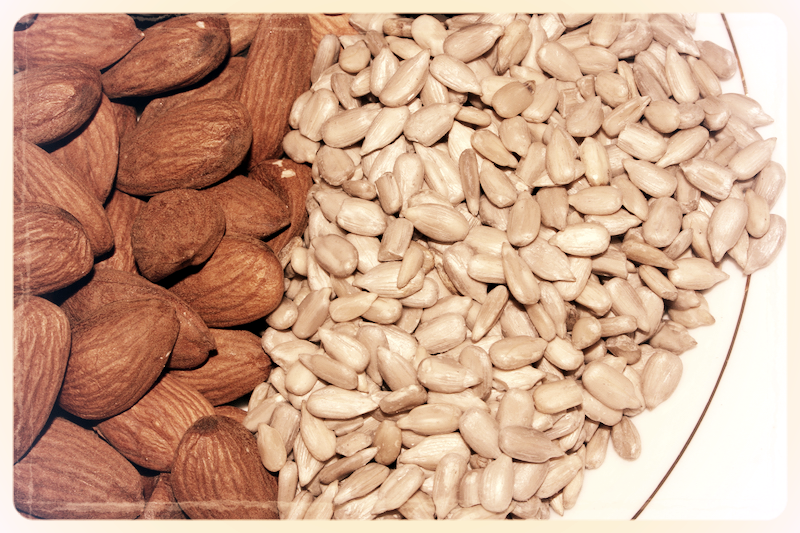
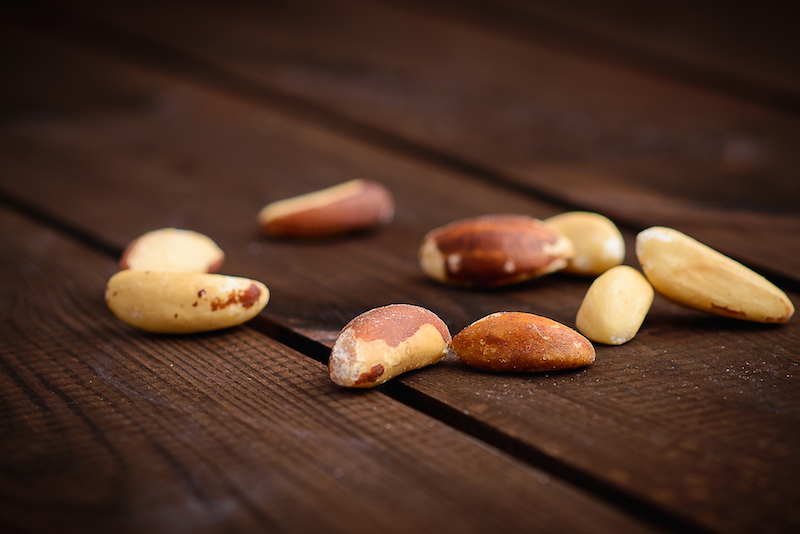
3/8 cup of nuts and seeds, combined (I love pumpkin seeds, sesame for the calcium, flax and brazil nuts but you can use whatever you have on hand)
3/4 cup of filtered water
THE HOW-TO
The morning before you plan to have this smoothie, measure your nuts/seeds mixture into the filtered water, cover and let sit on the counter for 24 hours, until tomorrow's breakfast. For added benefit, I'd add a tbsp of a ferment like kombucha or water kefir, or some whey from yogurt or kefir in my fridge. (Say goodbye, phytic acid! Sayonara, enzyme inhibitors!)
The next morning, blitz this mixture in your blender along with an additional cup of filtered water. You will be consuming the whole seed! No milking required!
You can add whatever you usually add to your smoothies at this point. I usually include about a cup and a half of frozen mixed berries, sometimes a banana, a little bit of maple syrup and voila. Down the hatch. Delicieux.
Of course you could add some swiss chard for the super-greens kind of effect (less of a negative impact on your thyroid than kale ), or an apple for extra fibre. I always make sure I have some good fats in my smoothie, in order to help slow down the absorption of sugars into my bloodstream and help carry me and satiate for longer periods. For me, this usually means creme fraiche, but you could add some coconut butter or coconut oil, or good old butter if you'd like.
Baby steps, my friend. Baby steps.
Soak those seeds for your smoothies. Love your guts. And bones. And liver. And heart. And brain. And every other sweet part of your body is attached to that gut.