
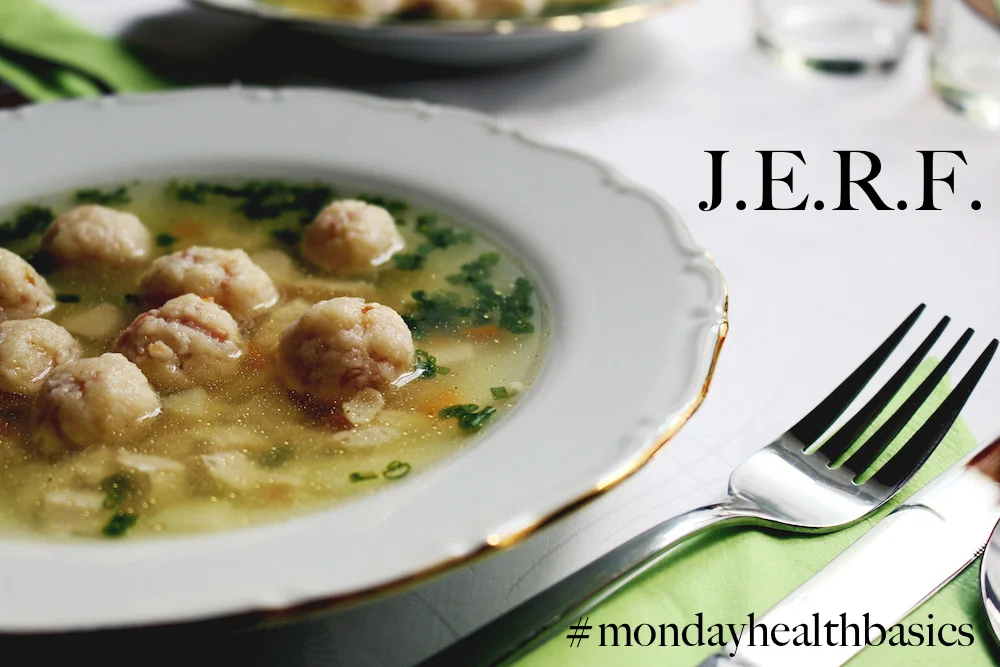
THURSDAY BASICS: J.E.R.F.
Next up in this year-long revamped series now called Thursday Basics is perhaps one of the most revolutionary actions you can take in order to ensure yours and your family's optimal health. It's about JERF. Just. Eat. Real. Food.
Happy Thursday! Here we are, with another revisit to the now-rejigged Monday Health Basics from 2016.
We’ve gone over some of the little things or some ideas you can implement to your day to day life to help support the good health. We’ve talked about some lifestyle ideas to support you in this work, and other things you can implement one at a time. (Scroll back through the blog!)
But this one. It’s really at the core of what I do in Holistic Nutrition, how those good foods can help support you with vitality, how foods can nourish resiliency, I mean without getting too onerous, how to make your kitchen your ally.
JUST. EAT. REAL. FOOD.
COLES’ NOTES:
1. We're talking simple, delicious and easy meals that are good enough. And good enough is good. And that's enough.
2. Start by making dinner at home once a week, if you’re new to this. Figure you’re well seasoned? Learn to make a homemade version of one of your packaged staples like say, Butter Chicken sauce.
3. Sheet Pan Dinner recipe included.
Read on for some ideas and things that might make you go hmmmmmmm…
Next up in this year-long series called Monday Health Basics is perhaps one of the most revolutionary actions you can take in order to ensure yours and your family's optimal health. It's about JERF. Just. Eat. Real. Food.
I've been catching up on a little television these last few days, holed up with a pretty good bout of the flu. I've had the chance to watch a few episodes of the Netflix series Cooked by Michael Pollan. (I highly recommend you track this one down.) In it, he explores food and our relationship to it through four different lenses: fire, water, air and earth. It's not about rocket science (although how that fellow roasts pig is pretty darn close to rocket science I think); it's more about what it means to be nourished by food, what food means to a community and culture. And how our way of cooking has changed in these last fifty plus years, and how this is affecting our overall health.
This series explores how much our food choices have been usurped and have altered in these last fifty years or so. One of the reasons is because of the immediate availability of ready-made meals and snacks that are easier to pick up on the way home than it is for us to make a full fledged meal. How do they get us to keep buying those ready made meals? They load them up with salt, sugar or fat; these are all things that we are hard wired to like and so we tend to reach more and more for these kinds of foods. We actually crave them! And that is the idea here, the manufacturers have scientists in their midst in order to develop that perfect mouth-feel for their customers, that perfect balance of salt/sweet/savoury in order to get us to keep buying their products over and over. Those flavours and the sugar factor is something we've evolved to like: when something has good fat in it, it will satiate us and make us feel fuller, longer. When something has a sweet taste to it, we developed an affinity for this as it indicated the vegetable or fruit at hand was at its peak freshness. Consuming sweet foods, and thus craving them, allowed us to eat a more nutrient-dense diet! That is, until processed foods came along.
The problem here is that these prepared foods, while they may taste amazing, are made with the cheapest and most refined ingredients possible, in order for the company making these foods to turn a profit.
They don't end up supplying our bodies with as many nutrients to fuel us through our days as if we were making our own foods at home. There are many ingredients in these products that may contribute to inflammatory things we have going on in the body.
They may also contribute negatively to our body's ability to digest. They may provide our bodies with some rancid oils, especially things like soybean oil. These rancid oils wreak free radical damage in our bodies, setting us up for some health concerns along the way.
And while you’re on Netflix, check out Salt Fat Acid Heat, the four part series from Samin Nosrat where she explores flavours and their influence in regional cooking. She’ll inspire you to get in your kitchen!
Looking up statistics online, I found that on average, a Canadian household spends just short of $6000 per year on groceries. Money spent at restaurants is just over $2200. These stats are for 2014, the latest year available online. These numbers indicate to me that on average, most families are eating out quite a bit if the money spent outside of the home is equal to a third of what they spend on their grocery bill!
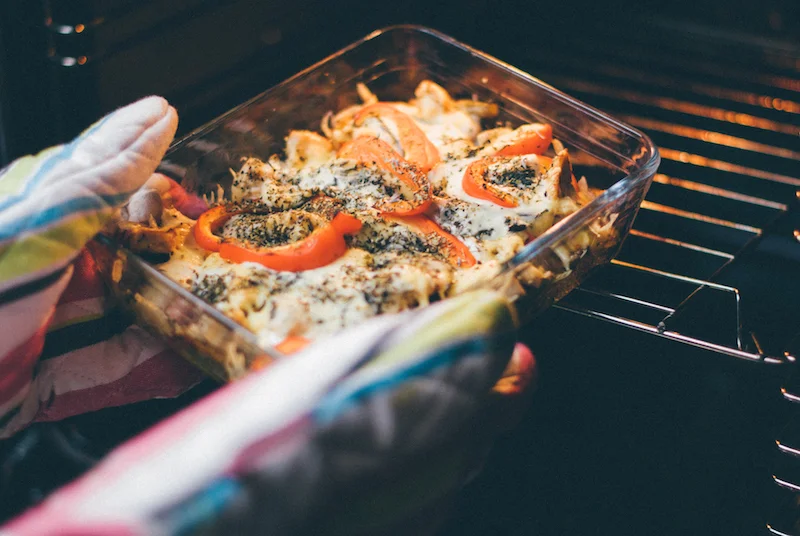
The simple act of cooking at home is perhaps one of the most revolutionary acts you can do.
In cooking from scratch, you are inherently using better ingredients than those found in processed and packaged foods. You are reaching for fresher produce which will better provide those necessary antioxidants, vitamins and minerals to help your engine run clean.
And we're not talking gourmet meals here, friends.
We're talking simple, delicious and easy meals that are good enough.
And good enough is good.
And that's enough.
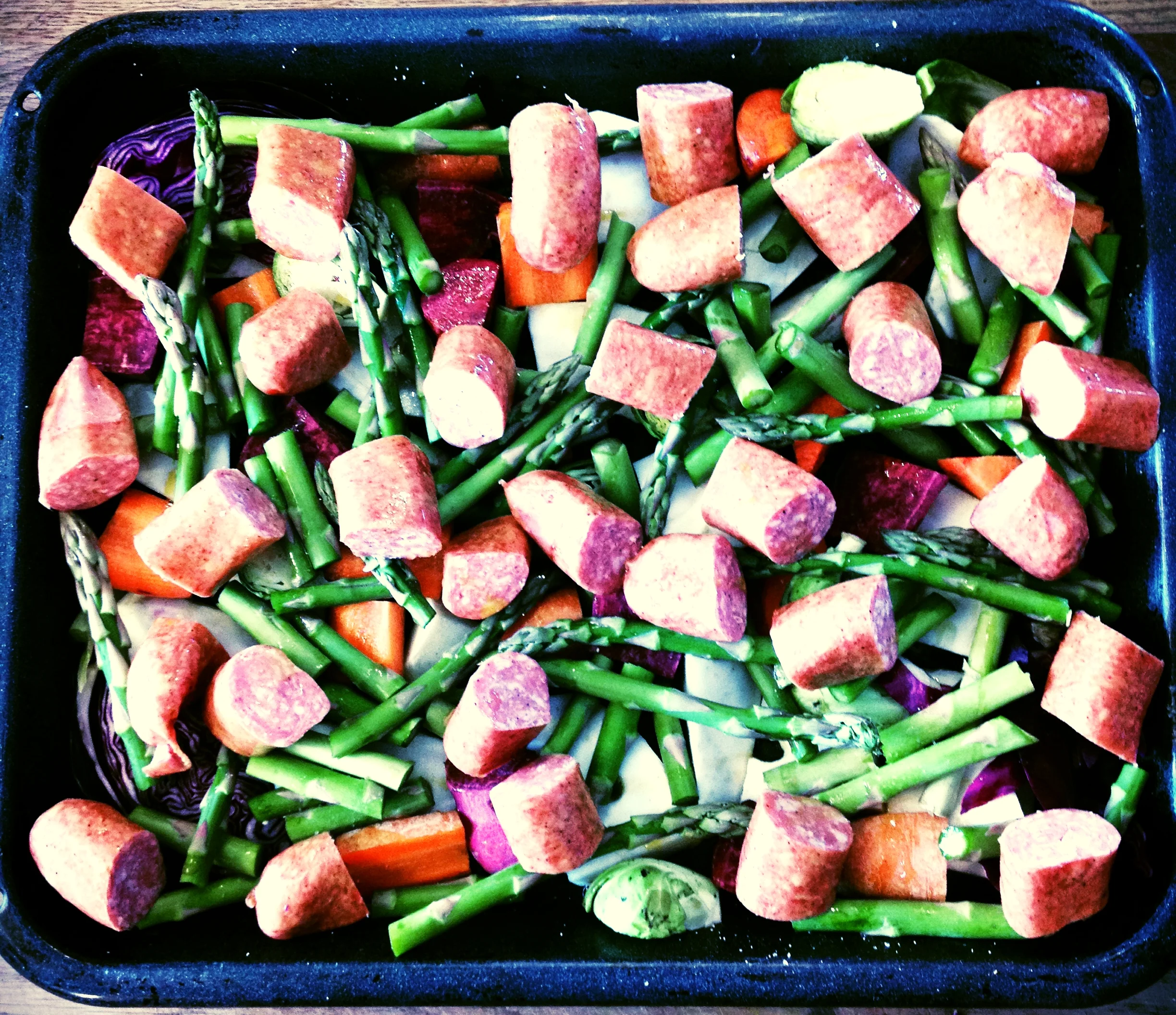
EASY SHEET PAN DINNER
If you have time, turn your oven on to 350F.
If you're in a rush, turn your oven on to 425F.
Slather a roasting pan with a good fat (I love to use bacon fat here, but butter will work or any other fat you have on hand).
Chop the veggies you have in your crisper. I added purple yams here, celery root, carrots, Brussels sprouts, purple cabbage and asparagus. You can also add frozen veggies to the mix. The only limit is your supply and your imagination.
You can add sausage if you like, or chunks of chicken. Chop them into bite size and scatter on top of the veggies.
Drizzle with olive oil (I used a basil flavoured one here from Blue Door Oil + Vinegar)
Sprinkle with salt + pepper, and any herbs if you'd like (rosemary or paprika is good!)
Pop in your oven, if it's at 350F it will take an hour. If it's at 425F, it should take 30 minutes or so.
#JERF
Other easy home-made meals:
fry an egg and use it as topper to whatever veggies you’ve got, throw some kimchi on the side for more flavour.
Cook some easy veggies in a bit of fat, S+P in a pan at first, and then finish them by roasting in the oven at 375F.
Make your own salad dressing of olive oil + apple cider vinegar, tossed over some shredded veggies like cabbage, green apple, carrots and green onions.
Toss some asparagus in melted butter and squeeze some lemon juice over top.
Boil a bag of frozen mixed veg, drain and toss with butter + garlic powder.
Perhaps the easiest and most nutrient dense meal idea: hard boiled eggs with some vegetable sticks.
Roast a few chickens at a time, and shred the extras into freezer bags for easy retrieval on those busy weeknights. Toss leftovers together with some stock and maybe a bit of pasta, and flavour with some pesto.
Check my Instagram page - I’m always posting some good food ideas to make mealtimes a bit easier.
Bon appetit!
THURSDAY BASICS: stock up.
My work in Holistic Nutrition is to arm you with the ways the good foods can support you in keeping chronic inflammation at bay. There is no greater tool in my toolkit than today’s topic of conversation. So if this topic is new to you, settle in for a good ride. If you add nothing else to your regimen in 2019, this will be 80% of the work.
It's time to Stock Up.
Welcome to another revisiting of the 2016 series I lovingly called Monday Health Basics; the only difference is, this year, the ideas presented are in a more cohesive order, and they’re showing up in your social media feeds on Thursdays.
My work in Holistic Nutrition is to arm you with the ways the good foods can support you in keeping chronic inflammation at bay. There is no greater tool in my toolkit than today’s topic of conversation. So if this topic is new to you, settle in for a good ride. If you add nothing else to your regimen in 2019, this will be 80% of the work.
STOCK UP.
COLES’ NOTES:
1. Not sure of the difference between Meat Stock and Bone Broth? READ UP.
2. Tried the bone broth but felt worse? READ UP.
3. Who can handle Meat Stock? EVERYONE. Who should reach for Bone Broth? THOSE WHO WANT TO KEEP THE STATUS QUO AT THE GUT LEVEL.
My work is always about reducing low grade chronic inflammation. When you do this work, you actively work at keeping chronic diseases at bay. This is the juicy bits on how the good foods can support you in reducing health complaints, and supporting optimal health in order to garner both QUALITY and QUANTITY of life.
Stock it up, kittens. #meatstockFTW
This blog article is one of the foundational pieces of a gut-supportive protocol. If you do nothing else but add this to your daily regimen, this one thing will do lots of the heavy lifting. Get in the groove, kittens.
It's time to Stock Up.
You have probably heard it by now, and if you haven't, I think you should come out from under that rock.
Bone Broth. Stock. Chicken Stock. Meat Stock.
It's all the rage. And with good reason! This frugal save-your-scraps kind of cooking that our grandmothers' grandmothers were doing, and all grandmothers before them (in all walks of life, and all parts of the world) has been an integral part of the diet in just about every culture around the globe.
Food was never a plentiful thing; grocery stores have only been on the scene since the late 1920s. You used to have to cook from scratch all the time. And you used every morsel you had; nothing was wasted. That is the food with which our bodies and our genetics evolved for countless generations. It's time to bring it back to the table.
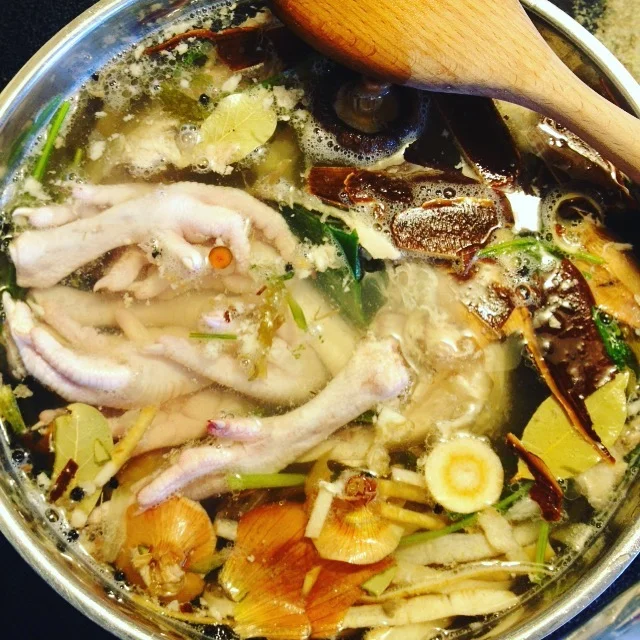
Chicken feet poking out of a chicken meat stock chez moi.
To be clear, we're not talking tetra packs of stock or broth; we're also not talking about the powdered or cubed kind of 'insta-stock' either. Sorry to disappoint.
They won't impart the health benefits that a real deal from scratch kind of meat stock or bone broth will. So know that when I'm referring to meat stock or bone broth in this article, I'm talking about simmering in your own kitchen some bones with or without meat on them, along with a few added tasty things.
Want to bypass the written word here
and just get the gist via a short video? Voila, mon amie!
Meat Stock vs Bone Broth
These terms seem to be interchangeable; and certainly when it comes to following a recipe that calls for either meat stock or broth, you can use easily substitute with what you have on hand. I want to outline here though the difference between a Meat Stock and a Bone Broth in order to help clear up the confusion.
The clarification between the two became crystal clear when I spent a long weekend in Colorado two years ago with the lovely Monica Corrado, a Traditional Foods Chef and Teacher, as well as a Certified Nutritional Consultant who put together a fabulous weekend of cooking for the GAPS Diet, a revolutionary diet from Dr. Natasha Campbell-McBride intended to 'heal and seal' the gut. It was here that I learned there are massive differences between the Meat Stock (let's call it MS) and Bone Broth (let's call this one BB).
A bone broth (BB) is a traditional kind of broth cooked with the bones of an animal for a long time at a wee simmer.
A meat stock (MS) is a shorter cook time of bones with meat on them, on a low simmer. The big difference? The time the bones or bones+meat will simmer for.
MS=short, BB=long. MS=meat+bones, BB=bones.
This is not where the only differences lie, however. If you're like me and are working on improving your gut health, you may have run across a few issues when consuming a long cooked stock.
I remember when my kiddo was wee, I made a vietnamese soup with bone broth I had cooked for the requisite 72 hours they called for in my early days of Nourishing Traditions exploration.
Within an hour and a half of chowing down the good soup, I fell apart. And I mean that quite literally. We were at my kiddo's dance studio at the time; thank goodness my in-laws were there to take her home. I was escorted out the door via the ambulance as I had a pretty violent reaction to this long and slow simmer of a stock as it messed with my body.
I'll spare you the images, but know that it wasn't pretty. They couldn't explain what happened to me, or why I reacted the way I did. They chalked it up to food poisoning; I was left scratching my head as my daughter and I had eaten the same foods, yet she never reacted like I did.
It wasn't until I attended this weekend cooking retreat with Monica Corrado that it all came into focus: this long, slow simmer of a stock was at the root of my troubles that day. And quite a few times since then. I was cooking like the folks who know these things were cooking it; I was following the rules. Why did I feel so rotten?
It is the long, slow process that concentrates amounts of glutamic acid in the final product. Monica goes in to a brilliant explanation on the troubles with glutamic acid for those with digestive complaints in this article, I highly recommend you take the time to read through in order to understand what is happening here.
Her conclusion? For anyone with a compromised digestive system (read: intestinal permeability / autoimmune disorders / any diagnoses with the nervous system like ADHD or seizures or depression or anxiety / any digestive diagnoses like IBS IBD or Celiac), you must stick to the shorter cook times, keeping to a more nutrient-dense short cook meat stock.
Fret not though; bone broth will come in to the picture further on down the road, once some of that support to the gut starts to take hold. Cooking for a shorter time reduces the amount of glutamic acid, which is a substance that can exacerbate any kind of physiological concerns you have that are related to the gut (which is just about everything.)
The other thing to think about when making a meat stock or a bone broth is the amount of histamines in the final product. If histamine overload is a problem for you (migraines, acid reflux, chronic pain, hives, allergies, urticaria) this is important information.
The longer the cook time, the higher the amount of histamines produced in the final product. Whenever there is an issue of histamines, you can rest assured there is a need to look at reducing inflammation in the individual. How to reduce chronic inflammation? Short cook meat stock, to the rescue. Lower in histamines than a long cook BB, the MS will be a nutrient dense way to support your intestinal lining, in order to reduce inflammation at the source and therefore, radiating outwards without adding extra histamines your body has to clear.
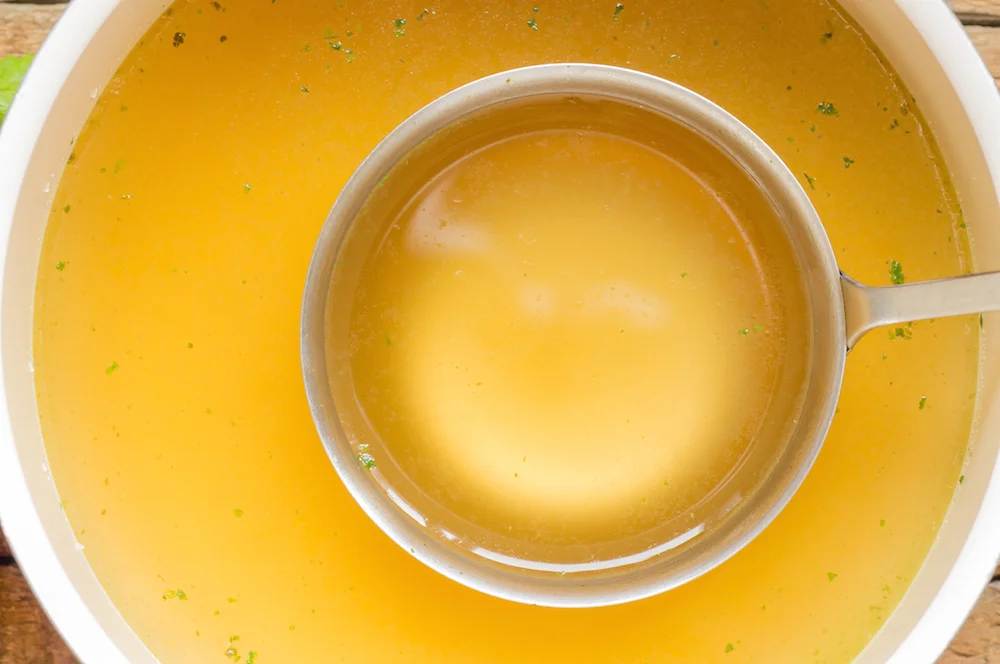
Why make stock or broth?
The health benefits of including this elixir in your dietary regimen are everywhere these days. This stuff is golden when it comes to supporting collagen production in your body, a substance we need for every skin cell in our body including those all important skin cells of our intestinal lining.
MS and BB are both rich in nutrients necessary to support healthy cartilage and connective tissue, including bones. They are easy assimilable forms of protein for the body, making it a super nourishing drink for anyone feeling under the weather or facing a serious health challenge at this time. They're a great source of nutrients when you're in repair or building mode (like say, mending that broken leg of yours or making a baby).
If you or anyone you love has been diagnosed with osteoarthritis, rheumatoid arthritis, scleroderma, psoriasis, any kind of autoimmune disorder including that of the thyroid, any type of digestive disorder like IBS or Crohns; anyone in your life working on a cancer diagnosis, any kind of motor-neuron disorder or degenerative disease like MS or ALS; for the person looking to support mental health and balancing moods or decreasing anxiety; anyone looking to upkeep their body's functions for high performance sports or fitness endeavours; anyone looking to age like a champ; consuming meat stock (and bone broth in some instances or at some point down the road) can be of tremendous support.
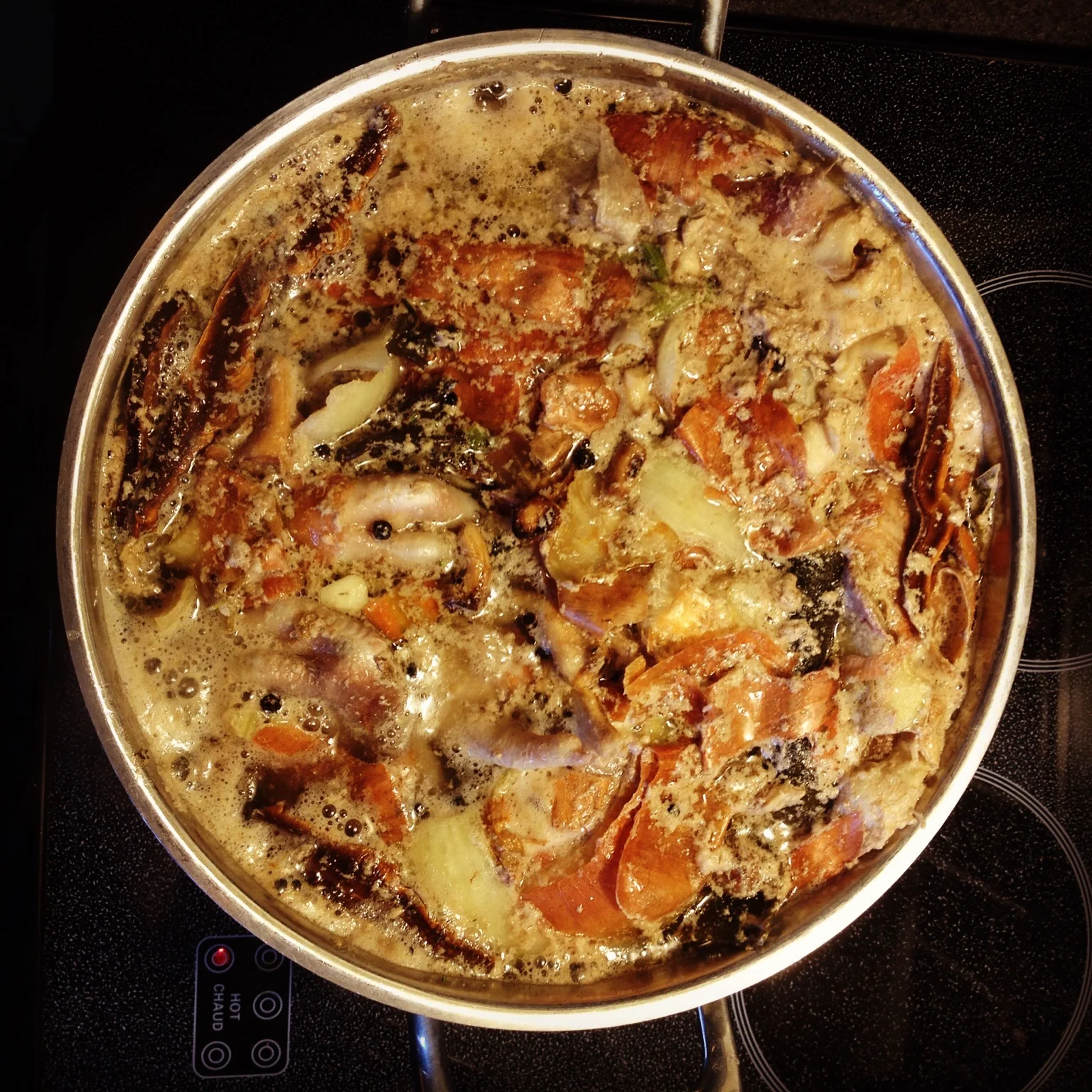
A low, slow simmer is key to making a meat stock that will gel.
Let's go over how to easily make a meat stock. For today's blog post, I am going to stick to a chicken meat stock for the sake of simplicity.
POULTRY MEAT STOCK inspired by Monica Corrado of Simply Being Well
The players
a chicken or duck or quail, whole (if you start to have a glut of chicken meat in your freezer from making this meat stock, opt instead to go with chicken backs and necks, ensuring you add in a package of chicken feet to the mix!)
if you're not too squirmy about it, a package of chicken feet or chicken backs and necks
enough filtered water to cover
add in any extras you wish here (suggestions outlined below)
The How-To
Put your bird and chicken feet / backs / necks in the biggest stock pot you own. Top with enough filtered water to cover your bird, adding in any extras from the list below to the pot.
Turn your stovetop on, bringing the meat stock to a slow and gentle simmer. Skim off any impurities that show up. Allow this brew to bubble for a good hour and a half, with the lid off.
Turn your stove top off; strain your entire soup through a sieve, hanging on to the whole chicken. The juices you have collected are your meat stock. Good work. SAVE THIS AND SAVOUR IT.
The whole chicken you have strained is ready for you to debone, and reserve all of the good meat. This is what you can stash in to little freezer bags or containers and have at the ready for easy and simple meals during weeknights, or to add to salads for a nourishing lunch.
What to do next
Take that meat stock, allow it to cool and pop into containers in the freezer for easy meals.
Fill an ice cube tray with this meat stock and freeze individual ice cubes for those times when you need just a dab of stock to thin a gravy out, or steam some greens or cauliflower, or want to braise a veg.
Drink this stuff like tea; add miso paste to it after heating, add some chopped chives and/or seaweed, swirl an egg in it. A nutrient-dense snack that bigs and littles will love.
Save the meat stock, return the pot to the stovetop and add a good solid cooking fat like duck fat. Saute in this a chopped leek, add a few chopped carrots and celery, a few garlic cloves, toss the shredded chicken in and the meat stock, and add a couple of handfuls of slivered greens like swiss chard and parsley. Adjust the flavours, the S+P to make a delicious stew. If you have some pesto, throw that in the mix to make a chicken pistou stew. (Who doesn't want to make that just to say that's what they made? Chicken Pistou Stew. Say it out loud.)
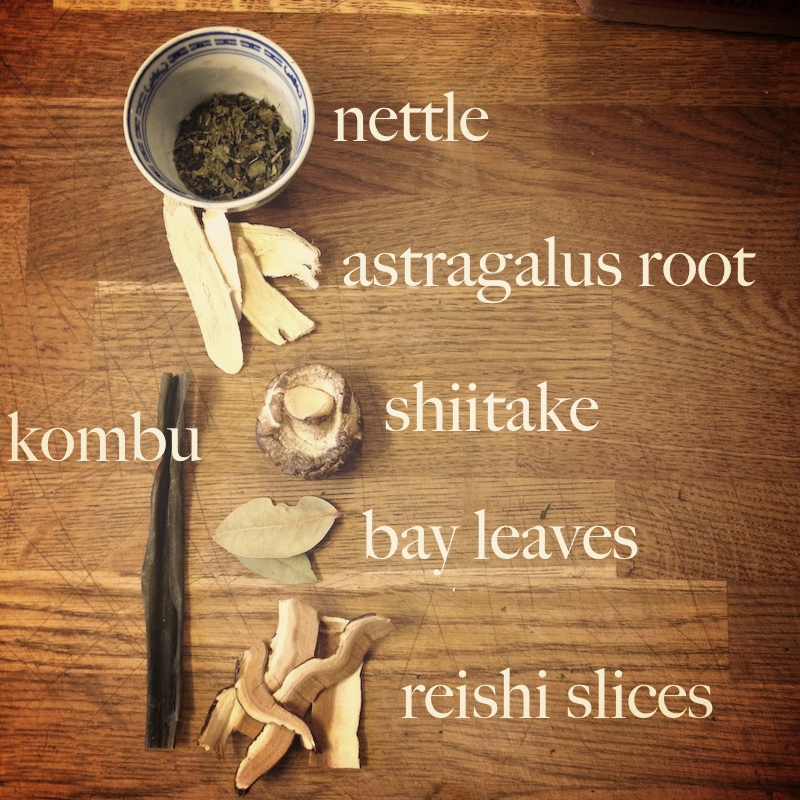
Good add-ins
I love to boost my meat stock with additional herbs or veggies to increase the nutrient density of said stock. Think of adding any number of these things when next you brew. Add them in to the soup pot at the beginning of your meat stock:
a chopped onion (sulfur! Detox superstar! Liver lovin at its best!)
a few chopped carrots and celery (added minerals! And yum flavours!)
any limp looking veggies from your crisper you're wanting to move (except things like kale, radishes, cauliflower or broccoli; their taste is better suited in the final product than in the simmering-stock stage)
a handful of fresh herbs like parsley or rosemary or thyme (minerals + flavours)
a few bay leaves (a traditional flavour for meat stock)
a few dried herbs like nettle or parsley (for anti inflammatory support)
a few peppercorns (a traditional flavour enhancer for meat stock)
a slice of seaweed like the kombu in the photo above (incredible mineral powerhouse, and detox and liver and immune loving support) – any seaweed will do
a few dried shiitake mushrooms (additional immune support)
some medicinal mushrooms like reishi or chaga mushrooms (excellent adaptogens that support adrenals, immune system, everything from head to toe)
additional herbs like astraglus root slices (immune support) or turmeric root slices (incredible anti-inflammatory support)
I keep a freezer bag going in my freezer where I add my vegetable scraps from meal prep during the week. I add the carrot tips, celery leaves, onion skins, garlic skins, carrot greens, parsley stems, fresh shiitake mushroom stems, etc to this bag with the express intention of using it in my next batch of stock. When the bag is full, it's time to put some stock up. (Don't fret about this too much – you're straining these goodies out of the final product.) (Onion skins lend a beautiful golden colour to your stock.)
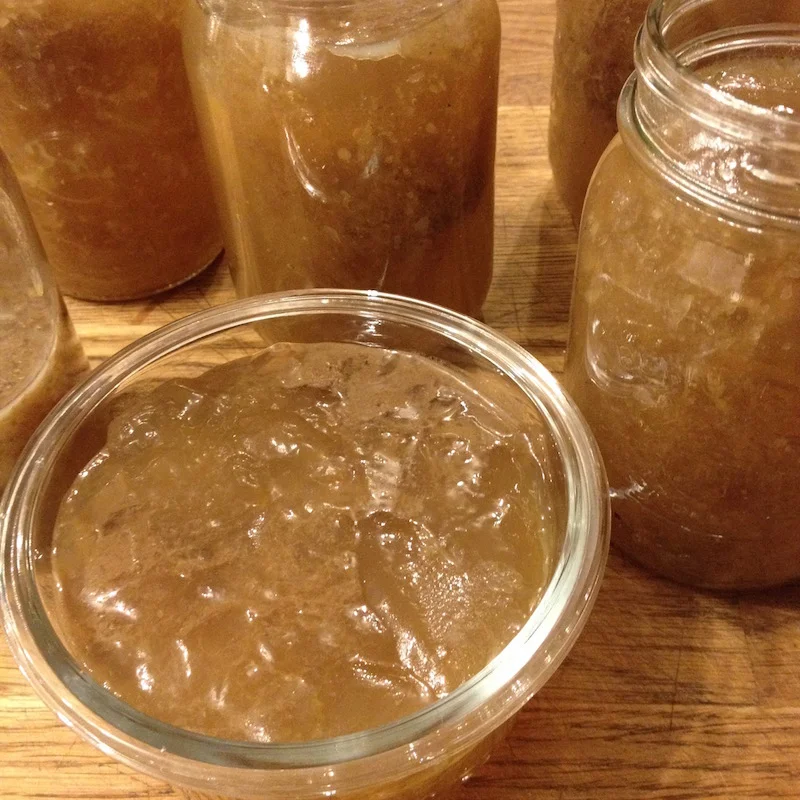
Ready for the freezer.
If you've made your meat stock well, allowing it to come to a slow simmer, not used an excessive amount of water (use enough to cover the bird, and you should be good), your end product should gel upon cooling. This will happen especially if you have some connective-tissue rich feet, heads, necks or backs in the mix; it's worth seeking them out and adding them to the mix!
If it didn't gel, do not despair: this is still good stuff to eat! Adjust your water next time, or keep a more watchful eye to make sure the simmer is slowly bubbling.
Once it has cooled, go ahead and store the goods in the freezer. I'd aim to use it up in 3 months' time; it never lasts that long at our house. We have a weekly soup night; plus I often make myself a good cuppa with an egg swirled in for my breakfast on short-on-time-mornings.
If you're looking for a cookbook that could catapult you in to soup making things and broth and stock recipes, track down Monica Corrado's Grandmother's Kitchen Book. I have a well worn copy that lives in my kitchen and is referred to on a regular basis.
At the same link, you will find Monica's e-book on Meat Stock and Bone Broth, an essential in any kitchen looking to support gut health. You may also want to purchase a copy of the wonderful book Nourishing Broth: An Old-Fashioned Remedy for the Modern World by Sally Fallon Morell and Kaayla T. Daniel. While they do not differentiate between a meat stock and bone broth in this cookbook, you will find this book has myriad recipes and ways to use the nourishing stocks and broths you will be making. Delicious recipes!
OK friend. You got this. Go make some meat stock. And play with your food, if you please'm.

THURSDAY BASICS: take a walk.
I've been talking lots of food ways to up the health ante these past few weeks, some of those big foundational things you can put in place in order to support your ever lovin gorgeous bod. While I love the good foods kittens, it's time to get practical.
Another Thursday, another revisit to the now-rejigged Monday Health Basics from 2016.
While we’ve really been working hard at implementing some of the BIG FOOD ideas thus far (the cornerstones, if you will, of looking to Holistic Nutrition for support in reducing inflammation), there is a pretty easy thing you can count on that will go miles in supporting your ever lovin self into wellness. It doesn’t cost very much; it’s something that most people are able to do. It’s also one thing that can help move the needle in a really manageable way to help support optimal health.
TAKE A WALK.
COLES’ NOTES:
1. Penciling this idea in to your day brings benefits to EVERY SINGLE SYSTEM in your gorgeous body.
2. Daily walks/saunters have been linked to adding 7 years to your lifespan. SIGN ME UP.
3. It’s one of those key tools in your toolkit to balance blood sugars + hormones - which in turn, REDUCES INFLAMMATION.
My work is always about reducing low grade chronic inflammation. When you do this work, you actively work at keeping chronic diseases at bay. While I love to talk about how foods can support, we must also pay attention to creating a life and environment conducive to health!
Let’s move + groove, baby!
I've been talking lots of food ways to up the health ante these past few weeks, some of those big foundational things you can put in place in order to support your ever lovin gorgeous bod. While I love the good foods kittens, it's time to get practical.

Getting outside for a walk a day, even if it's a short walk,
will do wonders to help support your body
through the work it wants to do.
The benefits are manyfold – I mean name a system in the body, and you are sure to find that walking would support that system's function, nay I'd go so far as to say improve that system's work.
DIGESTIVE: As stress shuts down the digestive system, walking helps here. See, walking helps reduce stress; therefore you can better do that digestive bit your system needs to do! So by walking after a meal, you use up the sugars that are being released in your blood stream, and utilizing them right away means you are helping keep your blood sugars balanced. Anxiety and stress are more pronounced when your blood sugars aren't balanced.
INTESTINAL: Reduces constipation. Supports peristalsis! Helps keep you regular!
IMMUNE/LYMPHATIC: Walking engages the lymphatic system and assists your body in doing its house-cleaning and detoxification work. Walking can then help your body move those toxins out. Fresh air outside is one of the best immunity system builders there is.
GLANDULAR/ENDOCRINE: Gentle walking is also good exercise that will not contribute to increasing stress on your system, in fact it helps dissolve it and use up the nutrients in your body that are part of the load on your adrenals. Therefore, walking reduces stress. Which helps alleviate anxiety too and support your adrenals. Which just helps everything else. And your thyroid? Why yes, it benefits from this gentle form of exercise too, by boosting thyroid function.
NERVOUS: A change of scenery can do good things to help bolster moods, as endorphins are released during exercise and these have been shown to provide relief from low moods. These endorphins act by diminishing your perception of pain as well. What's not to love? If that's not enough to convince you, good exercise like walking has been shown to contribute to improved sleeping; it also shows signs of slowing mental decline and can lower your risk of developing Alzheimer's.
REPRODUCTIVE: Exercise like walking helps reduce the risk of certain hormone-related cancers like breast cancer. As all of our systems inter-relate, physical activity plays an important influencing role on our fertility too.
STRUCTURAL: Regular physical activity is important in maintaining healthy bones, helping reduce the risk of bone fractures. So walk to help keep osteoporosis and osteopenia at bay, walk to support your joints as the walking motion helps to keep them well lubricated and in good working condition. This gentle form of exercise can be of tremendous support to someone with arthritis.
CIRCULATORY/CARDIOVASCULAR: Walking has been shown to help lower blood pressure. It helps increase energy levels by providing more oxygen to the blood and muscles, and is heart-protective. Walking and exercise improve circulation and can help prevent strokes.
RESPIRATORY: Daily walking has been shown to benefit those with chronic lung diseases like COPD. Walking is a gentle enough exercise that if done at a leisurely pace (consult your doctor first!), can help improve the health and vitality of your lungs.
URINARY: Walking helps move fluids that can accumulate in your veins in your legs during sedentary periods. If you tend to sit all day, that excess fluid can mean you'll be visiting the loo more often at night, just to move those fluids out. How to help? Take a walk or three during the day, the muscles that contract in the legs during the walking motion will help flush them out, at a more reasonable hour.

That's not all. Daily walks have been linked to a longer life, even adding 7 years to your lifespan! It might be obvious, but walking can be of good support to help strengthen muscles and can lead to weight loss. We went over the idea that exercise helps use up the sugars released in the bloodstream, and so by ensuring a good walk a day, you'll be reducing your risk of developing diabetes.
Another way to spell it out:
Walking helps improve your body's
control of blood glucose.
It helps to uptake excess blood glucose circulating in your veins. Better blood sugar regulation is what you want in order to keep chronic inflammation and all diseases associated with inflammation at bay. (That's almost every slow-moving chronic disease under the sun, friend.)
If your exercise takes you outside, then double bonus for you: you'll be soaking up some rays and enhancing your body's ability to manufacture the all-important vitamin D! This vitamin is essential to bone health and maintenance, thyroid and endocrine function and can help prevent cancer. Of course it's pretty important to immune health and is also noted to help reduce your risk of diabetes and hypertension.

My guy Max, and one of our favourite spots in town: Paskapoo Slopes.
The How-To:
Get outside. A gingerly pace is good. A slower pace works too. You set the tone.
Grab a coworker and go for a good jaunt during your lunch break. Have walking meetings! Walk to your next appointment, if it's within reasonable distance.
Take your sweetheart for a walk around the block after dinner at night. (Geez I could also delve into the importance of connecting with loved ones – do you see how walking can facilitate that?) Family outings! Joining a walking group might get you motivated. If the weather isn't cooperating, you may want to do a few laps at the mall every morning. You could meet a friend for a few laps before you go for a cup of tea to visit.
Head outside and find some new hiking trails on the weekend. Walk through a new neighbourhood, discover your city. Head out to spot the northern lights if it's dark. Get a dog. Borrow the neighbour's dog. Go for the aromatherapy at different times of the season, to see and smell what's in bloom.
Why I love it:
No special equipment save maybe shoes. It's inexpensive. The tools are at the ready, and the venue can change or remain the same. It's whatever will work for you. YOU'RE THE BOSS.
Walking is good for your brain and your heart. It's good to reduce stress and boost mood. It revs up the immune function. It's good for you, it's good for me. Get grooving my friend.
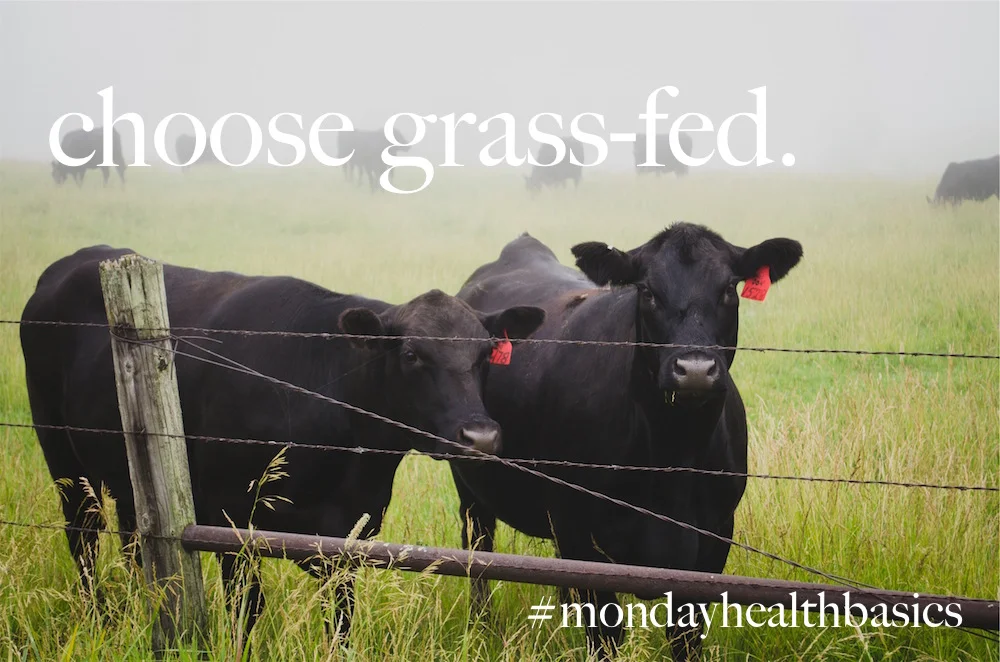
THURSDAY BASICS: choose pastured.
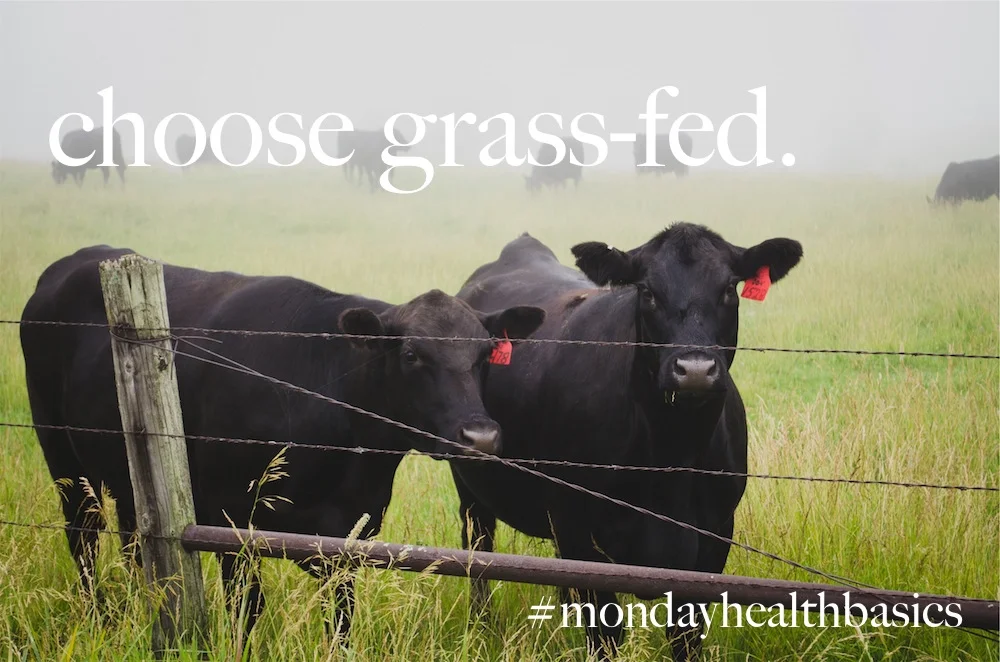
This week's topic is one that can be a bit of a hot button topic for some, and while I love a good debate, I will be talking simpler here. The impetus behind these weekly blog posts is to get the discussion going on how to choose our foods and make those lifestyle choices that are in support of optimal health, not to stir the pot. So this week's topic is about choosing meats, and reaching for grass-fed or pastured options when you're able to.
Another Thursday, another revisit to the now-rejigged Monday Health Basics from 2016.
This week’s topic is one that I share with each and every client that comes in for their first appointment with me. I think it’s also one of the most important things when looking for support in Holistic Nutrition: HOW + WHERE TO SOURCE YOUR ANIMAL PRODUCTS.
If this is the only blog post you read from me this year, you done good.
CHOOSE PASTURED.
COLES’ NOTES:
1. Necessary source of hard-to-find anti-inflammatory fat soluble vitamins (A, D, E, K2)
2. Necessary source of hard-to-find anti-inflammatory Essential Fatty Acids (Omega 3s)
3. Necessary for the health of your gut microbiome + intestinal health
My work is always about reducing low grade chronic inflammation. When you do this work, you actively work at keeping chronic diseases at bay. Reaching for pastured or grass-fed sources when including animal products (meats + fats!)? This is something to prioritize if you wish to stay well.
This week's topic is one that can be a bit of a hot button topic for some, and while I love a good debate, I will be talking simpler here. The impetus behind these weekly blog posts is to get the discussion going on how to choose our foods and make those lifestyle choices that are in support of optimal health, not to stir the pot. So this week's topic is about choosing meats, and reaching for grass-fed or pastured options when you're able to.
This blog post is not a debate on whether or not to eat meat.
This blog post is not about the environmental impact of animals. (In fact, if ever you have a free three hour block, I'd love to chat about how animals can be of incredible benefit to the maintenance and building of our soils, adding those good minerals and compounds necessary to maintaining healthy soil, which means healthy produce. The status of our soils, friends! It's impacting everything! Barring our three hour convo, check out Joel Salatin either for his approach to farming as stated on his website, or in the chapter where author Michael Pollan visits Salatin's farm and has a pretty insightful conversation in the necessary-read The Omnivore's Dilemma. First and foremost, Salatin considers himself a grass farmer. The animals on his farm just help to grow grass and build soil.)
This is about The Minding and Keeping Of You.
GRASS FED/PASTURED vs CONVENTIONAL
So what does it mean to purchase meat that is grass-fed, or pastured, or grass-fed/grain-finished and how does it differ from conventionally raised meat? It turns out that what the animal eats during its life can have a pretty big impact on the quality of the food.

For the animal allowed to live on pasture when possible, their diet closely resembles what has been a traditional diet for that animal for the last few hundred years. It is a low-stress way of living for the most part, and allows for the animal to munch on the foods they have been designed to consume. These foods are incredibly nourishing to the animal, providing key nutrients and easy-to-digest foods so that they can develop and grow at a natural and normal rate.
What does this mean for us?
The meat from these animals then is low in inflammatory compounds, seeing that the animal was able to consume foods as it was meant to consume. This means your pastured beef and bison will provide you with a good source of the anti-inflammatory powerhouse Omega 3 Fatty Acid, along with other fat-soluble vitamins and their precursors A and E, essential vitamins to retain the integrity of our intestinal lining, our skin and keeping free radical damage at bay. Throw in D3 and K2 in the mix, higher in some animals’ fats than others, but good sources all-round. We need these for most systems in the body, including depositing minerals where we want them (bones! teeth!) and not where they aren’t wanted (arteries! gallbladder! kidneys!).
As if these antioxidants weren't enough, important compounds glutathione and super-oxide dismutase, also antioxidant powerhouses are in good numbers in grass-fed products. These nutrients are necessary for keeping our engines and liver running clean.
Let's talk fats
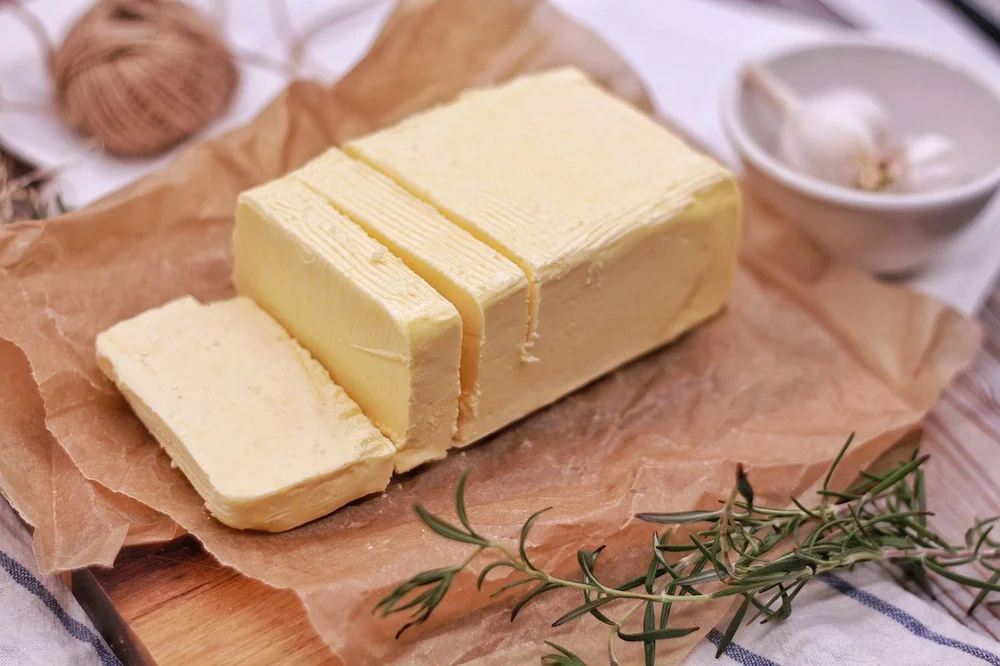
Oh yes, let me be clear: this is not just about the meat we are consuming. This is also about the other products we consume from animals, specifically the dairy. When milk comes from a pastured animal, the vitamin content will be higher in those all-important fat soluble vitamins A (retinol) and K2, necessary for skin health, intestinal lining integrity, brain health and bone health too.
For the animals that are to live their lives out in a conventional way (aka CAFOs, or confined animal feeding operations), their diet is drastically different than what their systems were meant to handle; they are also supplemented with extras like antibiotics to help support their health, as a health management tool if you will in order to ensure good profits for the farmers.
Surprise though, those antibiotics end up actually fattening the animals up faster, in order to get them sooner to slaughter. The problem is, an estimated 80% of the world's antibiotics are being used in agriculture. Such a huge amount of antibiotic use is now contributing to creating superbug infections in humans, due to antibiotic resistance as outlined by the World Health Organization.
What does this mean? The frequent use of those antibiotics will harbour a space where bugs can build resistance, and no longer respond to our number one weapon, our antibiotics. That is NOT the situation we want to be in.
Furthermore, the antibiotics in the animals remain in the meat we consume, and these contribute to wiping out our own gut flora. This means consuming meat that has been raised conventionally will have a negative impact in throwing our microbiome/gut bugs/flora/probiotics out of balance, which will contribute to further inflammation in our bodies and toxin load on our livers.
Antibiotics are not the only supplement these feedlot animals are fed. Some get hormones and steroids supplemented, and their feed is not the kind of food the animal was meant to consume, nor made to digest.
Imagine when you have a serving of a food you have trouble digesting. Know how you feel? Imagine having that meal every day. While being crammed in a small space. With a lot of other animals that feel like you do. Those are not conditions that are supportive to the animal; they contribute to higher stress levels too.
Back to the fat
And where do these toxins get stored? Always in the fat. So consuming fats from pastured animals will better serve you, my friend than reaching for the sources from conventional animals. By choosing butter or milk from a pastured cow, you will be reducing the toxin load your body has to deal with. And will get better nourishment from those food sources, as they will be higher in the fat-soluble nutrients.
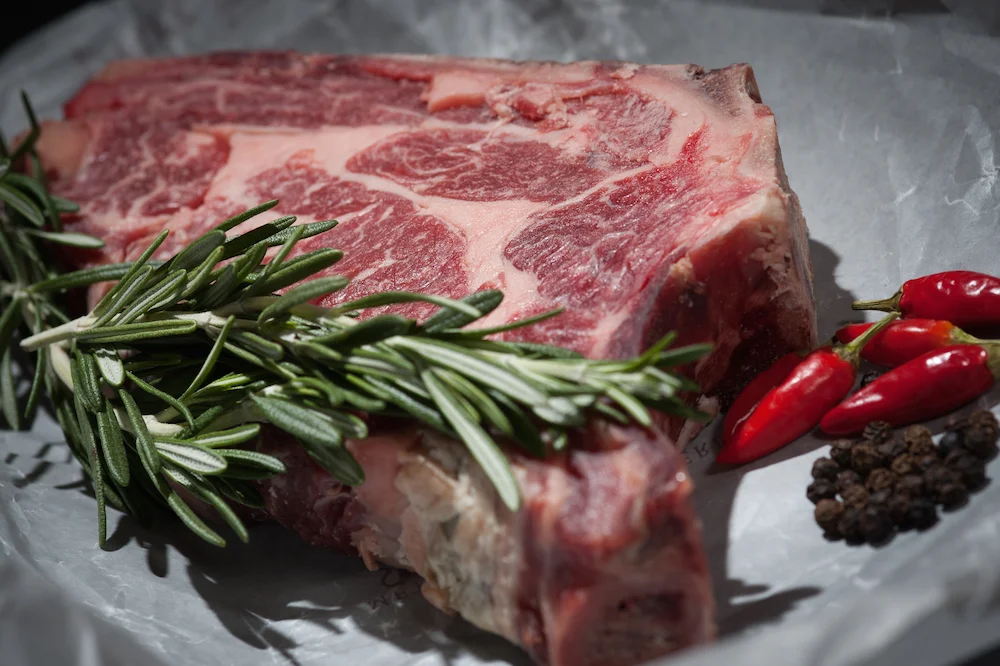
But dairy is not the only fat source from an animal; if you are consuming cuts of meat from a pastured animal, go ahead and eat the fat!
Rendered fat from a pig is called lard and fat from a cow is called tallow. When the lard or tallow comes from a pig or cow that was fed on pasture, the nutritional profile reads such great amounts of Vitamin A in retinol form, the animal version we need for the health of our intestinal lining. It is also a fabulous source of Vitamin D3, a key player in thyroid function, essential to our immune health and bone building and maintenance to mention a few.

happy pigs
Consume meat from an animal that has been raised on pasture and you will be making a choice that will support your gut flora, not to mention up the nutritional ante of your meals. Those fat-soluble vitamins are critical for our optimal health!
For the love of your skin, your intestines, your brain, your bones, your glandular system, your reproductive system, heck for your lovely body from head to toe, aim to reach for animal products from animals that were fed on grass more often than conventional sources and your body will thank you.
If you're new to pastured meats or grass-fed products, may I suggest contacting Alberta Farm Fresh Producers Association, an organization working to connect local farms and local people. Come August this year, Alberta Open Farm Days will be on again; follow their missives on how they work to connect local farms with people in the province at their website.
I also have connected with a few local small farms that specialize in pastured animals; look for them via my facebook page (Scroll down to 'Liked by This Page'). If you're a local producer, I would love to connect!
And it's a good-better-best kind of scenario, friends. If you're new to consuming pastured products and are put off by the higher cost, start by going 40/60, and adding a few good things at a time. Or purchase cheaper cuts of meat to get started; you can also eat smaller amounts of meat, knowing it is more nutrient-dense you don't have to consume big cuts.
You will find an interesting series exploring Red Meat online here. Chris Kresser explores the health benefits of nutrient-dense red meat in a series of articles, and includes some yummy recipes too. Looking to explore the environmental impact a bit more? This series may be for you.
And if you're really curious to understand a bit more about the health and environmental benefits of consuming products from animals raised on pasture, might I point you to this comprehensive article from the Weston A. Price Foundation called Splendor From the Grass.

THURSDAY BASICS: liver loving brews
Ah yes, the birds are chirping, the bees have been busy, and the yellow fields have been greening up as spring is here upon us in the prairies and foothills. Hooray for spring! In the spirit of the season, we will look at some liver loving brews you can add to your food arsenal, in order to best support this hard working organ. This is the perfect time of the year to do so.
Another Thursday, another revisit to the now-rejigged Monday Health Basics from 2016.
As we are diving in to this new month, the focus will be on Liver Supportive Things You Can Do. (Capitalizing each word in that sentence should make you feel a sense of purpose - loving up your liver is one of the best ways you can support a long and healthy life, keeping those chronic diseases at bay.)
This week’s topic: ADDING IN SOME LIVER LOVING BREWS
COLES’ NOTES:
1. Build your tea cupboard one cuppa at a time.
2. Included is a recipe to make a long brew - Medicinal Mushroom Brew
3. Should you need more inspiration, check out my IG stories for daily posts I call TODAY’S CUPPA. (Join the good tea revolution and use the hashtag #howicuppa when you post about it on your own social media hangouts!)
My work is always about reducing low grade chronic inflammation. When you do this work, you actively work at keeping chronic diseases at bay. Adding in a daily cuppa is one of the easiest ways to support this work, be it in a cup of herbal tea, an elixir or via smoothie delivery!
Ah yes, the birds are chirping, the bees have been busy, and the yellow fields have been greening up as spring is here upon us in the prairies and foothills. Hooray for spring! In Traditional Chinese Medicine, spring is the season best associated with the liver, as TCM practitioner Efrem Korngold states,
I like to think of tea and herbal brews as necessary (and delicious!) tools in one's medicine chest. And so, in the spirit of the season, we will look at some liver loving brews you can add to your food arsenal, in order to best support this hard working organ. Perfect time of the year to do so.
First things first. Your liver is your main detoxification organ, and does something like 500+ jobs in the body. It hangs out just under your rib cage on the right hand side of your body (unless of course, if your inner organs are hanging out on the other side. In our cadaver lab at school, we got to witness this incredible phenomenon – FASCINATING. But I digress.)
Did you know it's actually a gland?
The liver's main tasks are to cleanse your blood and build blood-clotting factors, move the waste and toxins out, break down hormones, build up new ones. It gets rid of so much stuff, like chemicals from your environment and diet, byproducts made during regular body metabolism, and it packages them back up in to bile. This good stuff helps emulsify the fats you eat, which means it makes those fats easier to digest and better to assimilate the nutrients found within. So bile is the perfect recycling tool, see? Isn't your liver a star? (And eating fats helps you move those toxins out. SUCH GOOD WORK.)
The liver also regulates the sugars in your blood, and is the key player in metabolizing carbs, fats and proteins. It builds proteins from the smaller building blocks called amino acids. The liver is also a storage house for some good things like extra vitamins (the fat soluble ones, my favourites), and extra blood just in case. It is also a key player in your immunity, and is the principal organ that deals with inflammation in the body. Enzymes are made by this organ. As if it didn't have enough of a workload...
My favourite part about this big organ – IT REGENERATES LIKE A DREAM. It loves to repair and rebuild. Itself. Multi tasking, folks. That's what this organ's main super power is. It is the only organ in the body that can do this.

Herbs and Teas
There are so many things we can do to love our livers up, ways to let them know we appreciate their workload and are thankful for all they do. (Who's game to start having Liver Day, in addition to Mother's and Father's Day? I think it is warranted.)
Today's post is focusing on beverages that are best suited to this wonderful gland.
Before we dive in to this work though, I highly recommend you check with your medical team to see if adding these brews to your list of daily to dos would be a good idea.
You can seek out Burdock root at your favourite local health food store and steep the dried parts in simmering water for a good 20 minutes. I personally like to throw in a few slices in when making good ole meat stock.
Chicory root is another one that benefits the liver, and is a great alternative to coffee if you're looking to curb your caffeine intake. Know that chicory helps stimulate bile production, and so thus could help get your colon rollin. You can sometimes find a good coffee alternative that will include both of these liver-supportive roots in the mix.
Yellow Dock Root might be worth seeking as well: it has been shown to help purify the blood and super bile inducing.
Astragalus root is a traditional Chinese herb that has been shown to be of wonderful support to the immune system, as well as showing promise of supporting liver metabolism, especially in those diagnosed with diabetes. I share a recipe on how to use it below.
Imbibing bitter brews will help support the liver, and influence it to produce bile. Think hot lemon with water, or nettle tea. (Remember my good friend nettle?)
Peppermint tea, while not of the bitter persuasion, can stimulate the bile production as well. It's good at bringing down cholesterol as well, double bonus!
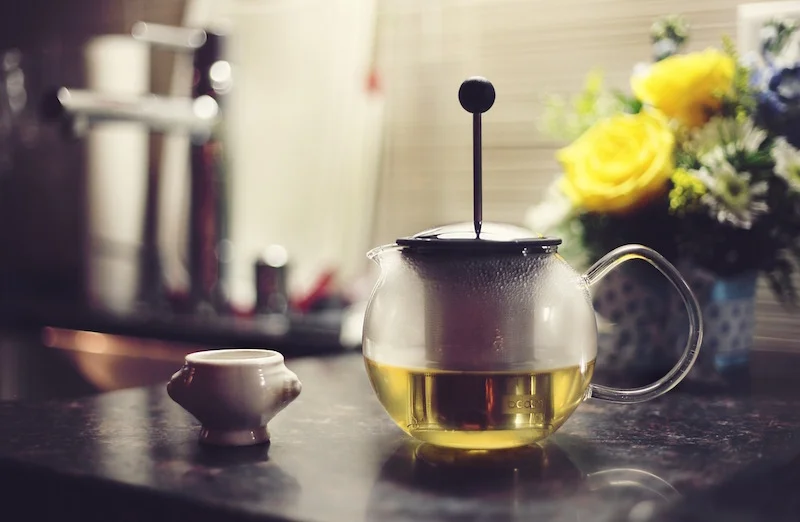
I am a big fan of the delicate notes of Green Tea as well, when it comes to liver support. The polyphenols found in the tea protect your cells from free radical damage, possibly contributing to slower aging and keeping certain diseases such as cancer and heart disease at bay. Be forewarned, green tea supplements may not be a good idea and in fact may prove to be toxic to some folks' livers. Consult your medical team before embarking on this new brew.
There are two roots I routinely use in my cooking and brew-making that you may want to get to know better: ginger and turmeric. They are in the same rhizome family, and are both wonderful protectors of the liver. They are adept at reducing overall inflammation, and are excellent sources of antioxidants, those all-important compounds that help reduce free radical damage at the cellular level.
One of the active chemical compounds found in these rhizomes is called curcumin: it has been shown to be liver-protective, also helping to up the production of bile. They also help stimulate your liver to produce enzymes that will flush toxins out.
How to make a brew: check out Toronto-based nutrition practitioner Meghan Telpner's site for a good one. You can also easily purchase ginger tea in prepared bags for simpler preparation, or for taking on the road.
Rooibos tea is another good one you may already have in your cupboard. A 2008 study found that this loose leaf tea native to Southern Africa is high in antioxidants and may be a good tea for those wanting to support their liver.
Rose Hip tea is another popular wild-foraged food that can be made into a Vitamin C rich brew by allowing the rose hips to steep in just-boiled water for a time. This essential vitamin is a key player in this organ's detoxification work.
THE FUN-GI’S (fun guys?)
The wonderful world of medicinal mushrooms is an ancient practice that is seeing new light these days. Find your way to this article to read on the benefits of Reishi mushroom in particular, noting that it is a liver-protective herb that can be a key player in mitigating the effects of chronic inflammation and supporting the immune system, a system intricately linked to the liver.
Chaga is another wonderful medicinal mushroom that grows on birch trees and has been used traditionally for many centuries. This mushroom serves as a potent blood purifier, and excellent at reducing chronic inflammation as well, providing the body with key nutrients necessary for the body's detoxification and antioxidant protectors.
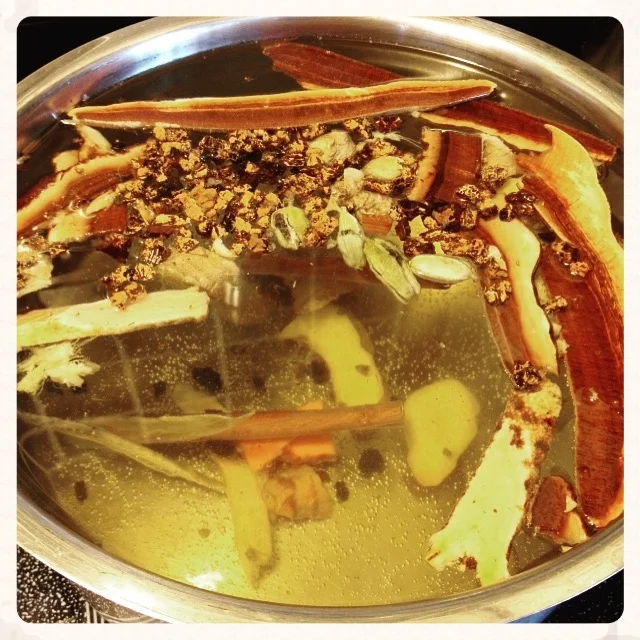
I like to prepare my own concoction at home to support my liver. This is part of my Long Brew I have on the go, and use as the base for daily cuppas, elixirs and sometimes for braising veg. I just poached pears in it - so yum!
Every few weeks, I set a pot of this goodness to simmer for the better part of the day, with the intention of consuming a good mugful every day until the pot is empty. I leave it on the stove top and bring it back to a good boil once a day before consuming it. I sweeten it with some delicious local honey to taste.
LIVER and IMMUNE SUPPORTING BREW
Steeping on a low simmer for six hours:
8 cups of filtered or spring water (the chlorine in tap water is an added toxin the liver has to handle)
5 slices dried Reishi mushrooms
1.5 tbsp chaga pieces
4 slices astragalus
2 cinnamon sticks
2" fresh ginger, sliced
1" fresh turmeric, sliced
4 cardamom pods cracked open
OTHER BREWSKIS AS YOU BUILD YOUR TEA CUPBOARD
Dandelion Root Tea is a popular one in our house; it is a wonderful liver tonic. (Did you know the word dandelion comes from the french word 'Dent de lion'? I find that funny because the french name for this flower is 'pissenlit'. Which literally means pee the bed. And Dandelion root tea is a diuretic. See what they did there? Those smart frenchies.) I think this one may be my absolute favourite liver loving brew. It helps incite your liver to rebuild and function at a higher capacity. Read on for more information on this magical brew.

What kind of cuppa will you prepare next?
The information provided in this post is not intended to replace your doctor's advice. This is for educational purposes only. If your liver is currently giving you cause for concern, it is best to seek out the support of your Medical Team before consuming any of the brews mentioned in this post.