MONDAY BASICS: stock up.
The nights are cooler. Some of us have to cover our gardens for fear of the goods perishing under the waning moon. We start to turn inwards, as the daylight gets shorter and the furnace turns on. It's time to get a slow simmer going on the stove.
It's time to Stock Up.
The nights are cooler. Some of us have to cover our gardens for fear of the goods perishing under the waning moon. We start to turn inwards, as the daylight gets shorter and the furnace turns on. It's time to get a slow simmer going on the stove.
It's time to Stock Up.
You have probably heard it by now, and if you haven't, I think you should come out from under that rock. Bone Broth. Stock. Chicken Stock. Meat Stock. It's all the rage. And with good reason! This frugal save-your-scraps kind of cooking that our grandmothers' grandmothers were doing, and all grandmothers before them (in all walks of life, and all parts of the world) has been an integral part of the diet in just about every culture around the globe. Food was never a plentiful thing; grocery stores have only been on the scene since the late 1920s. You used to have to cook from scratch all the time. And you used every morsel you had; nothing was wasted. That is the food with which our bodies and our genetics evolved for countless generations. It's time to bring it back to the table.
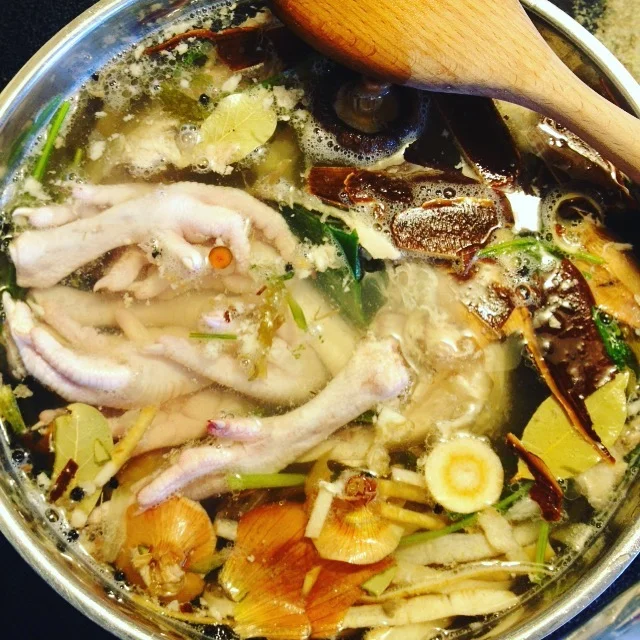
Chicken feet poking out of a chicken meat stock chez moi.
To be clear, we're not talking tetra packs of stock or broth; we're also not talking about the powdered or cubed kind of 'insta-stock' either. Sorry to disappoint.
Sure, there are places for these types of manufactured stocks or broths, but they won't impart the health benefits that a real deal from scratch kind of meat stock or bone broth. So know that when I'm referring to meat stock or bone broth in this article, I'm talking about simmering in your own kitchen some bones with or without meat on them with a few added tasty things.
Want to bypass the written word here
and just get the gist via a short video? Voila, mon amie!
Meat Stock vs Bone Broth
These terms seem to be interchangeable; and certainly when it comes to following a recipe that calls for either meat stock or broth, you can use easily substitute with what you have on hand. I want to outline here though the difference between a Meat Stock and a Bone Broth in order to help clear up the confusion.
The clarification between the two became crystal clear when I spent a long weekend in Colorado two years ago with the lovely Monica Corrado, a Traditional Foods Chef and Teacher, as well as a Certified Nutritional Consultant who put together a fabulous weekend of cooking for the GAPS Diet, a revolutionary diet from Dr. Natasha Campbell-McBride intended to 'heal and seal' the gut. It was here that I learned there are massive differences between the Meat Stock (let's call it MS) and Bone Broth (let's call this one BB).
A bone broth (BB) is a traditional kind of broth cooked with the bones of an animal for a long time at a wee simmer. A meat stock (MS) is a shorter cook time of bones with meat on them, on a low simmer. The big difference? The time the bones or bones+meat will simmer for.
MS=short, BB=long. MS=meat+bones, BB=bones.
This is not where the only differences lie, however. If you're like me and are working on improving your gut health, you may have run across a few issues when consuming a long cooked stock. I remember when my kiddo was wee, I made a vietnamese soup with bone broth I had cooked for the requisite 72 hours they called for in my early days of Nourishing Traditions exploration. Within an hour and a half of chowing down the good soup, I fell apart. And I mean that quite literally. We were at my kiddo's dance studio at the time; thank goodness my in-laws were there to take her home. I was escorted out the door via the ambulance as I had a pretty violent reaction to this long and slow simmer of a stock as it messed with my body. I'll spare you the images, but know that it wasn't pretty. They couldn't explain what happened to me, or why I reacted the way I did. They chalked it up to food poisoning; I was left scratching my head as my daughter and I had eaten the same foods, yet she never reacted like I did.
It wasn't until I attended this weekend cooking retreat with Monica Corrado that it all came into focus: this long, slow simmer of a stock was at the root of my troubles that day. And quite a few times since then. I was cooking like the folks who know these things were cooking it; I was following the rules. Why did I feel so rotten?
It is the long, slow process that concentrates amounts of glutamic acid in the final product. Monica goes in to a brilliant explanation on the troubles with glutamic acid for those with digestive complaints in this article, I highly recommend you take the time to read through in order to undertand what is happening here. Her conclusion? For anyone with a compromised digestive system (read: intestinal permeability / autoimmune disorders / any diagnoses with the nervous system like ADHD or seizures or depression or anxiety / any digestive diagnoses like IBS IBD or Celiac), you must stick to the shorter cook times, keeping to a more nutrient-dense short cook meat stock.
Fret not though; bone broth will come in to the picture further on down the road, once some of that support to the gut starts to take hold. Cooking for a shorter time reduces the amount of glutamic acid, which is a substance that can exacerbate any kind of physiological concerns you have that are related to the gut (which is just about everything.)
The other thing to think about when making a meat stock or a bone broth is the amount of histamines in the final product. If histamine overload is a problem for you (migraines, acid reflux, chronic pain, hives, allergies, urticaria) this is important information. The longer the cook time, the higher the amount of histamines produced in the final product. Whenever there is an issue of histamines, you can rest assured there is a need to look at reducing inflammation in the individual. How to reduce chronic inflammation? Short cook meat stock, to the rescue. Lower in histamines than a long cook BB, the MS will be a nutrient dense way to support your intestinal lining, in order to reduce inflammation at the source and therefore, radiating outwards.
Why make stock or broth?
The health benefits of including this elixir in your dietary regimen are everywhere these days. This stuff is golden when it comes to supporting collagen production in your body, a substance we need for every skin cell in our body including those all important skin cells of our intestinal lining. MS and BB are both rich in nutrients necessary to support healthy cartilage and connective tissue, including bones. They are easy assimilable forms of protein for the body, making it a super nourishing drink for anyone feeling under the weather or facing a serious health challenge at this time. They're a great source of nutrients when you're in repair or building mode (like say, mending that broken leg of yours or making a baby).
If you or anyone you love has been diagnosed with osteoarthritis, rheumatoid arthritis, scleroderma, psoriasis, any kind of autoimmune disorder including that of the thyroid, any type of digestive disorder like IBS or Crohns; anyone in your life working on a cancer diagnosis, any kind of motor-neuron disorder or degenerative disease like MS or ALS; for the person looking to support mental health and balancing moods or decreasing anxiety; anyone looking to upkeep their body's functions for high performance sports or fitness endeavours; anyone looking to age like a champ; consuming meat stock (and bone broth in some instances or at some point down the road) can be of tremendous support.
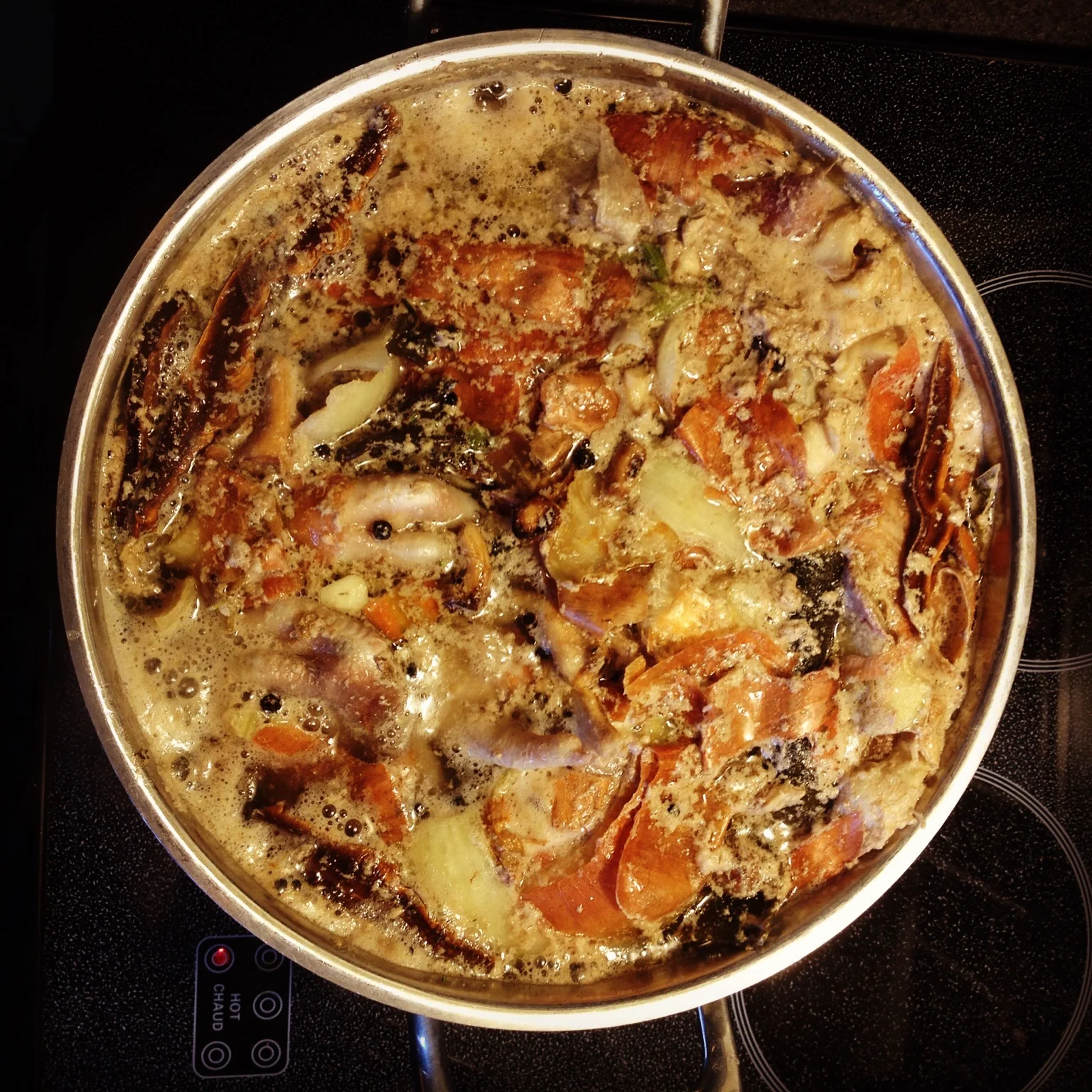
A low, slow simmer is key to making a meat stock that will gel.
Let's go over how to easily make a meat stock. For today's blog post, I am going to stick to a chicken meat stock for the sake of simplicity. I will be including other meat stocks in my repertoire as the months go by and cooking classes get built. But for now, let's look at what it takes to make a good ole meat stock.
POULTRY MEAT STOCK inspired by Monica Corrado of Simply Being Well
The players
a chicken or duck or quail, whole
if you're not too squirmy about it, a package of chicken feet or chicken backs and necks
enough filtered water to cover
2 tbsp of something acidic like apple cider vinegar, lemon juice, or juice from a ferment of sorts
The How-To
Put your bird and chicken feet / backs / necks in the biggest stock pot you own. Top with enough filtered water to cover your bird. Add your acidic medium. Let it sit for 1 hour. (This is to pull more minerals out of the bird into the stock.)
Turn your stovetop on, bringing the meat stock to a slow and gentle simmer. Skim off any impurities that show up. Allow this brew to bubble for a good hour and a half, with the lid off.
Turn your stove top off; strain your entire soup through a sieve, hanging on to the whole chicken. The juices you have collected are your meat stock. Good work. SAVE THIS AND SAVOUR IT.
The whole chicken you have strained is ready for you to debone, and reserve all of the good meat. This is what you can stash in to little freezer bags or containers and have at the ready for easy and simple meals during weeknights, or to add to salads for a nourishing lunch.
What to do next
Take that meat stock, allow it to cool and pop into containers in the freezer for easy meals.
Fill an ice cube tray with this meat stock and freeze individual ice cubes for those times when you need just a dab of stock to thin a gravy out, or steam some greens or cauliflower, or want to braise a veg.
Drink this stuff like tea; add miso paste to it after heating, add some chopped chives and/or seaweed, swirl an egg in it. A nutrient-dense snack that bigs and littles will love.
Save the meat stock, return the pot to the stovetop and add a good solid cooking fat like duck fat. Saute in this a chopped leek, add a few chopped carrots and celery, a few garlic cloves, toss the shredded chicken in and the meat stock, and add a couple of handfuls of slivered greens like swiss chard and parsley. Adjust the flavours, the S+P to make a delicious stew. If you have some pesto, throw that in the mix to make a chicken pistou stew. (Who doesn't want to make that just to say that's what they made? Chicken Pistou Stew. Say it out loud.)
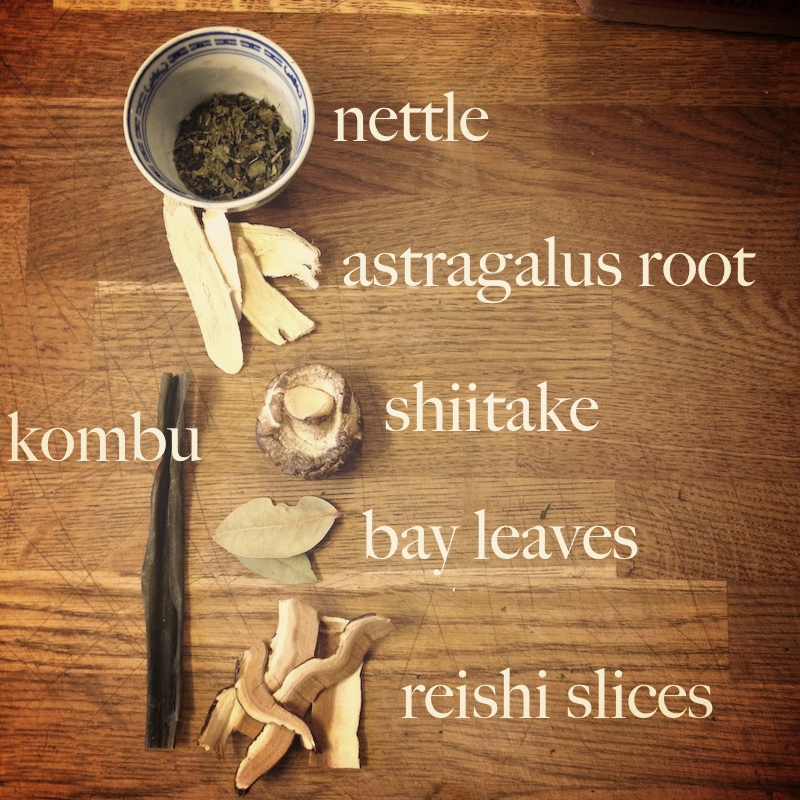
Good add-ins
I love to boost my meat stock with additional herbs or veggies to increase the nutrient density of said stock. Think of adding any number of these things when next you brew. Add them in to the soup pot at the beginning of your meat stock:
a chopped onion (sulfur! Detox superstar! Liver lovin at its best!)
a few chopped carrots and celery (added minerals! And yum flavours!)
any limp looking veggies from your crisper you're wanting to move (except things like kale, radishes, cauliflower or broccoli; their taste is better suited in the final product than in the simmering-stock stage)
a handful of fresh herbs like parsley or rosemary or thyme (minerals + flavours)
a few bay leaves (a traditional flavour for meat stock)
a few dried herbs like nettle or parsley (for anti inflammatory support)
a few peppercorns (a traditional flavour enhancer for meat stock)
a slice of seaweed like the kombu in the photo above (incredible mineral powerhouse, and detox and liver and immune loving support) – any seaweed will do
a few dried shiitake mushrooms (additional immune support)
some medicinal mushrooms like reishi or chaga mushrooms (excellent adaptogens that support adrenals, immune system, everything from head to toe)
additional herbs like astraglus root slices (immune support) or turmeric root slices (incredible anti-inflammatory support)
I keep a freezer bag going in my freezer where I add my vegetable scraps from meal prep during the week. I add the carrot tips, celery leaves, onion skins, garlic skins, carrot greens, parsley stems, fresh shiitake mushroom stems, etc to this bag with the express intention of using it in my next batch of stock. When the bag is full, it's time to put some stock up. (Don't fret about this too much – you're straining these goodies out of the final product.) (Onion skins lend a beautiful golden colour to your stock.)
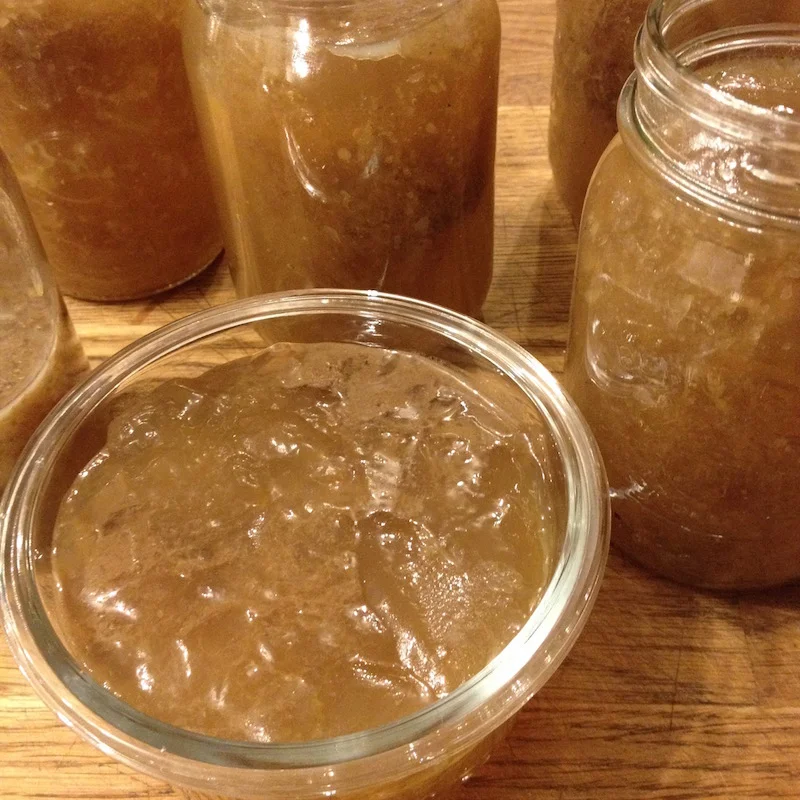
Ready for the freezer.
If you've made your meat stock well, allowing it to come to a slow simmer, not used an excessive amount of water (use enough to cover the bird, and you should be good), your end product should gel upon cooling. This will happen especially if you have some connective-tissue rich feet, heads, necks or backs in the mix; it's worth seeking them out and adding them to the mix! If it didn't gel, do not despair: this is still good stuff to eat! Adjust your water next time, or keep a more watchful eye to make sure the simmer is slowly bubbling.
Once it has cooled, go ahead and store the goods in the freezer. I'd aim to use it up in 3 months' time; it never lasts that long at our house. We have a weekly soup night; plus I often make myself a good cuppa with an egg swirled in for my breakfast on short-on-time-mornings.
If you're looking for a cookbook that could catapult you in to soup making things and broth and stock recipes, track down Monica Corrado's Grandmother's Kitchen Book. I have a well worn copy that lives in my kitchen and is referred to on a regular basis. At the same link, you will find Monica's e-book on Meat Stock and Bone Broth, an essential in any kitchen looking to support gut health. You may also want to purchase a copy of the wonderful book Nourishing Broth: An Old-Fashioned Remedy for the Modern World by Sally Fallon Morell and Kaayla T. Daniel. While they do not differentiate between a meat stock and bone broth in this cookbook, you will find this book has myriad recipes and ways to use the nourishing stocks and broths you will be making. Delicious recipes!
OK friend. You got this. Go make some meat stock. And play with your food, if you please'm.
MONDAY BASICS: break for 12.
Today's blog post is about loving your liver, and giving your body that rest it needs to recoup from the day and prepare for tomorrow.
Break for 12.
Today's blog post is about loving your liver, and giving your body that rest it needs to recoup from the day and prepare for tomorrow.
Break for 12.
Funny that today is Labour Day. Today's post is all about giving your body that break it needs! The one it requires to stay in tip top shape. The concept in today's write up is about taking a break from eating foods for a good twelve hours a night. That would typically mean finish up dinner by 7pm, and get ready for breakfast at 7am. Seems like a pretty easy task to tend to, yes?
There are lots of good reasons why this is a good thing. Let's concentrate first on the liver. This important organ goes to work when we go to sleep. This whole schedule depends quite strongly on the fact that our Circadian rhythm is functioning optimally. According to the concept of the Chinese Body Clock, 1:00 am is the peak time for our liver's functioning. This means that for the next two hours, our wee lil liver is drawing energy inwards in order to help restore function to the body, to do some of that repair work that needs to happen. One of the principal jobs here is that our liver works at filtering out the blood, doing some pretty major detoxification and working at reducing inflammation in the body.
In the interest of balance, the organ that peaks at the opposite end of the clock twelve hours later is your small intestine. Yes, the organ that works at further breaking foods down and assimilating those nutrients in to the body we need.
When the liver is at peak time, the small intestine is supposed to be at the lowest time. If you had a late night snack or only got to dinner at 11pm when you finally came home from your meeting, you are engaging your small intestine to work late into the night. Doing so will engage your small intestine into the wee hours of the morning, which will prevent your liver from going in to that restorative time slot.
If we haven't quite finished digesting our last meal of the day by the time 1:00 am rolls around, we are starting to play with the way things are meant to work in the body, namely disturbing this very important detoxification work. If the body is still working at breaking down our late night meal or snack, our body is now concentrating on digestion and not on the restorative work of the liver.
Circadian Rhythm
By asking our bodies to digest late night instead of entering a twelve hour fast, we are contributing to throwing the Circadian rhythm off kilter. This can have serious impacts on our optimal health.
Want to know just what is our circadian rhythm, what's it all about? Click here. Find some interesting studies and experiments based on the Circadian Rhythm here. Disrupting our Circadian rhythm can negatively impact our health in myriad ways: obvious things like contributing to our inflammation, contributing to Parkinson's, hormonal shifts, optimal brain function can be impaired, and this is just the beginning. Remember this post on prioritizing sleep? It goes in to more detail on the importance of restorative sleep. Head there for some good tips on how to ensure optimal sleep.
Back to snacking. Our bodies haven't evolved fast enough yet to allow for our late night snacking habits. Late night munchies means your body's clean-up crew (liver!) just won't be able to do the maintenance work it needs to do at night.
So give your digestive system a break, and influence your liver to rev up its cleaning duties by planning to finish eating by 7pm at the latest. Know that earlier is indeed better. My recommendation would be to aim to finish dinner a good three to four hours before you plan to hit the hay. That gives your body plenty of time to break down your last meal of the day and prepare for the clean up crew coming in at 1am.

The other part of this equation is this nasty lil thing called acid reflux. As we are now eating our heaviest meal at the end of the day, we are putting the most work on our digestive system as our body's ability to digest is at its weakest. Couple this with a late hour for noshing, and this starts to negatively impact our body's ability to produce hydrochloric acid enough to trigger proper and thorough breakdown of all foods coming down the pipe.
It is this release of hydrochloric acid (stomach acid) that chemically triggers our body's protein enzymes to get to work. It is also this acid that chemically triggers the sphincter at the top of our stomach to properly close in order to keep everything in the stomach. As our ability to produce hydrochloric acid wanes as we age, this digestion process starts to take longer and longer to finish. Going to bed an hour or two after a meal, while we haven't quite finished breaking foods down in our stomachs, as we lay on our sides, we start to tip some of this acid out of the stomach, resulting in acid reflux. If you give your body adequate time to digest your last meal of the day and get it going down the digestive system, you will better reduce those chances of acid reflux interrupting your beauty sleep.
Coles Notes
Break for 12 hours. Stop eating by 7pm, have breakfast at 7am. Alternately, give yourself 3-4 hours between your last bite and when your head hits the pillow. Your liver will thank you by bringing in the cleaning service, and your body's natural superpowers of detoxification will be best supported.
MONDAY BASICS: lunchbox planning.
The cooler nights are here. The tomatoes are ripening on the double. You've pulled out your first pair of socks in two months. You've stood in amazement at how much your little one has grown in the past two months in the sun. It can only mean one thing: it's time to think of lunch boxes.
The cooler nights are here. The tomatoes are ripening on the double. You've pulled out your first pair of socks in two months. You've stood in amazement at how much your little one has grown in the past two months in the sun. It can only mean one thing: it's time to think of lunch boxes.
Obviously it means more than one thing. But today's blog post is about developing a method to the lunchtime madness, be it for your littles who are away at school or daycare, or be it for the bigs in your life (including you!) who are keen to amp up the good food and make lunch a tasty and nourishing thing. We'll round it all out with a good list of quick ideas for lunches, and point you to a few good spots online for tote-friendly recipe roundups.
If this meal is for a little
Keep it simple. Repetition is a-ok. In fact, some children really thrive on predictability and the security of knowing what their lunchbox contains. If your child is one who likes surprises, still stick to the same lunches but add one small compartment with a surprise in it that is different every day.
Involve your children in the preparation! They are never too young to participate in food choice and prep. I think it is a big part of parenting and guiding them in this world, so get them in the kitchen. Take them grocery shopping, and give them the choice of veggies and fruit they would like to try in the coming week's meals. If they pick a packaged item from the shelf, read through the list of ingredients with them and help them decide if this is something with which they want to fuel their bodies. Have them help with a batch cook prep session on Sundays say, where they chop those veggies and fruit they're going to eat this week. They can cut them in to pieces and in to containers in the fridge. This will make meal assembly a breeze in the coming days.
For my daughter, as she is now preparing her own lunch, we sat down together to drum up a list of what type of meals she can pack for herself on what days. She has always loved the security of a routine, and so loves to have the same meal every Monday (tuna salad), and every Tuesday she counts on a mini pizza, and Wednesdays are for thermos meals, and so on and so forth. It takes the guesswork out of what to make, almost like the plan has been pre-decided and all she has to do is follow the plan. Which is easy, and certainly do-able for her. We went over the concept of what types of things to include in her lunches, always ensuring there is a good protein and a good fat, along with a vegetable or two every day. Not only does she enjoy making her lunches (I know, the school year hasn't yet started... (I promise she did this last year and was a champ)) she actually eats more of it too, meaning she has the fuel she needs to get through the day of school work and play. And I am throwing less soggy, spent good food in the garbage at the end of the day.
Think of themes for those days as a jump off point perhaps. Mondays = tacos; Tuesdays = soups; Wednesdays = eggs; Thursdays = salad; Fridays = pizza. This list can come from a 10 minute brainstorm session where everyone pitches in. What are your family's favourites?
We have a hand-drawn calendar on our corkboard in the kitchen that my kiddo refers to when preparing her lunch the night before; in this last week leading up to school is the perfect time to get them to build this calendar. They can design it themselves; or you may want to use a pre-made one. I found a few bright and colourful what they call free 'printables' online, you may want to check them out.

Whether you are preparing for a kid-friendly lunch or a meal at your desk or in the work lunchroom (think of the $$ you will save from not going out! and how much more nourishing the food will be!), there are a few good tips that apply to both.
Freezing smaller portions of things like roast chicken, extra pulled pork meat, or other things of the like can be done in easy portions by first doling them out in to silicone muffin trays or ice cube trays. Once they've had a few days to firm up in the freezer, pop them in to a freezer bag to keep them fresher and to keep them from drying out. They'll make for easy peasy meal prep in no time flat! Look for a list of ideas using this method below. (One of my favourites is to freeze pesto into cubes. Adding one to last night's dinner makes it a whole new meal for lunch today! Add one to some frozen stock, throw in the leftover side veggies from supper and add some roast chicken and lunch is served.)
Interested in bringing something liquid to lunch? Salad dressing? Apple sauce? Yogurt + fruit? I highly recommend picking up a flat of 1/2 cup sized glass 'mason-style' jars from Canadian Tire or your favourite grocery store. They seal up like a dream, preventing those sloppy messes from taking over the backpack or briefcase. Bonus, they're fairly easy for littles to open at school. I hand these half cup jars out at some of my classes; they're the perfect size to make enough salad dressing for a few days so that you only need bring it to work on Mondays. It can stay in the fridge at work for the rest of the week, one less step to think about when preparing your meals for the rest of the week. (Remember this post on making your own salad dressings? Worth a recap to understand WHY you'd want to make your own.)
Sandwich or wrap popular ideas chez vous? Might I recommend you go for a sprouted grain product instead of straight up white or brown bread (whether gluten-free or gluten-full). It's the same idea behind this story here about the fox; choosing a sprouted grain product will be immensely easier to digest, and kinder to your system. Think of swapping things out: use lettuce leaves for 'boats' instead of corn tortillas for build-your-own-taco lunch. Use nori leaves to wrap the tuna salad for lunch (although I'd recommend they are assembled only at eating time, otherwise they go soggy). Instead of the wrap, keep the inside components but make it a salad instead. Have them with sprouted grain chips or sprouted crackers instead. Use your liver pate or smoked salmon + cream cheese + chives spread as a dip for veggies!
Another way to have an easier time with grains is to reach for a true sourdough bread instead of a regular loaf. Sourdough is a naturally fermented process which breaks down those nefarious anti-nutrients in grains, inherently making the job of digestion easier. How to know it's a true sourdough? Make sure there is no yeast on the list of ingredients.
Double up and make extra
Next time you're making a pot of soup, or a stew in the slow cooker, consider making a bit extra. If you're roasting a chicken, it's worth throwing in a second one just for the meat you'll have at the ready for easy lunch planning. The extras can easily be frozen in containers or bags into the freezer in single-serving sizes. Taking them out the night before works well, or bringing them to work frozen first thing in the morning prevents them from leaking on the way to work. See? There's a plus to every side, my friend.
A note on thermoses: it's best to preheat the container with some boiling water for 10 minutes, as you are heating up the meal that will be going in. Just make sure to dump the hot water before you put your food in. I've been caught a few times with my eyes half open...
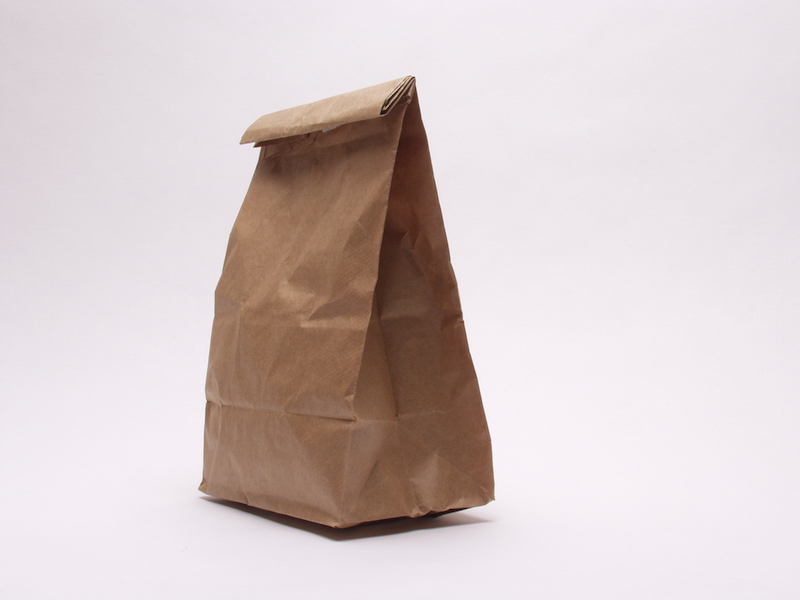
I have a wee list of things below, based on whether they're plant powered or animal powered. You'll find a list of thermos-friendly ideas, and freezing-friendly things too. Please add your ideas in the comments below! It takes a village, friend.
Throw some of these ideas together for a nourishing meal in a flash.
Plant-powered small bites
nuts + seeds
olives
avocado
sweet potato chunks
carrot 'coins'
vegenaise + pesto = dip
kale chips
seaweed crackers
popcorn + coconut oil/butter + hot sauce + parmesan (opt)
salad of vegs + salad dressing in a small glass jar
fruit
berries
smoothies (make sure there's a good fat – coconut oil, full fat yogurt, nut butter, cocoa butter)
nut butters on fruit
celery sticks with nut butter and goji berries (fire ants on a log!)
shredded coconut
homemade trail mix (seed + nut + dried fruit + cocoa nibs)
use sprouted grain bread or true sourdough for sandwiches and wraps
use nori leaves for wraps
make nori rolls with tahini, cukes, avocado, sprouts and cut into sushi like pieces
things-on-a-stick (fruit salad this way! Or veggies + cheese!)
easy homemade mini pizzas (naan bread + sauce + toppings)
guacamole + sprouted crackers or chips
pickles (fermented dilly sticks are a great first ferment, and tasty bites)
hummus or babaghanoush with veggies
sprouted corn chips with salsa
apple sauce
fruit crisp
Animal-powered bites
yogurt or creme fraiche + maple syrup + berries
yogurt + granola + berries
cheese
veggies + ranch dip
mayo + pesto = dip
sardines + mayo + celery + curry powder
hardboiled eggs
egg salad
deviled eggs
protein pancakes
pepperoni sticks (with clean ingredients)
farmer's sausage (with clean ingredients)
jerky
pâté or liverwurst
smoked salmon
shrimp
bacon strips
tuna salad (or salmon, or sardines); fish + celery + smashed avocado + curry powder
roast an extra chicken and shred that meat in muffin cups, store in freezer bag for easy portion retrieval
send lettuce or corn tortillas for your person to make their own tacos (+salsa +cheese +sour cream)
Meat salad in a wrap: chicken, apple, creme fraiche, celery, pickle relish
sushi salad (smoked salmon + leftover rice + nori leaves + sesame seeds + chives + avocado)
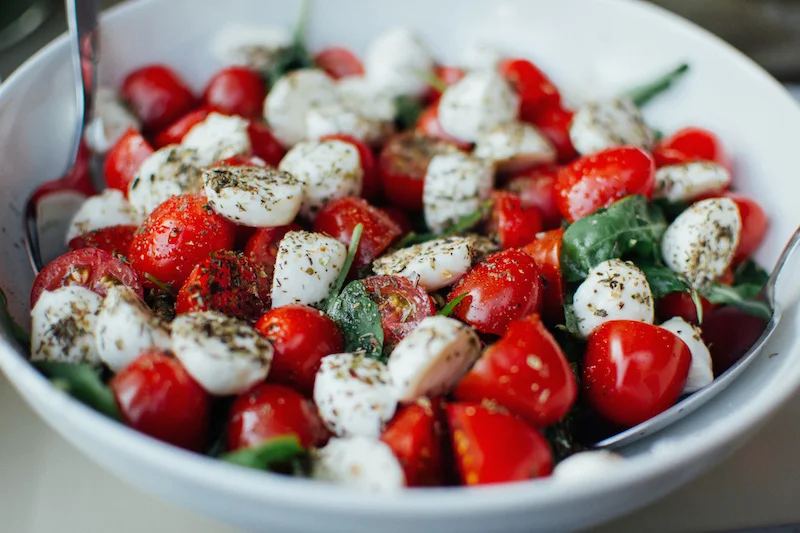
salad of cherry tomatoes + peppers + cucumbers + bocconcini cheese + basil + balsamic
tzatziki + cukes + snap peas
celery stick + cream cheese
1 tbsp butter + 1 tsp honey = frosting, along with an apple or pear to dip
yogurt + chia jam
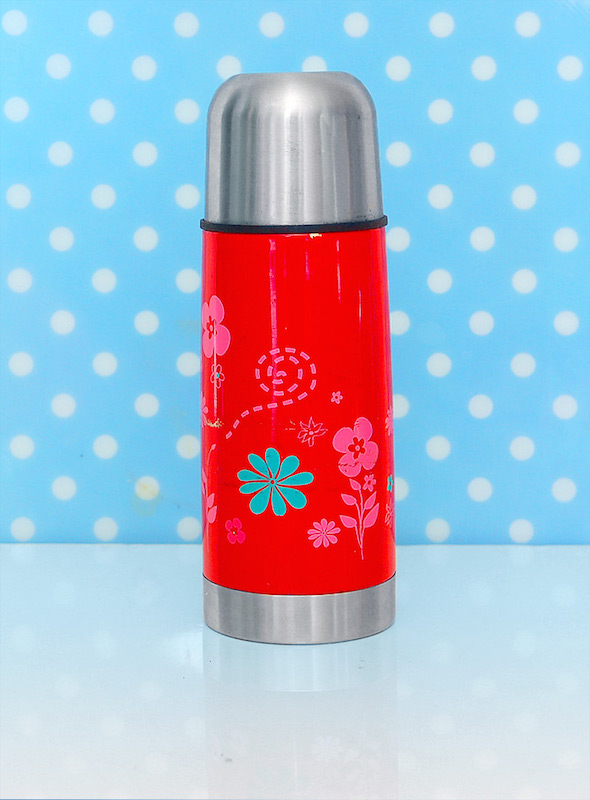
Good meals to cook extra for the thermos
cook extra sausages at dinner
meat stock + seaweed + chives
chili
make a big batch of soup or stew and freeze in individual portions for easy retrieval
make a double batch of your famous meatballs and freeze for easy lunches
make a double batch of your family's best crockpot recipe and freeze for easy lunches
make an extra shepherd's pie and divy it up into single sized portions
refried beans
keep your stock hot in your thermos, and make your own noodle soup with ingredients in a glass jar (veg, garlic, sesame oil, cellophane noodles, herbs); add stock only just before eating
last night's dinner
frozen stock cubes + frozen shredded chicken + frozen pesto cube + hit of salsa or cube of pizza sauce = instasoup
Use silicon muffin trays or ice cube trays to freeze small portions, pop in freezer bags + label
meat stock / bone broth
leftover meat
roast an extra chicken for dinner, and shred the meat for quick easy grab protein
double your recipe for pulled pork and freeze the meat for quick easy grab protein
pesto (great way to jazz up lots of things, and change the flavour of a leftover)
pizza sauce
blitzed pulse paste (great to add fibre and protein to a quick pieced together meal)
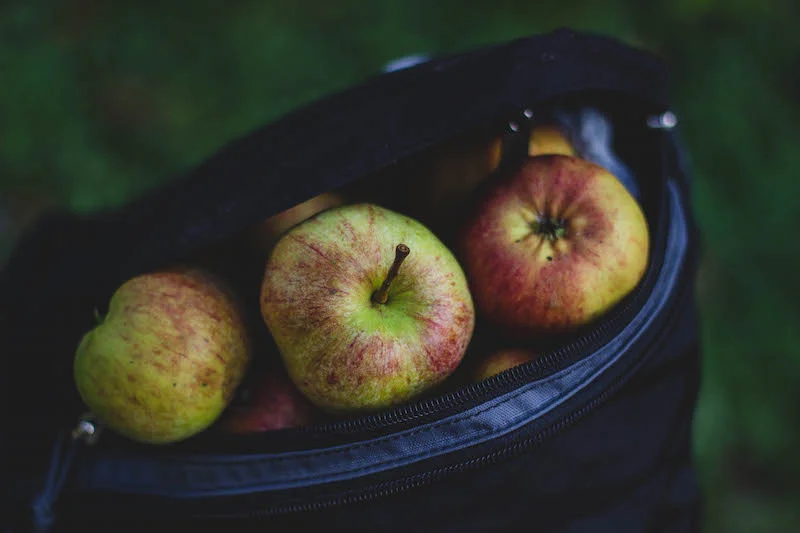
Find more ideas at the blog post on snacking well.
A full roundup of pack-friendly lunch ideas on a pinterest page of mine here
You'll find loads of recipe round ups when it comes to lunch ideas via pinterest. My fave is here.
My only rules: Keep it simple. Routine is key. You got this.
Good luck on your lunch planning! Now go play with your food.

MONDAY BASICS: breathe deeply.
Deep summer is the perfect time to practice today's Monday Health Basics tip: the air is warm, the sun might be out (or trying to make an appearance!); it's the time of year that commitments for our time are at a minimum. For some the impending weeks ahead with school start up and a return to work may be looming on the horizon. This is the perfect time to add this tool to your arsenal: breathe deeply.
Deep summer is the perfect time to practice today's Monday Health Basics tip: the air is warm, the sun might be out (or trying to make an appearance!); it's the time of year that commitments for our time are at a minimum. For some the impending weeks ahead with school start up and a return to work may be looming on the horizon. This is the perfect time to add this tool to your arsenal: breathe deeply.

The science behind the deep breath
When stress levels are elevated, we tend to breathe more shallow.
When we are in the sympathetic nervous system mode, we are on high alert and getting ready to fight or flight. Short shallow breaths are a part of the picture.
Shallow breathing exacerbates or amplifies the stress response.
Taking deep breaths or being more mindful about our breath calms that stress response, and triggers a shift in our adrenal glands.
Slowing our breath slows down our body's manufacturing of stress hormones.
Slowing down the breath influences the parasympathetic nervous system to kick in – think rest + digest mode, sometimes called calm + connect.
Slowing our breath allows our heart rate to return to normal. This allows our blood pressure to self-regulate.
Slowing our breath allows our mental chatter to calm down.
Slowing our breath allows our body to turn on digestion, allowing us to better break down foods into nutrients necessary for every cell of our body.
Deep breathing is focusing on releasing carbon dioxide just as much as taking that oxygen in.

Why I love it:
It's free.
It works.
It is your number one tool to bring down the ill effects of stress.
It is a super tool in times of anxiety. Excellent at helping regulate a racing pulse.
You can do it anywhere.
You don't need special tools.
It invites you to that physical state where your body can focus on resting and recouping, digesting and doing repair work.
It helps to relieve muscle tension that could be contributing to headaches or migraines, and other minor aches and pains.
It also helps your brain grow, keeping brain atrophy at bay!

The How To:
Sit up straight, reducing distractions around you (turn off the radio, put away your phone, take a break in the washroom if that's the only quiet place right now).
Breathe in through your nose for a count of say, four or five.
Breathe right down in to your belly, allowing your diaphragm to expand.
Hold for a count of 4-8, building on this with time.
Release the air through your mouth on a count of eight or ten, essentially twice as long as you spent taking that breath in.
Do this at least 10 times, in a quiet spot.

If you like or are able, you can close your eyes to help create that safe space.
Try visualization at this point if it would help; use your mind's eye to see a restful space, a spot in the woods, your favourite place. It all contributes.
If you're able to extend this into a 20 minute mindfulness or meditation practice, you will be doing wonders for your brain, heart, immune and overall health. Start your day with this kind of deep breathing and mindfulness exercise, and you will see how setting this calm intention at the beginning of your day may be of benefit to you. End your day with this kind of deep breathing and mindfulness exercise, and you will see how this could improve your ability to fall asleep and perhaps stay asleep better, longer.

Share this tip with the littles in your life: they too need help manoeuvring through this life.
Go breathe my friend. You got this.
MONDAY BASICS: eat butter.
Everything is better with butter. Short and sweet. That's the subject of today's blog post.
Everything is better with butter.
Short and sweet. This is the subject of today's blog post.
It's true, everything really is better with butter. And there is good reason! The idea behind this next in the series of Monday Health Basics is meant to inspire you to reach for this super food more often, in order to support your very best self. Allow me to go over some of the good stuff.
Why I love butter
butter protects against many diseases
it is a rich source of those all important fat soluble vitamins (A, D, E, K)
you need vitamins A + D to help take up calcium in to the bones, so eating butter will help keep osteoporosis and tooth decay at bay
good source of antioxidant vitamins + minerals, warding off free radical damage (think heart protective, liver protective, skin protective, lung protective, brain protective, warding off cancers, whole body protective)
excellent way to get more of the animal version of vitamin K (K2!) shown to protect our hearts, our noggins, our teeth + bones and showing promise of helping protect against cancer
excellent source of the animal version of vitamin A, integral to the intestinal lining and all mucosal linings (think respiratory- good to protect against asthma!), also helping support your immune system
vitamin A is also integral to thyroid and adrenal health, so important in metabolism and your response to stress!
Selenium is also part of the nutritional profile here, further supporting your thyroid and also contributing to butter's antioxidant prowess (liver loving!)
provides a good hit of B12, the 'energy' vitamin
butter is a good source of iodine, a mineral integral to the function of your thyroid
a good source of saturated fats, helping to protect our heart and liver
helps to balance blood sugars, leveling them out which means staving off spikes and dips which is supportive to our mood, adrenals and energy levels
consuming vegetables cooked in butter (or steamed, then adding in a pat of butter) will ensure we are better able to assimilate the minerals found within the vegetables (fat supports this!)
butter provides your intestines with butyric acid, which has been shown to help bring down inflammation in the gut lining, protecting your digestive system
you'll get a good hit of CLA (conjugated linoleic acid), which has been shown to protect against some cancers
other good fats found in butter have been shown to kick candida in the patootie
butter provides you with short and medium chain fatty acids that have been shown to have strong anti-tumour effects and immune supportive
butter has a good amount of cholesterol (the good kind I assure you!) necessary to proper brain development in our littles, maintenance of cognitive function as we age
that cholesterol is also important in the development of a child's reproductive system, as well as supporting a healthy reproductive function in those looking to have babies (yay fertility!)
as if that wasn't enough, butter has the right ratio of omega 3 fatty acids to the omega 6 fatty acids, which helps our bodies keep inflammation at bay (which is really at the root of just about every chronic disease out there)
you'll also find lecithin in butter, an important nutrient essential to liver function and fat digestion
oh man, it's just delicious (did you really need another excuse?)
Good thing to know is that the lactose content in butter is much lower than that found in other dairy products. Some people with lactose intolerance can tolerate butter. If casein is a problem for you, or if you find it tough to stomach butter, you may want to try your digestive prowess with some clarified butter, also known as ghee. This clarified butter is only the butter fat content; all milk solids (proteins) have been taken out in a low/slow cooking process.
While researching the health benefits of butter, you'll come across the Wulzen factor. This refers to keeping stiffness out of the body. Consuming butter will help protect against the calcification of certain tissues in the body; think joints, glands, arteries, cataracts. Unfortunately this factor is deactivated when the milk or cream is pasteurized. Keep this in mind.
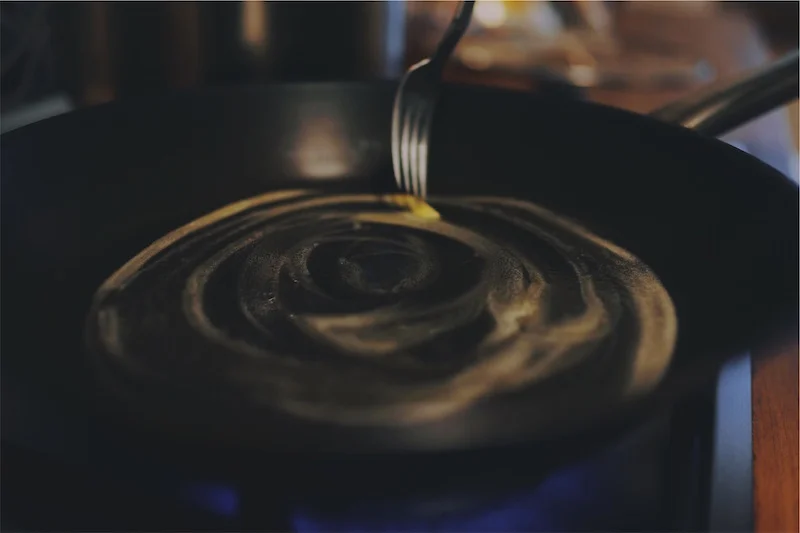
When it comes to choosing your butter, it's a question of good – better – best. Good = conventional butter. Better = organic butter. Best = butter from grass-fed cows. When the cows are out on the pasture consuming the diet they have evolved to eat, they are able to properly store those all-important fat-soluble vitamins in their fat, hence making them accessible to us. The better the quality of the butter, the more the quality and quantity of the nutrients found within.
Can you switch to butter from margarine? Are you able to alternate one week conventional butter, the other week organic butter, and maybe get one block a month of the grass-fed butter?
Incidentally, the butter coming from organic cows around this time of year in Canada will sometimes have a sticker on the packaging indicating the product is from grass-fed cows. Look for these, and stock up. The blocks of butter freeze beautifully! (It really is impossible to expect that all butter in our northern climate come from grass-fed cows all year long; it just isn't practical nor has it ever been done.)
Butter is the newest super food. Add a pat of the good stuff to your next bowl of soup or stew. Slather on a bit to your steamed veggies. Cook your vegetables in butter. Melt some butter and coat your next chicken before roasting. Put more butter on that snack/baked good/popcorn. Swap out the oils or margarines called for in your recipe and use butter instead. Mix 1 tbsp of butter with 1 tsp of honey or maple syrup, and call it frosting for fruit. Cook your eggs in butter! Add some butter to your morning coffee (butter coffee, anyone?)

I cannot lay claim to this quote. But it's so true. Food for thought...
I invite you to do some further reading, if you're still not convinced.
Dr. Mercola explores the nitty gritty science behind the benefits of butter here
Dr. Axe explores the difference between margarine and butter here