
MONDAY BASICS: write this down.
If today is the first time you've taken a gander at one of these Monday Health Basics posts, then you're in luck. It's the perfect place to start. It is, perhaps, where I should have started back in January earlier this year. See, this series of ideas I have been posting to the blog every Monday in '16 is meant to serve as a jumping off point for anyone looking to improve their own health, one building block at a time. And today's spot is the perfect place to begin. Write this down.
If today is the first time you've taken a gander at one of these Monday Health Basics posts, then you're in luck. It's the perfect place to start. It is, perhaps, where I should have started back in January earlier this year. See, this series of ideas I have been posting to the blog every Monday in '16 is meant to serve as a jumping off point for anyone looking to improve their own health, one building block at a time. And today's spot is the perfect place to begin. Write this down.
Whenever I meet with a new client, I always start with the same questions: What brought you here. What are your current health complaints, regardless if you think it's associated to nutrition and digestion or not. What are your questions. What are your observations. What are you feeling. And I play the part of stenographer, tapping away and entering this information to help build a map of where we started, and where we hope to go. I ask some more questions as the meeting progresses, making note of important information that may serve as a signpost along the way, or points of interest we'd like to revisit.
We are building a map, you see? Truly, they have been building a map for a long time, and I see myself as merely the cartographer. But the more I do my work as a Holistic Nutrition Practitioner and as a human, the more I see the value in empowering the person in the chair across from me to make their own informed choices on the daily, and to take charge and actively chart their own course from this point on.
Before you begin any kind of program, class or course of treatment, it is good to know where you are when you start. It is good to note what you have noticed, what you are thinking about and your outlook on the whole process before you take your first step, in order to be able to look back when times get tough. This will serve a purpose when you come to those days where you think nothing has changed! Or why am I even doing this? And those days will come, we all experience them. Writing things down at the get-go gives you that mile 0 marker, a chance to take stock and articulate things you perhaps haven't yet been able to put words to.
My favourite part about writing it down means that it can change your perspective when you really need it the most. Looking back and noticing how things have changed, seeing that certain aches may have disappeared, or maybe your migraines are a lot less frequent than they used to be; referring back to your journal invites you to see how far you've come, instead of getting stuck in the rut of how much farther do I have to go. Which, let's be honest, can sometimes feel incredibly overwhelming. Goodness knows, I'm all about the tools.

I am a big proponent in small changes over a long time. I truly believe that if you have certain chronic ailments or health complaints that have taken years to creep up on you, they aren't going to be dealt with in the span of two weeks, nor is it reasonable to think that we can do away with health issues that quickly without swinging the pendulum in the complete opposite direction. I see the human body as always aiming to steer towards centre, towards balance. As our body works to handle what is sent our way via toxins in our environment, or our diet, or emotional situations we have to process, we slowly start to veer off course and the body works hard to try steering us back towards the centre. It can't help but start to fall to one side.
When a client comes in to meet with me, I explain that through the next few months of work, we will be aiming to, at the very least, stop the progression from veering further off course, and hopefully start to reverse the body's direction in order to send it gently back towards centre. If it took years to get to where you are now, it will take a long time to get your body back towards centre. It is worth it though! It is only through slow and methodical ways that we can steer that body safely back towards the middle, so that we don't create a new wave of momentum that would keep swinging you past centre and in the opposite direction!
A soft landing is what we are after.
And in so doing, I have found that a good marker to demonstrate we are on the right path is if my client's memory starts to be selective. I have now witnessed quite a few times how people have forgotten earlier aches and pains that were a part of the initial intake forms, small booboos they may not have remembered were a part of their every day when they first stepped in to my office. It amazes me! I can only see this as a positive sign that if we have erased even their memory of these health complaints, then we have successfully changed the impact they originally had, and have charted a new course. And the lightbulb moment when they realize how far they've come is one of my favourite things about being a Holistic Nutrition Practitioner.

This being human is work. This being alive is work. But it is good work.
And writing down and taking stock of where you are when this first new day begins can be one of the most empowering tools in your toolkit. As you start this next step in your health and wellness journey, may I recommend purchasing a blank journal of sorts, a book in which you can freely write with no judgment, no expectations, a blank slate on which to start mapping your road. It can be fancy or it can be a coil-bound thing, you get to choose.
Write today's date. Write down some simple things about where you're at, today. Write down your thoughts and observations on what brought you here. What are your current health woes, complaints or aches and pains, doesn't have to necessarily be categorized. What are your questions. What are your observations. What are you feeling. What do you need help with, and where do you want to go. Write down symptoms you've got going on currently, whether or not you think they are associated to your main health concern. You might want to jot down some examples of foods you love, foods you crave, cuisines you are wild about. Jot down your current interests and passions, and anything you're grateful for at this point in time. You can take the time to also write down what you'd like to track, things like sleep habits, mood, or how often you are visiting the loo. Energy levels are always a good indicator of things. How foggy your brain is, or how keenly you feel stress might be good things to note. Women might like to jot down a few things they have noted about their menses cycle, or observations around menopause. If you are currently working through a medical diagnosis, take note of your symptoms and the severity, or how they change from day to day. Take the time to write down any aches and pains even if you don't think they're associated at all. Rate things on a scale of 0-10, if you want a good measure of things along the way. This is meant to serve as a picture in time of you, at the beginning of this next leg of your journey.
This book you are penning will grow with time, and will change as you make your way through the work. There is no set way to do this; the way you decide to go at it is the way that will work best for you. You are, after all, the expert on you. You can write in it every day if you like, once a week if you're more laid back, or once a month if you're like me. Put an alarm in your phone's calendar to remind you to jot something down, anything.
And when, down the road, you feel like you've hit a dead end or the uphill climb seems impossibly daunting, you can flip back to those early days you started this journey, and realize that you really have come a long way. This perspective change will confirm to you that you are in fact on the right track, and may it spur you to keep going when things seem insurmountable. It's all about momentum dear one. May this tool serve to keep you moving on the road ahead.

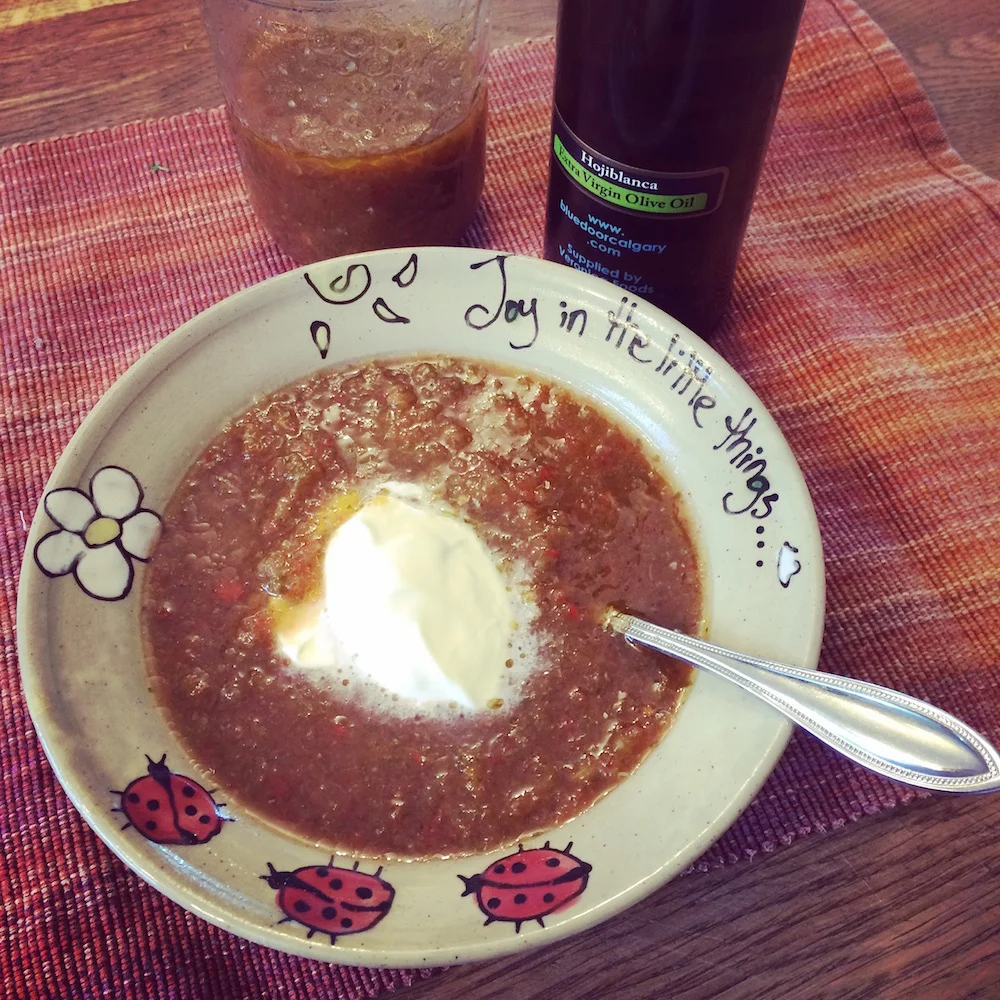
Gazpacho. Fermented.
New recipe on the blog, meant to take in the flavours of the season. Fermented Gazpacho, with flavour spikes from fused olive oil from Blue Door in Calgary, and flavoured vinegar from my wee garden patch. A nourishing probiotic-rich cold soup for the dog days of summer!
This is my story and I'm sticking to it. I had some cucumbers taking up space in my crisper, going a little soft. I had some lovely tomatoes from a local producer I had purchased in anticipation of my own tomatoes ripening at home, and so had to make something with them to make way for the home grown bounty. What does one make when one combines cukes and tomatoes? Well, gazpacho of course!
Being who I am, I couldn't just follow a recipe. Oh no, I had to experiment... I had some time on my hands. So play I did. Here is the finished product: Fermented Gazpacho! I fermented it in order to increase the nourishing aspects and add some probiotics to the mix. I fermented it in order to help it last in the fridge (fermenting extends the shelf life, did you know?). I also fermented in order to develop a really nice sour note to the cold soup; gazpacho just naturally lends itself to flavour explosions. I decided to try my hand at coming up with my own recipe.
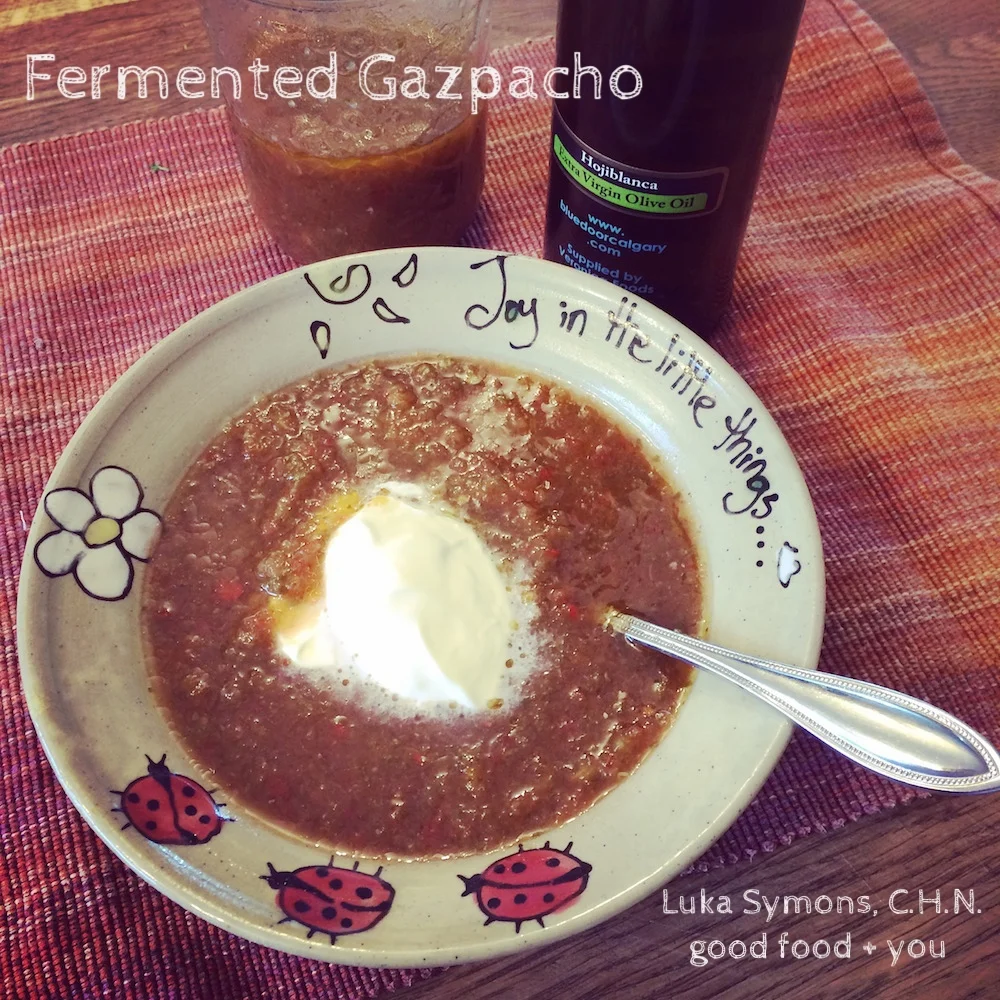
FERMENTED GAZPACHO
In a blender, combine until chunky (your desired consistency) or hand chop to pieces in the size you want:
- 5 mini cucumbers or 1 long english cucumber
- 4 tomatoes
- 2 bell peppers (I added colourful ones to enhance the visual glee you get from a gazpacho)
- 1 red onion
- 3 cloves of garlic (minced)
- 1 bunch of cilantro (minced)
- 1 bunch of parsley (minced)
- a handful of chives (minced)
Using a digital scale, pre-weigh a big kitchen bowl, big enough to hold your chopped veg. Mark down the weight of your bowl on a piece of paper, and return the bowl to the scale. Add your chopped veg. Mark the weight of the bowl + veg, and subtract the weight of the bowl: you have the total weight of veg! This is important, in order to know how much salt to use in order to allow for proper lactofermentation.
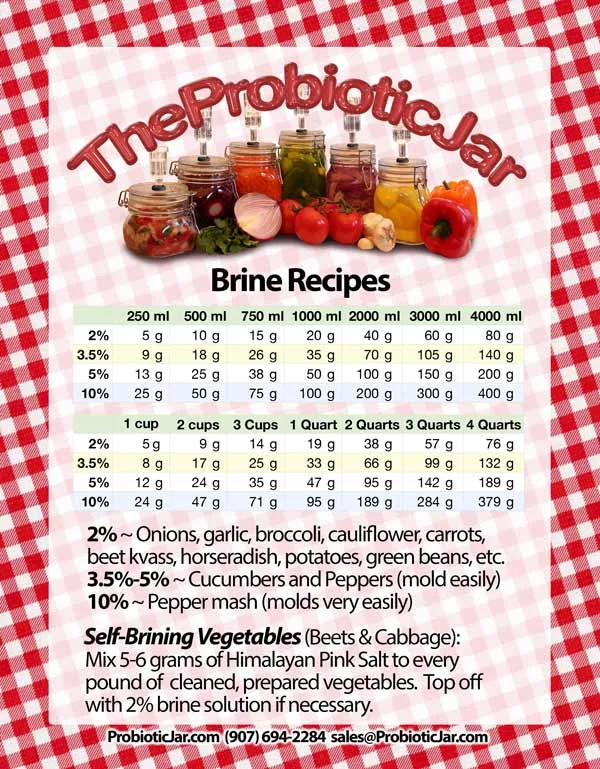
Handy chart to use to measure how much salt to volume. I prefer to measure by weight.
The good folks at The Probiotic Jar can do a much better and thorough explanation of how to figure out your salt brine percentage when making a ferment. See, when fermenting, it is crucial to set up the proper percentage of salt in your final product in order to have that tiny window that allows only the good probiotics to develop, selectively nixing out those that can't live in that salt percentage. This is how you ensure your product is food safe and won't mold, it's by ensuring the proper salt ratio for your ferment. And seeing as this gazpacho had cucumbers and peppers which are prone to mold, I opted to go for a 3.5% brine.
The total weight of my chopped veggies came to 1,623 grams. I multiplied this by 0.035 to get the 3.5% of weight to figure out how much salt to add to this lot. That turned out to be 57g of sea salt. I measured this amount out in a separate bowl using my digital scale, and then proceeded to swap out some of that salt for some leftover brine from a jalapeno+garlic ferment I did last summer. Knowing that 1 tbsp of sea salt can be replaced with 4 tbsp of leftover brine, I then whittled down the 57g of sea salt to 30g of sea salt by scooping out 2 tbsp of sea salt, and I added 1/2 cup of the juice from the jalapeno+garlic ferment, along with a few jalalpeno peppers for proper hit of spice.
It is important you figure out your own amount of sea salt you will need to add to your ferment, in order to ensure it is in that fine range to keep nefarious molds and bacteria out of the final product and make it a food safe venture. Do not follow my measurement, you won't have the same amount of veggies as I did. Each batch is different; it's why I am a big believer in measuring out in grams on a digital scale. It's not as hard as it seems!
Mix the salt + brine (if you are using) in with the vegetables well, and pour your final mix into a fermenting jar that will fit, or a fermenting crock or my favourite, a Fido jar. Make sure the lid is on tight, and if it's a jar you are using, mix your gazpacho every day by tipping upside down and right side up again to redistribute the veggies and salt, in order to prevent mold from developing on the top. If you have your gazpacho in a crock, it might be wise to mix it every day to redistribute the salt and re-submerge the tender veggies.
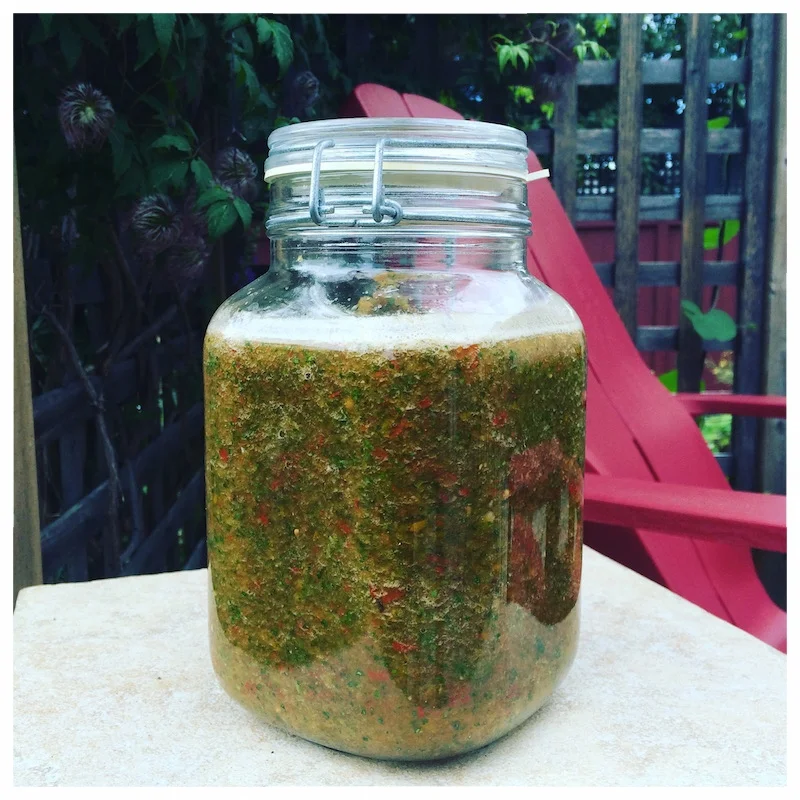
Gazpacho fermenting in my 2L Fido jar.
I let mine sit on the counter for 5 days, but you may prefer the taste at 3 days. It gets a bit more sour as the days go by, so when you decide to tuck in the fridge is completely dependant on your taste buds and preferences.
After the fermentation time on the counter, add to your jar:
- 1/4c flavoured olive oil (I used the Hojiblanca olive oil from Blue Door Oil + Vinegar, but you could use any flavour of olive oil here. Milanese Gremolata might impart that je-ne-sais-quoi!)
- 1/4c red wine or balsamic vinegar or flavoured vinegar (I used my homemade chive blossom vinegar)
- 2 tbsp of lime juice (fresh is best)
- Optional: hot sauce, chipotle peppers, red chili flakes
Mix well, and store the soup now in the refrigerator. Adding these ingredients deepen the flavours of the gazpacho, making each batch a unique offering. Having the good quality olive oil in the mix also imparts anti-inflammatory benefits, and packs on the nourishment and fats to help you assimilate more of the nutrients found in the gazpacho. Up that nutritional ante! Play with your food! And add a dollop of creme fraiche at serving time while you're at it.
The soup will keep for a minimum of 7 days, but I bet you'll run out before the end of day 2.
Bon appetit, les ami(e)s.
MONDAY BASICS: put up the harvest.
It's that time of the year, my dear. The time where the apples start to fall from the tree, where the abundance in your garden is gaining speed and you just can't keep up. It's the time when the price of produce is at its best, and local or BC-grown produce is within reach! The blog post today is meant to inspire you to take full advantage of Mother Nature's bounty and gifts, and to celebrate this most wonderful time of the year. Friends, it's time to put up the harvest. (In small batches. Do-able things. Easy things. Delicious things. One good thing at a time. Your future-winter-self will thank you.)
It's that time of the year, my dear. The time where the apples start to fall from the tree, where the abundance in your garden is gaining speed and you just can't keep up. It's the time when the price of produce is at its best, and local or BC-grown produce is within reach!
The blog post today is meant to inspire you to take full advantage of Mother Nature's bounty and gifts, and to celebrate this most wonderful time of the year. Friends, it's time to put up the harvest. (In small batches. Do-able things. Easy things. Delicious things. One good thing at a time. Your future-winter-self will thank you.)
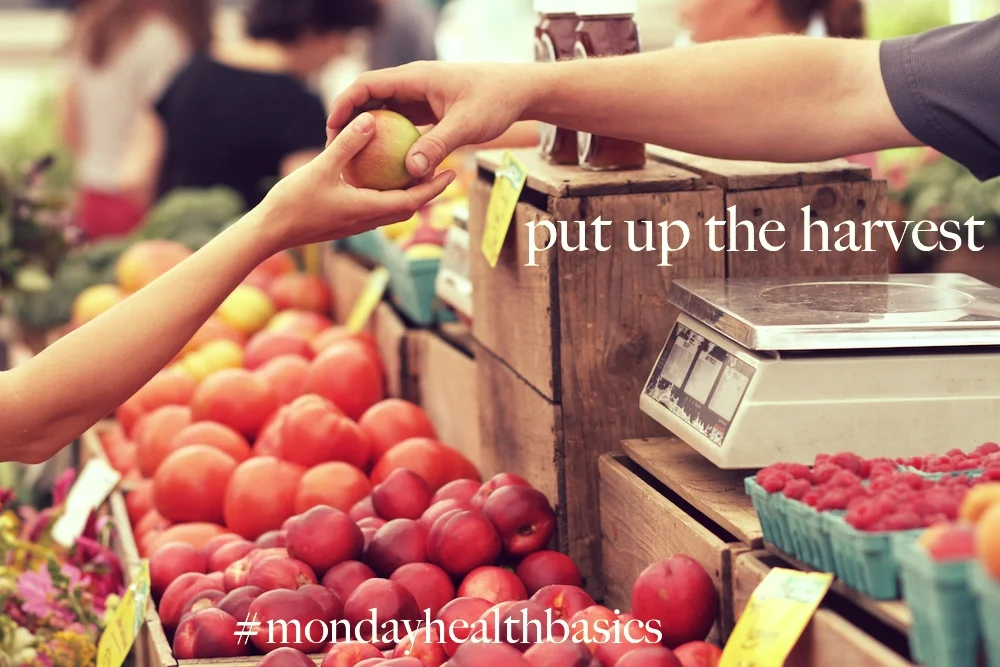
It seems the harvest this year has started a bit earlier than usual in these here prairie/foothill parts. I for one am thankful for it all, the rain, the sun, the intense heat we had earlier on in the season. My apples are ready a month early already!
I took advantage of a friend's invitation yesterday and gathered quite a few handfuls of mint from her garden in order to let them hang to dry already. I suspect my winter-tea-loving-days will be cozy and fragrant, and will remind me that heat really does happen in this part of the country, that summer was not just a figment of my imagination.
This time of year is really kind of like Christmas for me. I feel like there are gifts EVERYWHERE, and there is reason to celebrate at every corner. Taking a jaunt down to my favourite markets, ogling the non-stop growth in my little patch out back, stopping by the roadside fruit stands while driving through the Okanagan, it really seems to be a celebration of our riches. It is at this time every year for the last fourteen or so years that I have been prioritizing and making time to do a little something every day or two, in order to bottle this summer goodness for the hibernation days in the (very far) future. The price is right, the local produce is picked at its ripest peak, and the flavours seem to be the most concentrated out of any fruit or vegetable you've ever purchased.
Incidentally, that super concentrated rich flavour means the fruit/veg you hold in your hand is also at its most nutrient-dense-ness. You just won the food lottery, friend.
Today I want to send you to a few spots in this harvesting round-up. This blog post is meant to inspire you to choose a few projects to prepare, in order that your freezer, pantry or cold storage is filled up with the earth's summer treasures. The time is right, you may have some free weekend hours, the price is certainly right and cheapest it will be all year; I sense a bit of preserving in your very near future.
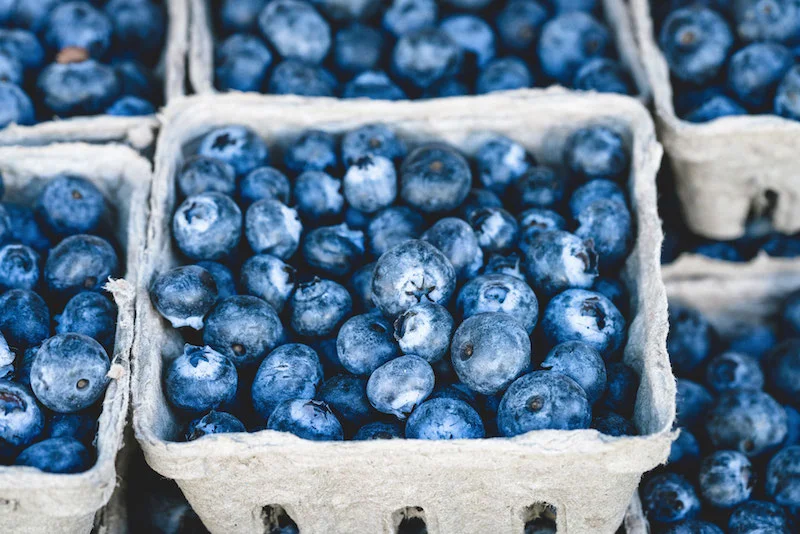
Buy the whole flat. You won't be sorry.
This time last year, I started in on a month of blog posts centering on the theme of harvesting. I spent some time every weekday of the month of August preparing some kind of harvested item and posting about it to my blog by the end of day. I am still reaping the benefits of those sessions, in fact using up dried hail-damaged greens and snipping dehydrated sliced tomatoes in to my dinner this evening.
Here's a bit of a spiel about the whole thing on day 1 of my quest last August:
Why preserve the harvest, you ask? I know what you're thinking: but Luka, there's always fresh stuff at the grocery store, year-round! I thought it was best to eat fresh in order to get the best nutrients! Well for one, the stuff I'm going to be preserving is goodies grown either in my back yard or close to home. My reason for this is that these veggies and fruit, when grown close to home, means they only have to be picked just as they are ripe; there is no need to pick them two weeks or more before ripened in order to do that job on the truck on the way to being shipped to me in Calgary. By picking at the ripest point in time from the vine, this ensures that all nutrients can develop right there on the vine as Mother Nature intended. Did you know that Vitamin C is one of the last nutrients to develop in a tomato on the vine? Why not pick at peak times then! And actually eat from my own back yard. And support a local farmer. I'd rather keep my dollars in my community than send it to someone who runs a big multi-corporation in another country, thanks very much. That way, those community dollars may also stay in my community, making it a better place to be. And really keeping the local local, if you're picking up what I'm putting down. (So many influences my parents have had on my life! So very grateful!)
I talked about dehydrating (with and without a dehydrator), freezing, saucing, preserving, fermenting, drying, canning as ways to keep that summer bounty going strong in the winter months. Once the month wrapped up, I put together a compendium in order to find the recipes that interest you a bit more easily.
Find that compendium here.
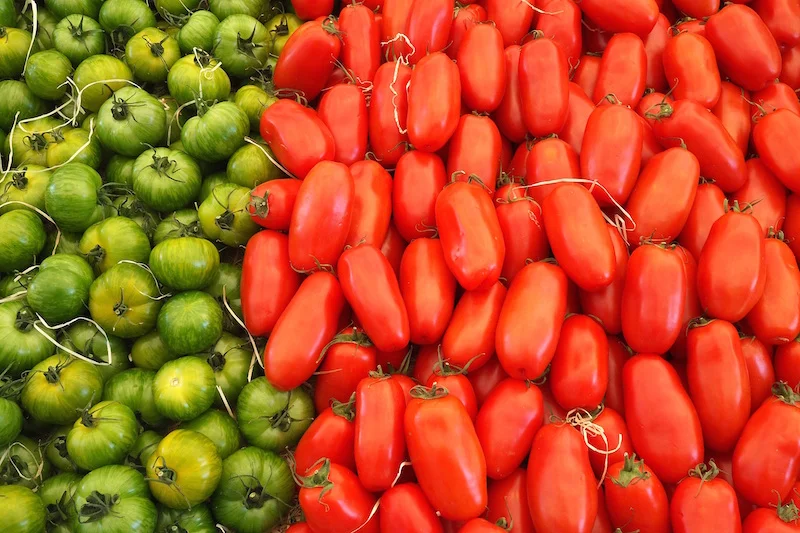
You'll find dehydrated tomatoes, freezing fruit, saving pock-marked greens, drying herbs, a few fermenting projects, a canning session with my sister, easy ways to save those extra herbs. I also included a few new-to-me projects like storing garlic in honey and making my own flavoured vinegars, still one of my favourite tricks I learned last year. And seeing as I'm a tomato hound, head to the compendium to find my recipe for easy freezable pizza sauce. (Did I mention that I tend to buy 100 pounds of the stuff?)
I found a few other neat ideas you may find inspiring.
Here's a list of fruits + veg that won't go bad as fast; might be worth stocking up
Here's a write up on how to harvest herbs, with some great tips
Why not tuck extra fruit/berries/herbs/greens in individual plastic bags in your freezer for easy smoothies?
Forage in the wilds near your house, by the river, in the gulley, and tuck that goodness in to fermented beverages or dry for tea
You could also do like my mom does, pick berries in the wild and make pies without baking them, and stashing in the freezer for instant mid-winter pick-me-ups. (Fond memories of these pies. Magic.)
If you are out foraging in the wild, be sure to leave some in the ground still growing for the animals and for the plant to continue to thrive, so that you can come back next year and so others can harvest too!
I have a few more ideas tucked under my 'harvesting' board on Pinterest
I'd love to hear how you are going about this yourself, there are so many tricks to learn as we navigate how best to feed our families. I'm all about health, to be sure, but I'm also about making this a do-able task. Try a few here and let me know how you make out! Don't be shy, comment on this article with ways you are saving up the harvest.
Now go play with your food, willya?
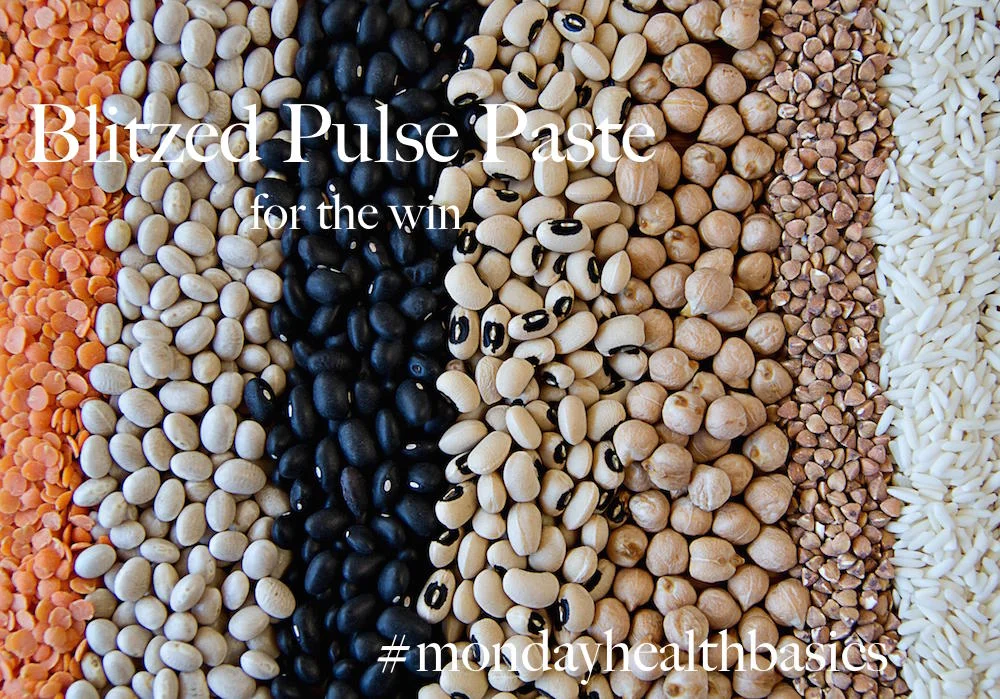
MONDAY BASICS: blitzed pulse paste for the win.
Today's simple-addition-trick-up-my-sleeve is one that takes a bit of forethought, but will bring lots of rewards should you choose to take this on. There were studies conducted by Health Canada in 2012 that looked into whether or not Canadian adults were getting adequate nutrients from the foods they eat, through food intake alone. Amongst those nutrients, of particular interest was the fibre intake of the average adult. One of the key findings was a concern that the majority of the population is not meeting an adequate intake of this very important nutrient, which could have a pretty serious impact on the health of the population long-term. How to help you reach those good levels, and why? We'll cover that in today's blog post; let me introduce you to Blitzed Pulse Paste.
Today's simple-addition-trick-up-my-sleeve is one that takes a bit of forethought, but will bring lots of rewards should you choose to take this on. There were studies conducted by Health Canada in 2012 that looked into whether or not Canadian adults were getting adequate nutrients from the foods they eat, through food intake alone. (Find that report here.) Amongst those nutrients, of particular interest was the fibre intake of the average adult. One of the key findings was a concern that the majority of the population is not meeting an adequate intake of this very important nutrient, which could have a pretty serious impact on the health of the population long-term. How to help you reach those good levels, and why? We'll cover that in today's blog post; let me introduce you to Blitzed Pulse Paste.

WHY THE FUSS?
Fibre is an essential component of foods that should be in our every day regimen, and with good reason. We'll get there in a second. But just what is fibre? It is the part of plant-based foods that our bodies can't digest, the stuff we can't break down like you would carbs, fats or protein. There are two kinds, soluble and insoluble and that refers to whether or not they dissolve in water.
The soluble stuff becomes kind of like a gelatinous mixture when added to water. This stuff is golden! It plays an important role in reducing our blood cholesterol, binding to it and moving it out of our system. Cholesterol shows up in our bodies in order to protect us from inflammatory things on the go; cholesterol is like our body's bandaids. When our blood cholesterol levels are up, it has been shown that our propensity for developing chronic diseases like cardiovascular disease, strokes, obesity, diabetes, cancer, dementia and alzheimer's goes up.
Soluble fibre also helps slow down our digestion in order to release any sugars from carbohydrates in our meal in a much more metered fashion, thereby helping us keep our blood sugars level. Keeping your blood sugars level is integral to keeping inflammation down, and thus reducing your blood cholesterol. Consider the soluble fibre a double whammy in helping keep your cholesterol down!
Where to find it: beans and pulses, oats, peas, barley, fruit of apples and pears, citrus, carrots and psyllium fibres. (Lots more. These are just the best sources.)
The insoluble fibre is a bulk builder when it comes to your stool. (I like to call it poo-maker. (I have been called the Poo Whisperer. I'll gladly accept the title.)) This good stuff acts as a broom in your innards, sweeping stuff through and out the poop shoot. It helps promote movements of bulk through your intestines, and so is essential to helping someone struggling with constipation or for someone who struggles to go once a day.
Where to find it: beans and pulses, whole grains (need the outer husk of the kernel to get the insoluble fibre goods), cauliflower, sweet potatoes, celery, and the peel of fruit and veggies like apples and potatoes.
Poop like a champ
Fibre is the superstar that brings you washroom heavyweight titles. It bulks up your stool to make it easier to pass; it hangs on to water to soften your stool so that you can have an easier (and shorter!) time on the throne. If your stool tends to be on the less-solid side of things (sorry for the visual), then fibre can also help you keep it all together, binding it to make it a better toilet experience for you.
Note that the addition of fibre for the benefit of improving your poops only works when done in tandem with adequate water intake. So make sure you are reaching for water or herbal teas often during your day in order to make this fibre work for you and not against you.
Fibre also hangs on to spent hormones and waste products from your own body's inner workings that your body is ushering out. As your body packages that spent metabolic waste and spent hormones, it ushers it out in different ways, mainly re-packaged as bile made by your liver. (Your body is the ultimate reuser/recycler!) That bile is meant to help emulsify fats (break them into smaller globules to make it easier for your enzymes to get at), and provides a big portion of your stool. If that bile/poop stays too long in your gut, those toxins found within end up getting re-absorbed into your body. This then re-circulates those spent hormones and metabolic waste, and your body has to work at filtering them out again. This means double-workload for your liver and your detox pathways in the body.
Where this poses the biggest threat, in my eyes: estrogen. This hormone is only meant to be used once, but when recycled (due to slow motility in the gut, read infrequent poops, also when not bound to the insoluble fibre) it starts to concentrate and can now contribute to inflammation in the body. See, when it hangs out too long in your gut, it gets re-absorbed in to your bloodstream if you aren't moving it out fast enough. From there, it heads to the liver. Your liver starts to slow down because its workload just got doubled, and as you can imagine, that excess estrogen makes the rounds again and again if not moved out properly. Estrogen dominance is a real issue: with an excess of estrogen in the body, you could be at higher risk for hormonally-related acne, added contribution to PMS and menstrual complaints, and reproductive cancers for starters. See, estrogen is a stimulant to build and grow cells, and doesn't discern between normal cells and cancer cells. It is imperative we bulk up our stool and build our bile so as to bind to these fat-based hormones and usher them out the poop shoot, in order to reduce our chances of developing those dangerous hormonally-based cancers.
For a more complete write-up on the dangers of estrogen, point your browser here.

Gut love
Fibre also provides important food for the good bugs in your gut! It's why they call it prebiotic. The food that feeds the probiotics. We can't break this stuff down, but the bugs in your gut can. They love this stuff! See, in order to look after your intestines, you need to look after the bugs that reside there. (Hopefully you are already eating fermented foods; this is the best way to go about it. It's a pretty important part of my practice. Get the full low down here.) If they're fed, they'll be happy and multiply, keeping your intestinal health in check and working in tandem with your immune system to promote optimal health. These good bugs also help to build stool and facilitate the passing of said stool. So ferments plus fibre and water? A winning combo.
It wouldn't be a stretch to say that by adding some good fibre in to your diet then, you would be working on reducing inflammation and contributing to healthier blood pressure levels. You'd be moving toxins and spent hormones out much more efficiently, pooping like a champ. A happy coincidence: those foods that are high in fibre are also high in other important nutrients like vitamins and minerals we need to keep our engines running clean.

Pre-soaking your pulses deactivates nefarious enzyme inhibitors and phytic acid that can negatively impact your body's ability to digest.
One of my favourite little tricks to add fibre to my family's way of eating is to make this blitzed pulse paste. The gist: you prepare any kind of pulse you have on hand be it lentils, beans or split peas. You blitz the cooked stuff into a paste and pop into an ice cube tray, freezing the lot. Pop those cubes out when they're ready and tuck into a container or freezer bag, and pull one out to add fibre to your meal! Pretty easy.
You can do this with canned beans if you like too, but know that there is an estrogen-mimicker hiding in the lining of those cans, the dreaded BPA. (Look for a blog post on this in the future.) Using canned beans might negatively contribute to your estrogen levels, so best to do this practice with pulses you have prepared from the dried stuff.
THE HOW-TO
Pre-soaking your pulses will make them easier to digest, turning off those enzyme inhibitors and phytic acid that could be negatively contributing to your body's ability to digest them. (Remember the story of the fox? That explains it in greater detail.)
This recipe is for lentils, split peas and beans.
Measure out 1 cup of your pulses, and rinse under running water. Pick out stones and debris.
Pop your pulses into a 1L glass jar.
Top with filtered water until covered by at least 2 inches.
Add 1-2 tbsp of either apple cider vinegar, juice from a ferment, or lemon juice. (This helps break down nefarious things) Put a lid on it.
Leave on the counter for 12 hours, adding more water if it gets absorbed.
For beans and split peas, drain your water and go through the same process again, soaking with filtered water and apple cider vinegar or juice from a ferment or lemon juice for a second 12 hours. Lentils only need 12 hours.
When your soaking time is up, drain your pulses.
For lentils, cook on a simmer in 3 cups of filtered water for 30-40 minutes, depending on the type of lentil, until cooked to your liking.
For beans and split peas, cook on a simmer in 7 cups of filtered water for anywhere from 1 hour to 4 hours along with a piece of kombu/kelp seaweed, until cooked to your liking. Check often to see if they're ready. Make sure to add more water if it is starting to dry out.
Drain your pulses well, add a touch of salt. Allow to cool a bit.
Add your cooked pulses to a blender or food processor and process until into a good paste, adding water as needed to reach your desired consistency (I like it rather thick).
Pop this paste into an ice cube tray and tuck in the freezer for 2-3 days.
Pop the ice cubes out into a container of plastic freezer bag.
They are ready for use!
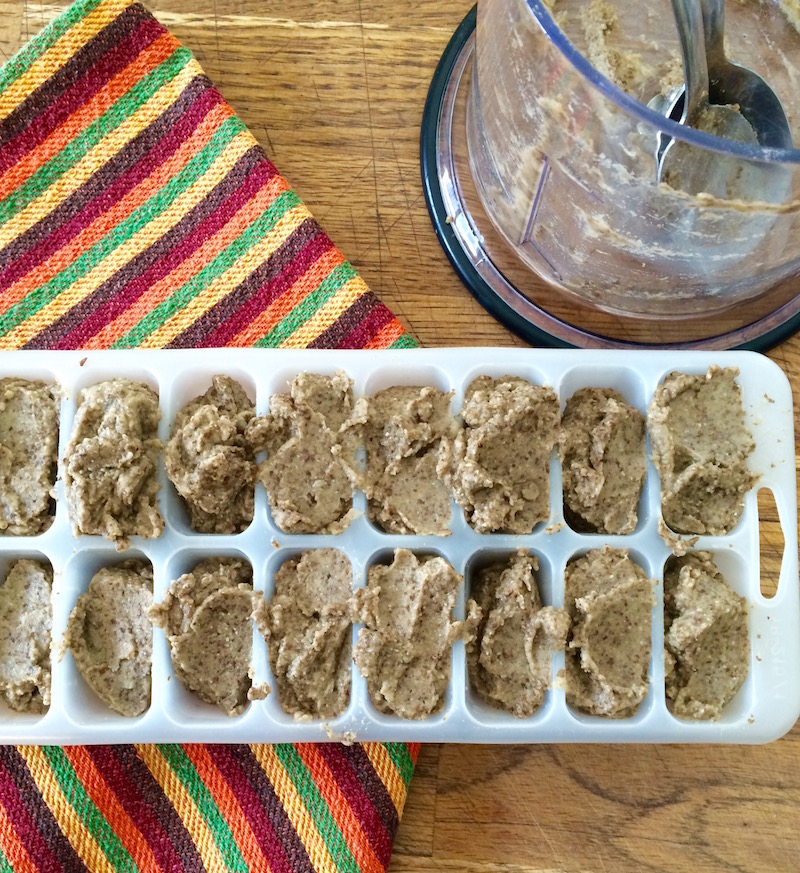
These were puy lentils, but you can use any lentil, bean or split pea here.
I just like to say it: blitzed pulse paste cubes.
How you use them is limited only by your imagination. Throw a few cubes in to your soup as it cooks, your spaghetti sauce, chili, whatever kind of sauce you have going on that could use a little bulking up. Add some to thicken your gravy perhaps (not sure how that would work, but just an idea.) Pan cook with some onions and chili powder for a yummy refried beans kind of side dish! Toss some in your omelette in the morning to set the tone for the day. Opt to not salt them and toss a cube or two in to your smoothie. Add some to your favourite dip, hot or cold. Make a five layer dip with this paste as one of your layers, salsa, guacamole, sour cream and grated cheese for a delicious hot summer night's treat when friends come over to play cards! Defrost a cube to spread on a tortilla as a base for a yummy nutrient-dense wrap.
I often like to toss leftover meat with leftover veggies in a pan and serve on top of salad greens for a quick lunch. Why not throw in a cube of this blitzed pulse paste in at the same time and a cube of pesto to add flavour! Delish.
I love how 2016 has been designated the International Year of Pulses. So apropos.
How would you use these blitzed pulse paste cubes?
Share in the comments below.
MONDAY BASICS: love your heart.
Ah, summertime. A time of lolling about, eating fresh foods, taking some time away to spend it solo or with someone you fancy. Time for family get-aways. Puttering around in the garden. Late night games on the deck under cheesy patio lanterns. Trips out to the cottage/chalet/cabin/camp. Refreshing dips in a lake or river, maybe even an ocean. A daily nap in the hammock. Long days and sunshine. Sighhhhhhhhhhhhhh... Am I right?
Through the Traditional Chinese Medicine lens, summer is the season of the heart. In today's #mondayhealthbasics blog post, we will look at how Holistic Nutrition can best support your ever-lovin heart.
Ah, summertime. A time of lolling about, eating fresh foods, taking some time away to spend it solo or with someone you fancy. Time for family get-aways. Puttering around in the garden. Late night games on the deck under cheesy patio lanterns. Trips out to the cottage/chalet/cabin/camp. Refreshing dips in a lake or river, maybe even an ocean. A daily nap in the hammock. Long days and sunshine. Sighhhhhhhhhhhhhh... Am I right?
Through the Traditional Chinese Medicine lens, summer is the season of the heart. In today's #mondayhealthbasics blog post, we will look at how Holistic Nutrition can best support your ever-lovin heart.
INFLAMMATION
It is interesting to note that while the heart is the main organ of the summer, the small intestine is the second organ we should be focusing on, according to the teachings of Traditional Chinese Medicine. And this makes all the sense in the world! To me, it underscores the importance of looking after gut health when it comes to your heart. Let me explain.
I think it is safe to say that at the root of most if not all chronic diseases, there is inflammation. Think cancer, diabetes, cardiovascular disease, dementia, depression, CFS, MS, ALS, etc. When there is inflammation happening, there is a major component of this taking place in the gut. As your intestinal wall is only one cell thick, any kind of chronic inflammatory state is having a severe impact on your gut. (Here's a good primer on inflammation, if you want to understand it.)
An inflammatory response is regulated by your immune system. If the estimation is that 80% of your immune system resides in your gut, you can see how inflammation has a pretty big impact on this part of the body. Where there is inflammation happening in any other part of the body, rest assured there is inflammation taking place in the gut. As cardiovascular disease, high blood pressure, high cholesterol all count an inflammatory component, it is imperative that we look after the gut, in order to love up the heart.
How best to reduce inflammation then, via diet? Let's look at some of the ways. Click on some of these items to read further, if you're interested.
eat fermented foods in order to reduce inflammation in the gut
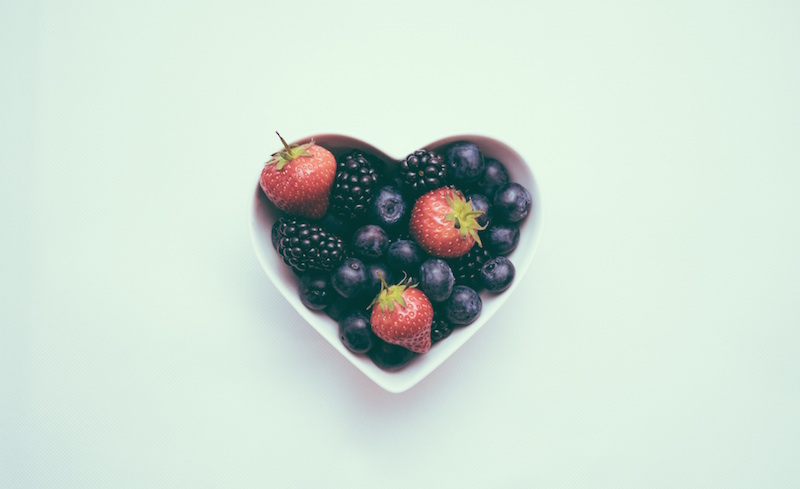
eat loads of veg, pulses and beans to feed those bugs in the gut in order that they may stick around to help reduce inflammation. Concentrate on berries, apples, cabbage, potatoes, avocado, sweet potatoes, lentils, split peas, beans, asparagus, artichokes, broccoli.
Eat your Essential Fatty Acids to help lower inflammation. Concentrate on wild-caught fish from the ocean, avocados, pumpkin seeds, flax seeds, pastured beef and bison, walnuts, olive oil, pastured eggs.
reduce prepared and packaged foods, and opt for more real food
drastically reduce or eliminate refined carbs (think baked goods, breads, GF and non!) as simple carbs are quickly converted to sugars, which contribute to increased inflammation
When it comes to heart health, there are many nutrients that are essential to maintaining vitality, good circulation and supporting this hard working muscle. Magnesium is top most in my favourite minerals for the heart: it is an essential mineral here as it helps keep a normal heart rhythm, and helps regulate blood pressure. It is also integral in helping mitigate inflammation! (Look for Mg)
Vitamin K2 is a relative newcomer to the field of nutrition. This important vitamin helps bust clots, and helps keep calcium out of your blood vessels, reducing the calcification or 'hardening' of the arteries. (Look for K2)
Antioxidants and polyphenols do the clean up work in your blood vessels, promoting good circulation and reducing inflammation. (Look for A/P)
If you do consume products from animals, I encourage you to reach for those listed below, as they are more nutrient-dense than their vegetable counter-parts in some of those all-important nutrients like K2.
VITAMINS & MINERALS – plant sources
pumpkin seeds, almonds, all nuts and seeds, peanuts (Mg, A/P)
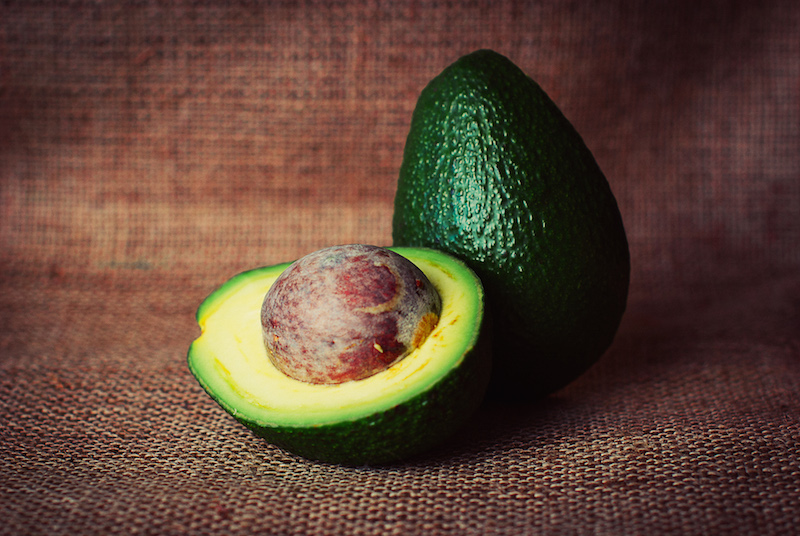
avocado, seaweed (Mg)
figs, dried apricots, dates, raisins (Mg)
dried beans, legumes (Mg)
buckwheat, millet, brown rice (Mg)
sauerkraut, natto (K2)
olive oil, onions, purple cabbage; eat the rainbow! (A/P)
sea salt, dark chocolate, molasses (Mg, A/P)
berries, citrus fruit, apples, kiwi, pears (A/P)
VITAMINS & MINERALS – animal sources
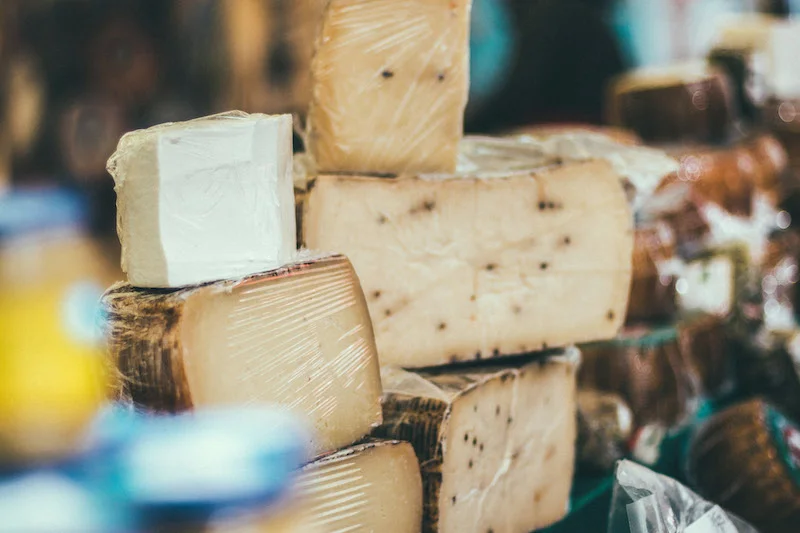
dairy products like butter and cheese from grass-fed animals (Mg, K2, A/P)
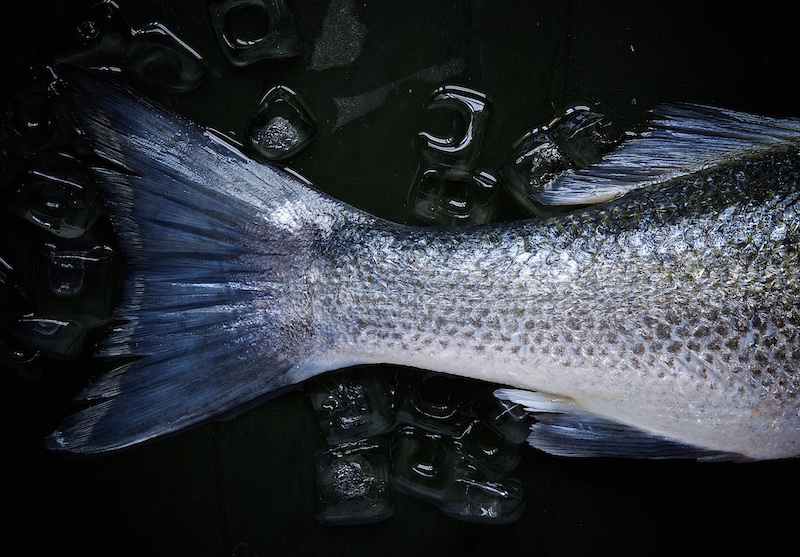
wild-caught fish, especially sardines (Mg, A/P)
eat your yolks! (Mg, K2, A/P)
meat and animal products from beef, bison and chicken raised on pasture (Mg, K2, A/P)
THE FAT OF THE MATTER
It is also imperative you consume good fats in order to reduce inflammation and best fuel your body, protecting that lil beautiful heart of yours. Saturated fats are heart protective, and assist in regulating blood pressure as well. The fat that surrounds your heart is made of saturated fat – it is on this energy store that your heart draws when in times of stress.
The EFAs mentioned earlier assist in regulating heart rhythm, and reducing inflammation. Reach for these happy fats every day.
LIFESTYLE CHOICES
While I love a good meal, I think it's important to also take that awareness of heart health to the rest of your day. As your heart is the centre of joy and love, it is good practice to cultivate it on the daily! This seeking of joy and love will be of great benefit to your heart, and will also work for you in helping to reduce stress.
Don't want to add to the stress of it all, but yes it's true, stress is not so good for your lil ole heart my friend. How best to support your heart then, and reduce stress? Read on for some good ideas, and suggest some more in the comments section below.
Prioritize fun! Play games, go to movies, comedy shows, go dancing, buy season's theatre tickets, go out for a game of cards, get a pet
get involved in something that is important to you, in order to connect. Volunteer somewhere!
good exercise to get the blood pumping. Move and groove friend.

KEEP HYDRATED
Your blood is made up of 50% water just about. In order to help it flow well and unimpeded through the vessels in your body, you best stay hydrated! Adding other goodies to your water like I mentioned a few blog posts back will add in some all-important electrolytes, further helping support heart health. Starting your morning with a glass of lemon water would also be a lovely heart-loving thing to do.
THE COLES NOTES VERSION
Eat lots of veggies, especially greens. Have avocados, olive oil, nuts and seeds. Seek out fish from the ocean (wild-caught!) a few times a week. Consume dairy and animal products from animals raised on pasture, especially eggs. Cook with butter. JERF. Have some ferments. Eat berries. Have so much fun. Go play or dance or walk or climb a tree. Make sure to laugh. Drink lots of water. Sleep like a champ.
And repeat.
Now go find that hammock, it's calling your name.